
Technological History

The Industrial Organism: Mechanics of the Early 20th-Century Steamship
·1474 words·7 mins
The early 20th-century steamship was a transitional industrial organism that achieved transoceanic scale by integrating high-density manual labor with a sophisticated 'closed-loop' thermodynamic system. Quantitative analysis reveals a critical dependence on thermal recycling, where steam volume expanded sixteen-hundredfold to drive quadruple-expansion engines before being condensed to prevent the catastrophic loss of fresh water. The structural mechanism of this integration was a steam-based nervous system that synchronized propulsion, navigation, and life support across a five-hundred-foot riveted steel hull. This analysis requires one post to synthesize the ship's mechanical and logistical unity.

The Resilience Premium
·668 words·4 mins
How redundancy fails when it is most needed — and why the systems that survive catastrophe are built on a quantifiable principle, not on a hope.
The Resilience Premium – Part 4: Where Redundancy Genuinely Works
·1732 words·9 mins
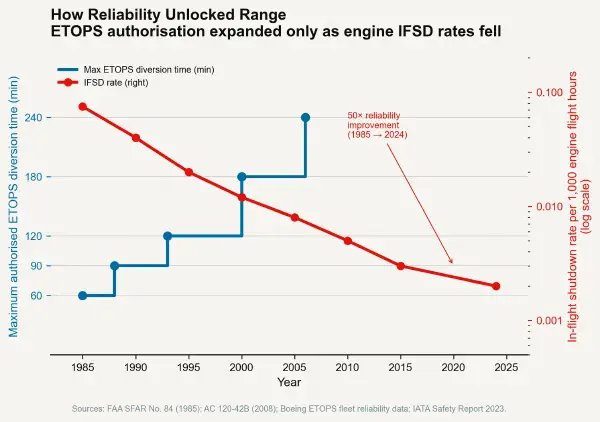
Documents ETOPS-240 aviation data showing twin-engine in-flight shutdown rates below 0.002 per 1,000 engine flight hours, establishing what separates high-SRR from low-SRR redundancy architecturally.
The Resilience Premium – Part 3: The Boeing Backup Paradox
·1499 words·8 mins
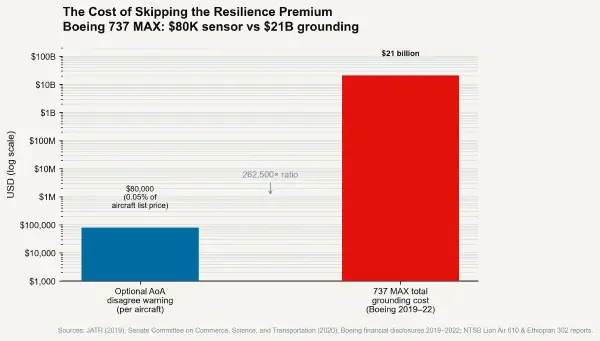
Dissects Boeing MCAS as a SRR < 1 case: a redundancy measure whose second sensor was eliminated to reduce complexity, guaranteeing that a single sensor failure would be catastrophic.
The Resilience Premium – Part 2: The Fukushima Premium
·1706 words·9 mins
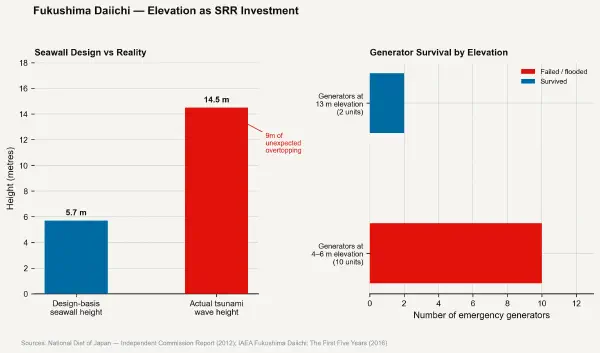
Analyses the Fukushima Daiichi disaster as a SRR ≈ 0 case: multiple redundant backup systems that all failed simultaneously because none were truly independent of the same failure mode.
The Resilience Premium – Part 1: Swiss Cheese Accounting
·1672 words·8 mins
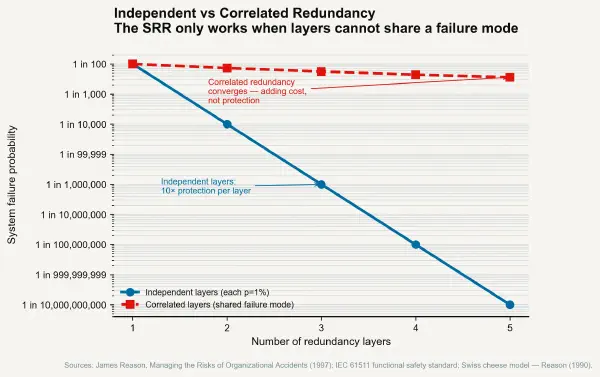
Introduces the Safety Return on Redundancy metric using James Reason's Swiss Cheese model, revealing when redundancy genuinely protects and when it simply redistributes false assurance.