

Systems Thinking

Colony to Collapse: A Psychological Autopsy of the Neoliberal Era
·292 words·2 mins
A historical-psychological post-mortem that traces neoliberalism to colonial rent-seeking in Madeira. It frames atomization as a neurobiological assault fueling authoritarian killer clowns and uses complexity theory to show deregulation turning networks into mutual incendiary devices. The answer, a politics of belonging built on commons and public luxury.

Colony to Collapse: Part 6 – The Politics of Belonging: Rebuilding the Commons After Capitalism
·641 words·4 mins
Proposing a new restoration story based on deliberative democracy and the concept of public luxury.

Colony to Collapse: Part 5 – Tipping Points: Why Markets Cannot Solve the Earth Systems Crisis
·636 words·3 mins
Utilizing complex systems theory to explain the 2008 crash and the impending ecological collapse.

Colony to Collapse: Part 4 – The Atomized Self: Loneliness and the Rise of the Authoritarian Right
·606 words·3 mins
Connecting the neurobiology of social pain to the political ascent of the "killer clowns."

Colony to Collapse: Part 3 – The Great Tollbooth: Turning Public Goods into Private Rents
·674 words·4 mins
Analyzing how privatization and "rent-seeking" hollowed out the welfare state and concentrated global wealth.

Colony to Collapse: Part 2 - The Engineering of Consent: Building the Neoliberal International
·620 words·3 mins
Tracing the rise of corporate-funded think tanks and the deliberate dismantling of the social contract.

Colony to Collapse: Part 1 - The Anonymity of Power: How a Nameless Ideology Conquered the World
·700 words·4 mins
Investigating the origins of neoliberalism and its foundations in the "fairy tale" of colonial extraction.

The Resilience Premium
·668 words·4 mins
How redundancy fails when it is most needed — and why the systems that survive catastrophe are built on a quantifiable principle, not on a hope.
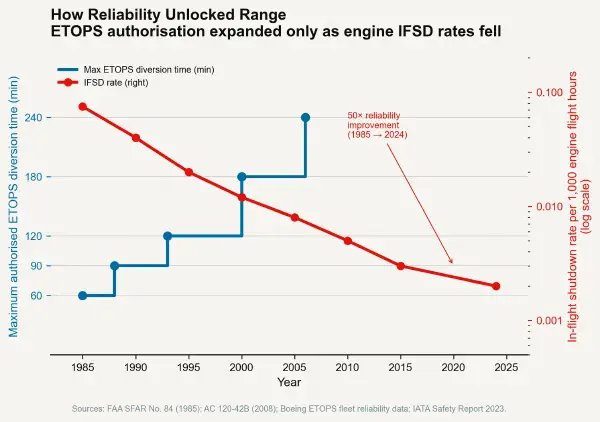
The Resilience Premium – Part 4: Where Redundancy Genuinely Works
·1732 words·9 mins
Documents ETOPS-240 aviation data showing twin-engine in-flight shutdown rates below 0.002 per 1,000 engine flight hours, establishing what separates high-SRR from low-SRR redundancy architecturally.