From Whitney's musket parts to EUV lithography — how the tightening of dimensional tolerances across 200 years defines the true frontier of industrial capability.
Examines EUV overlay registration approaching its fundamental physical limits and the direct implications for Moore's Law continuation and semiconductor supply chain geopolitics.
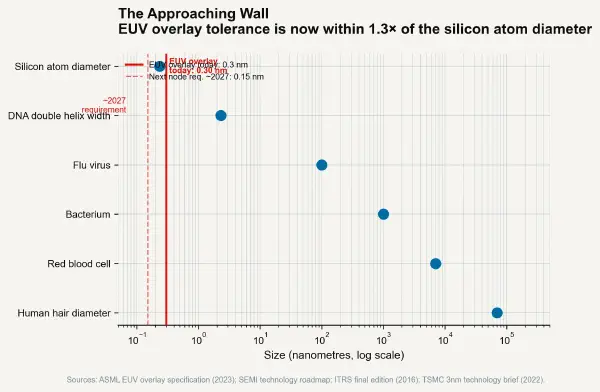
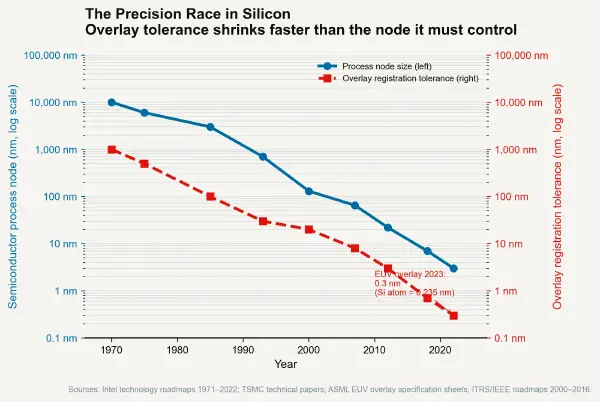
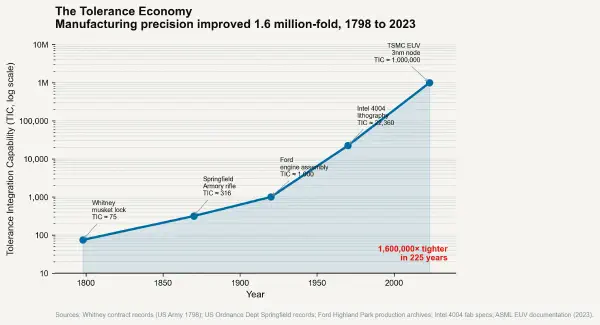
Applies TIC analysis to EUV lithography overlay registration at ±0.3nm — a tightening factor of approximately 1,600,000× relative to Whitney's musket lock tolerances — at the frontier of physical measurement.
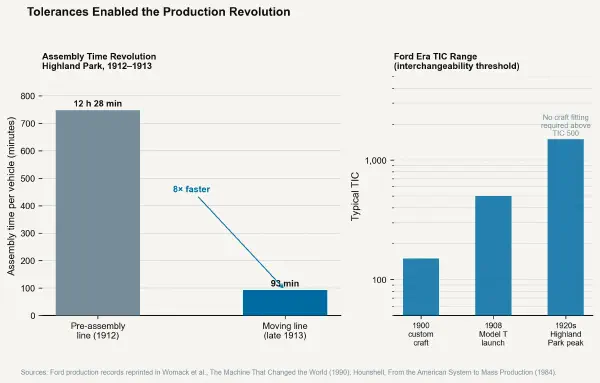
Documents how Ford's moving assembly line made tolerance management — not speed — its core contribution: every part compatible with every other part eliminated custom fitting and enabled mass production.
Uses Eli Whitney's 1798 musket parts contract to establish that the attempt to achieve interchangeable tolerances created the measurement infrastructure of the industrial economy — even before the tolerances were achieved.
How winning the standards race generates perpetual licensing revenue — and why standard-essential patent dominance is the highest-return engineering investment in technology.
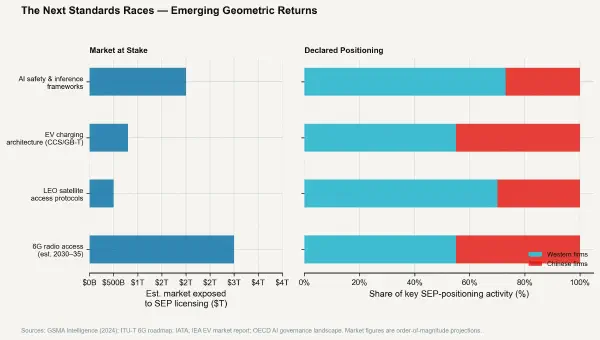
Analyses the AI safety framework, EV charging architecture, and satellite communications standards being written now as the next SCI competition — identifying who is positioned to capture the next generation of licensing revenue.
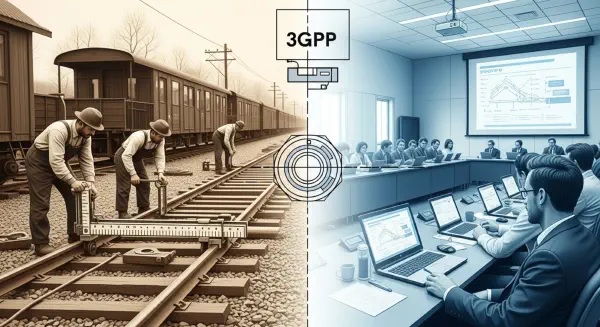
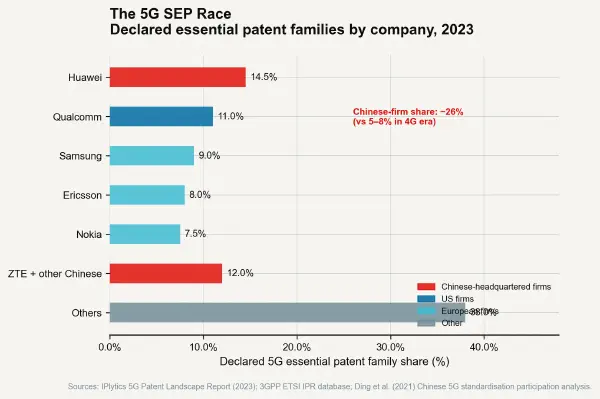
Examines 3GPP standards negotiation as a geopolitical and commercial competition, where Huawei's declared SEP strategy represents an attempt to reverse Western Standard Capture Index dominance.