

Design and Innovation

The Measurement Apparatus
·489 words·3 mins
How the test cycle replaced reality — and why any system measured by a proxy diverges toward gaming the proxy rather than achieving the underlying goal.
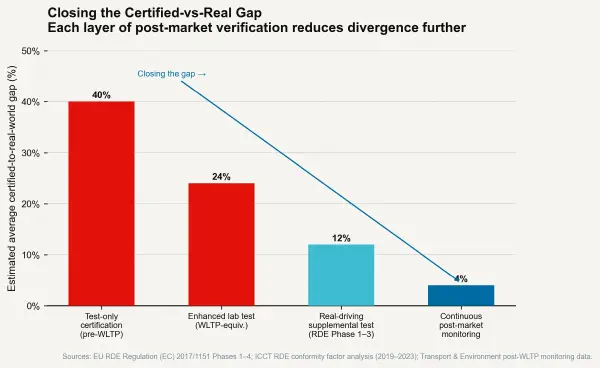
The Measurement Apparatus – Part 4: Designing for Real-World Performance
·1270 words·6 mins
Examines closed-loop certification, post-market surveillance, real-driving emissions regulations, and outcome-based contracting as the structural fixes for MPDI — and what separates regulators that apply them from those that don't.
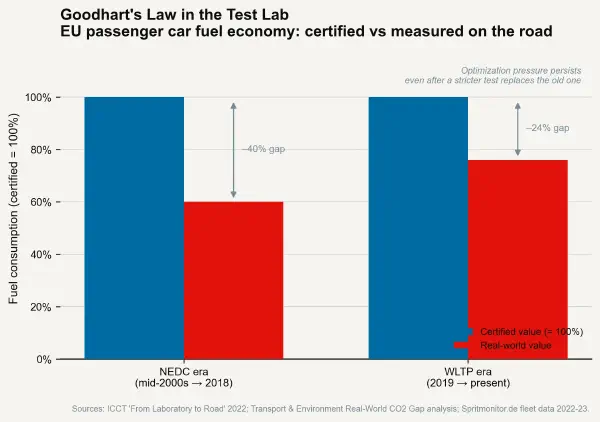
The Measurement Apparatus – Part 3: The Goodhart Trap
·1490 words·7 mins
Applies Goodhart's Law as the social science statement of MPDI: when a measure becomes a target, it ceases to be a good measure — measurement gaming is the rational response to a compliance-incentive system.
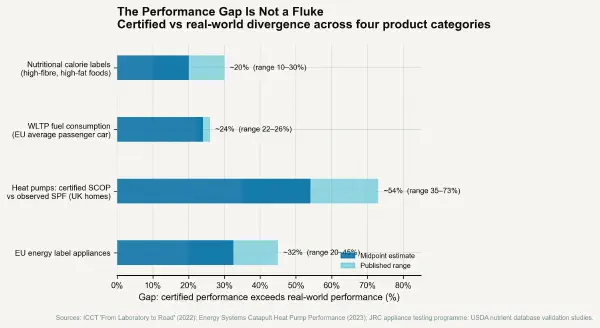
The Measurement Apparatus – Part 2: The Test Cycle as Fiction
·1428 words·7 mins
Documents systematic real-world performance gaps in automotive WLTP, energy performance labels, nutritional content measurement, and academic research metrics — all exhibiting MPDI that the measurement apparatus cannot close.
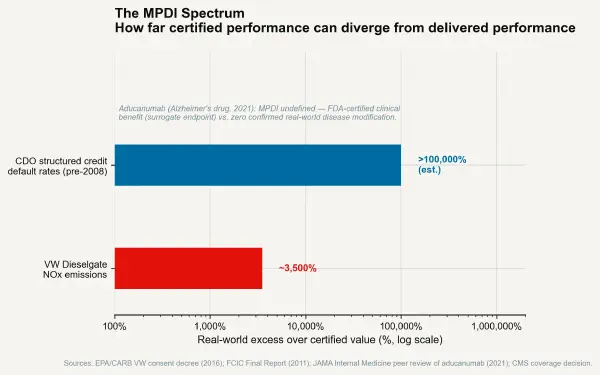
The Measurement Apparatus – Part 1: The Defeat Device and Its Relatives
·1492 words·8 mins
Uses VW Dieselgate as the logical extreme of the Measurement-Performance Divergence Index trajectory, showing that the defeat device is simply the name for MPDI reaching 100%.

The Cost of Convenience: Part 7—Designing Friction Back In
·3051 words·15 mins
Proposing frameworks for intentionally reintroducing meaningful friction to restore balance and sustainability.

The Cost of Convenience: Part 6—The Political Economy of Effortlessness
·2389 words·12 mins
Examining how convenience reshapes power dynamics, governance, and democratic processes.

The Cost of Convenience: Part 5—Environmental Debt: Cheap Now, Expensive Forever
·2265 words·11 mins
Exploring the deferred environmental costs of convenient consumption and linear economies.

The Cost of Convenience: Part 4—Cognitive Offloading and the Erosion of Skill
·1904 words·9 mins
Analyzing how delegating cognitive tasks to technology leads to skill erosion and dependency.