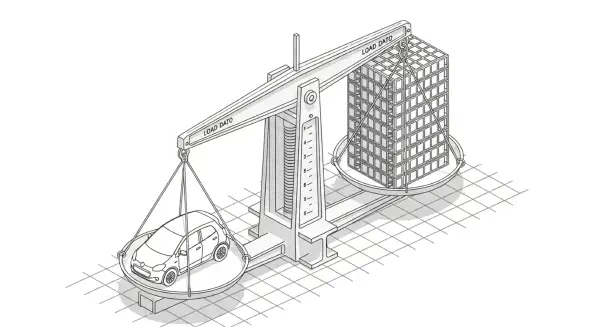
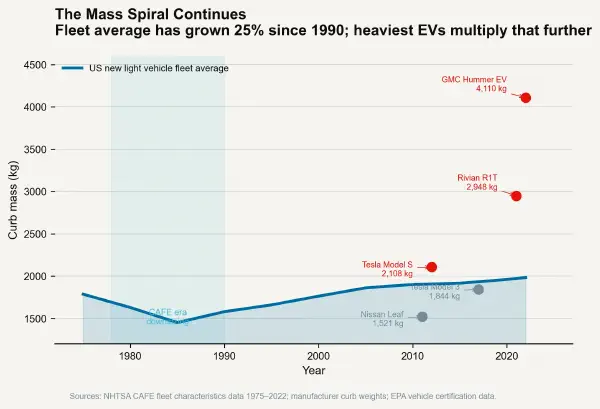
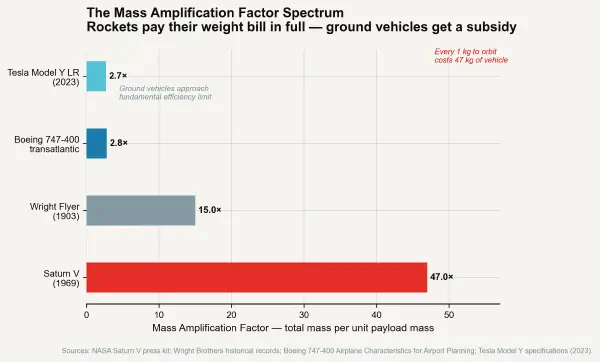
Why mass compounds against itself in every transport system — and what the Mass Amplification Factor reveals about the engineering limits of the electric vehicle.
Contrasts aerospace mass budget culture — where mass is the primary design currency — with ground transport engineering, demonstrating what the discipline of mass management achieves when enforced.
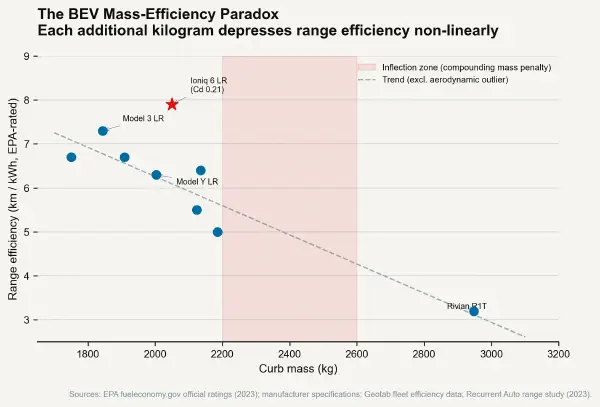
Applies MAF analysis to reveal that above approximately 2,400 kg total vehicle mass, adding battery capacity reduces net range per unit of additional battery mass — placing the 10 best-selling BEVs at or near this inflection point.
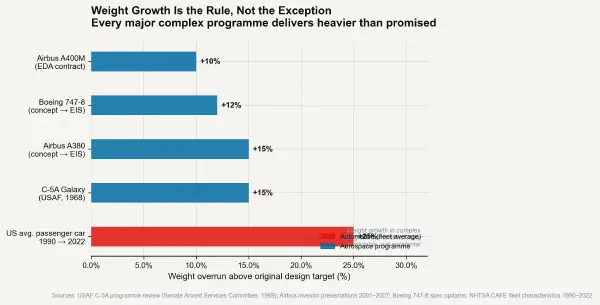
Documents how aircraft, ships, and ground vehicles consistently exceed design-phase weight targets because structural reinforcement requirements compound the original load-bearing specification.
Uses Tsiolkovsky's rocket equation as a generalised statement about compounding mass cost, establishing the Mass Amplification Factor as its surface-transport formalisation.
Discover how the anisotropic properties of wood provide superior strength-to-weight ratios and shock absorption, offering lessons for modern engineering from biological architecture.