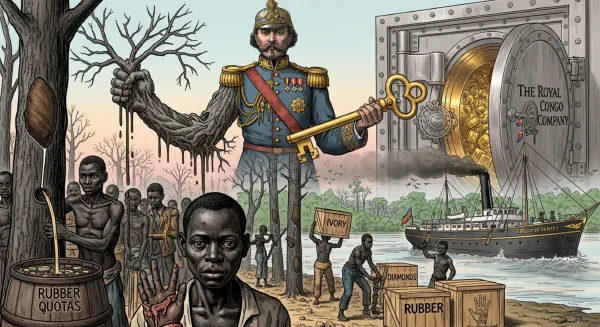
How the Belgian Congo under King Leopold II demonstrated the fusion of unaccountable corporate power with extractive economics, causing an estimated 10 million deaths.
How the Dutch East India Company’s 1621 massacre on the Banda Islands brought together all four factors for the first time, creating a template for colonial violence that would repeat across centuries.
Four posts. One accounting problem. The British Empire, examined through its own fiscal records, parliamentary debates, and the most rigorous academic cost-benefit study ever conducted of it, resolves into a recognizable structure: a system whose costs were socialized across a broad population and whose gains concentrated in a narrow connected class. This is not a moral verdict. It is a structural description. And it explains more about how colonial economies worked — and how their successors work — than any amount of rhetoric about civilizational mission.
For most of the nineteenth century, British politicians debated whether empire paid. The question was never cleanly resolved. This series applies cost-benefit analysis to the imperial project — not as a moral verdict, but as a fiscal one. Who bore the costs? Who captured the gains? The ledgers have answers that the speeches avoided.