Analyzing how large corporations dominate sand extraction industries while governments fail to regulate, creating systemic inequality and environmental injustice.
The Yasa was Genghis Khan's legal code – a framework for governing nomadic warriors and conquered civilizations alike. How did a law code from the steppes hold together history's largest empire?
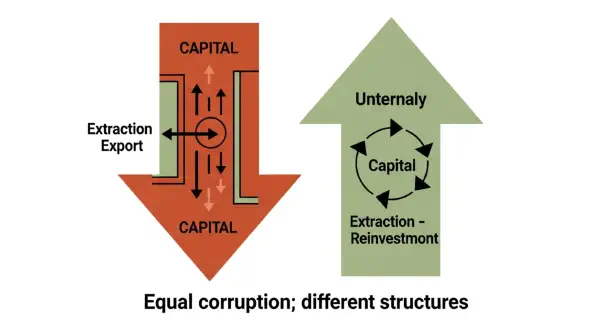
This post examines the two most common non-economic explanations for why poor countries stay poor: corruption and culture. It evaluates the empirical relationship between corruption and growth, asks why culturally identical countries at different levels of development exhibit different behavioral patterns, and traces the historical use of cultural argument as post-hoc justification for development outcomes.
Key Takeaways # The Cultural Code: Just as DNA dictates biological growth, culture dictates how a society functions—imported solutions often carry incompatible "codes." Tradition as Resource: Traditional knowledge is a reservoir of wisdom that has survived centuries because it works. Weaving, Not Assembling: Development should intertwine new threads with old ones to create continuous fabric, not replace the old carpet with plastic. Institutional Harmony: Institutions must reflect community values like solidarity, resourcefulness, and respect for nature. The Dual Society Problem: Modern institutions often disconnect from informal street-level reality, creating dysfunction. We have built the philosophy, the economic engine, and the human workforce. But why do so many development projects in the Arab world still fail? Why do "modern" systems often collapse or become corrupt when applied to our reality?
In this fourth step, Dr. Hamed El-Mously points to the missing link: The Cultural Context. He argues that you cannot simply "copy-paste" a Western institution (like a specific management style or a legal framework) into a developing society and expect it to work.