The Engineer Who Had to Justify Every Gram#
In aerospace engineering, mass is not free. This statement is so fundamental to the culture of aircraft and spacecraft development that it is structurally embedded in the program management processes used by every major aerospace developer. At Boeing, Airbus, and NASA, every engineering team working on a vehicle development program operates within a mass budget — a numerical allocation of allowable mass for their subsystem, established by the overall weight and balance (W&B) authority, that must not be exceeded without a formal change request filed against the program configuration mass and energy (CM&E) baseline.
The formal mass budget process at a major aerospace manufacturer works as follows: at program launch, a target operating empty weight is established based on the market requirement (which determines the required payload fraction), the performance targets (range, speed, altitude), and the best available historical data on achievable structural efficiency for the configuration. This target is allocated down through the program structure: airframe structure receives an allocation, propulsion integration receives an allocation, avionics receives an allocation, interiors receive an allocation, and so on. Each team designs to their allocation. If a design change is needed that requires more mass than the allocation permits, the change must be justified to the W&B authority, which either approves a target revision (which gets propagated through adjacent systems that may need to compensate), or requires the requesting team to find an offsetting reduction elsewhere.
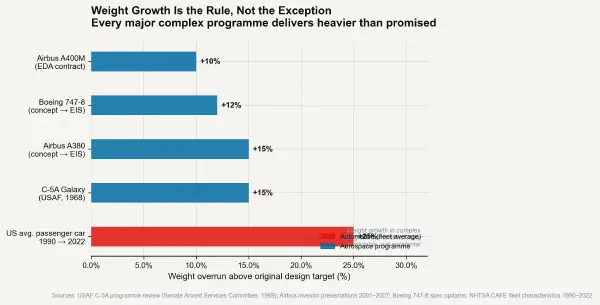
This culture produces engineering cultures where mass is the primary design currency — where the question “what does it weigh?” is asked before “what does it cost?” and where the trade-off between structural efficiency and manufacturing cost is consistently resolved in favour of structural efficiency. The results are measurable: the Boeing 787 target operating empty weight at program launch in 2004 was approximately 109,000 kg; the production aircraft entered service with an OEW of approximately 119,700 kg — a roughly 10% growth that, while significant and costly, was substantially lower than the historical programme average and was achieved with extensive use of carbon-fibre composite structures that would not have been economically justified without the stringent mass discipline of the W&B authority structure.
The Tools of Aerospace Mass Discipline#
Mass Budget Allocation and the W&B Authority#
The weight and balance authority structure in an aerospace program is not simply an accounting exercise — it is a design governance mechanism with real authority. In a well-run aerospace program, the W&B authority has the power to reject subsystem designs that exceed their mass allocation and to veto program decisions that accept mass growth without compensating reductions. This authority must sit above the subsystem program managers in the governance hierarchy; otherwise, the incentive structure of individual subsystem teams (whose performance is measured by subsystem functionality, not total vehicle mass) will produce a consistent upward drift.
The institutional structure of mass authority in aerospace reflects a hard lesson learned from multiple programs where no such authority existed or was ignored. The Lockheed C-5 weight growth crisis of the late 1960s — where fatigue-driven structural reinforcement produced an aircraft heavier than contracted specifications, triggering penalty clauses and a decade of operational limitations — created the institutional pressure for formal mass budget governance in large military programs. The resulting MIL-STD-1670, later superseded by various program-specific standards, established the requirement for formal mass accounting, margin management, and authority structures in military aircraft programs.
Margin Management and Technology Readiness#
A critical element of aerospace mass discipline is the formal treatment of design margins as mass. Early in a program, when detailed design knowledge is limited, mass estimates carry uncertainty of ±15–20%. The W&B authority accounts for this uncertainty by managing against a target that includes explicitly defined mass margins: a process for knowing how much of the allocated mass is consumed by design elements at high confidence, and how much remains as margin against future uncertainty.
Margin management distinguishes between margin that is available (the difference between the allocation and current estimated weight, representing design space for future growth), and margin that is committed (formal acknowledgement that specific design elements will use a defined quantity of mass without yet being fully designed). As a program matures and design elements are resolved, available margin converts to committed margin and then to actual measured weight. The W&B authority tracks this conversion in real time and identifies, early in the program lifecycle, the subsystems whose committed-plus-actual weight is approaching their allocation ceiling.
This practice — running mass margin accounts the way a treasury runs budget reserves — is the specific tool that aerospace uses to avoid the structural mass spiral described in the previous post. It does not eliminate weight growth; it detects and manages it before it reaches the stage where structural consequences have propagated too far to address without major redesign.
What Ground Transport Engineering Lacks#
The automotive industry’s equivalent of weight and balance authority is, in most programs, the vehicle system engineer (VSE) role or the vehicle architecture team. These roles exist in all major automotive OEMs and have nominal authority over system-level mass targets. However, the institutional authority of automotive mass management functions is structurally weaker than its aerospace equivalent for several reasons.
First, automotive programs have much shorter development cycles (36–48 months versus 7–12 years for aircraft) and much higher model volume complexity, making the overhead of formal mass budget governance proportionally more expensive per vehicle variant. Second, the commercial consequence of mass exceedance in automotive programs is lower — a passenger car 50 kg above target has reduced fuel economy margins and slightly degraded handling, but does not create the safety certification failure mode that an aircraft above maximum take-off weight creates. Third, the commercial incentives in automotive run against aggressive mass reduction: features that add mass (panoramic sunroofs, large battery packs, premium seating) command premium prices, while lightweight structural materials (aluminium, carbon fibre, high-strength steel) add manufacturing cost without adding revenue.
The EV transition has not fundamentally changed this incentive structure. Tesla’s decision to use large-format structural castings for the Model Y underbody and rear structure — its “Giga Casting” manufacturing approach — was motivated primarily by manufacturing cost reduction (fewer parts, lower assembly labour) rather than mass reduction, and the resulting castings are approximately weight-neutral or slightly heavier than the multi-piece steel structures they replaced. The mass savings in BEV development are coming primarily from battery chemistry improvements (higher cell energy density reducing pack mass for equivalent capacity) rather than from structural discipline.
The Coming Mass Reckoning#
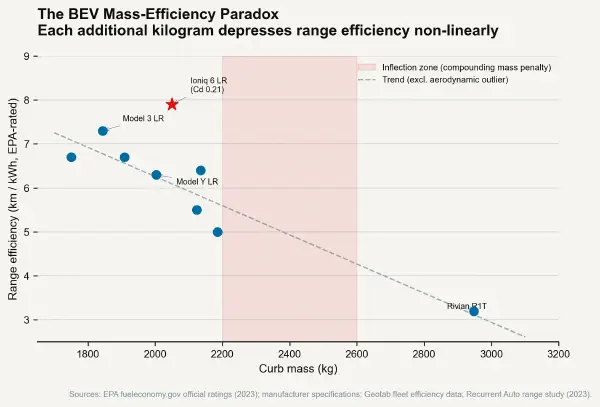
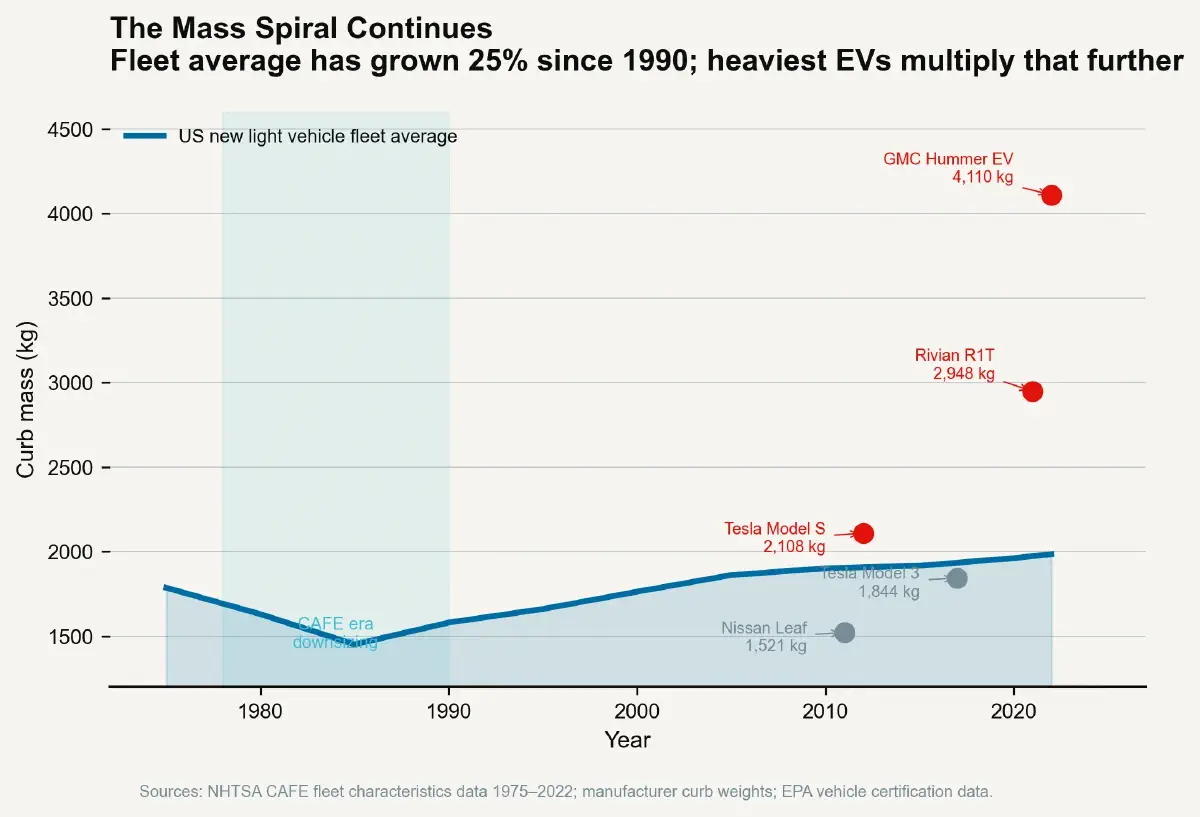
The mass trajectory of the EV fleet — toward heavier vehicles with larger packs driven by consumer preference and competitive positioning — is structurally in conflict with the efficiency and sustainability arguments used to justify EV policy support. A 2,948 kg electric pickup is not environmentally neutral compared with a 1,600 kg ICE hatchback; the embodied carbon of the battery, the tire wear particulate emissions, the road maintenance burden, and the energy consumed per passenger-kilometre are all significantly higher.
The aerospace discipline that prevents this outcome is a mass budget culture where each kilogram added to a design must be justified against a system-level constraint. The constraint in aviation is clear: exceed the maximum certified takeoff weight and the aircraft cannot legally fly. The equivalent constraint for EVs is softer and has not been efficiently enforced by market signals alone.
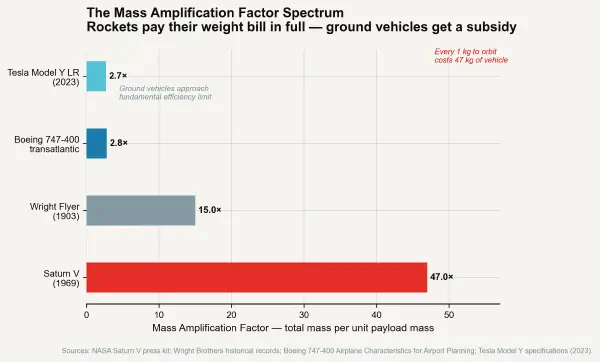
The MAF discipline ultimately requires acknowledging that mass is cost, even when the customer is willing to pay for it. Range achieved by adding battery mass is less efficient than range achieved by reducing structural mass, and structural mass reduction requires the kind of disciplined, program-wide governance that aerospace has institutionalised and ground transport has not. The gap between a sport utility vehicle at 2,000 kg and at 3,000 kg is not merely a design choice — it is a system engineering decision with compounding consequences for efficiency, road maintenance, and particulate emissions that the current automotive development culture does not fully account for.