The Curve That Bends the Wrong Way#
A lithium-ion battery cell at current production specifications stores approximately 250–270 watt-hours per kilogram of cell mass. This is the energy density figure that appears in battery manufacturer data sheets and in EV marketing materials describing range-per-kilogram of battery. It is an accurate figure for the cell level. At the pack level — accounting for the module hardware, thermal management system, battery management electronics, structural housing, and crash protection hardware required to integrate cells into a driveable vehicle — the effective energy density drops to approximately 140–175 Wh/kg for current production large-format packs. The difference between cell and pack energy density is approximately 40%, representing the overhead cost of making a large collection of individual cells safe, temperaturemanaged, and structurally integrable in a vehicle.
The MAF calculation for an EV battery system must use pack-level energy density, not cell-level energy density. When this is done correctly, and when the structural mass overhead of mounting a large pack in a vehicle body is added, a relationship emerges that has significant practical implications: the energy available per unit of total vehicle mass added is not constant as battery pack size increases. It declines, because each additional kilogram of battery requires additional structural accommodation, increases road load, and requires the drive motor and power electronics to move a heavier system. At some total vehicle mass, the incremental range from one additional kilogram of battery capacity is exactly offset by the range cost of the heavier vehicle that carries it.
The MAF Inflection Point for BEVs#
The Arithmetic of the Threshold#
The efficiency of a passenger vehicle can be approximated as a function of vehicle mass, aerodynamic drag, rolling resistance, and drivetrain losses. For a typical BEV:
- Rolling resistance energy consumption: approximately 10–12 Wh/km per 1,000 kg of vehicle mass
- Aerodynamic drag energy consumption: approximately 15–20 Wh/km at motorway speeds, largely independent of mass
- Drivetrain efficiency: approximately 85–90% round-trip efficiency from battery to wheels
At 100 kWh pack capacity and a vehicle mass of 1,900 kg, a typical BEV achieves approximately 400–450 km of real-world range. Adding a second 100 kWh pack (approximately 480 kg of battery mass plus approximately 50–80 kg of additional structural accommodation) increases total vehicle mass to approximately 2,430 kg and increases pack capacity to 200 kWh. The 100 kWh additional energy enables approximately 400 km of additional range in isolation. But the 480 kg mass increase of the additional battery increases rolling resistance consumption by approximately 4.8–5.7 Wh/km, reducing the efficiency of the base pack’s 100 kWh by approximately 25–30 km of range foregone over a 400 km typical trip. Net additional range from the second pack: approximately 370–375 km rather than 400+ km.
This is a minor penalty at the first doubling. The penalty compounds significantly as mass grows further. A hypothetical 300 kWh pack vehicle at approximately 2,900 kg total mass shows a net efficiency that is approximately 12–15% lower on a per-kilometre basis than the 100 kWh vehicle. The additional range from the third 100 kWh pack is approximately 310–330 km after mass penalties, versus the 400+ km that would be achieved if the pack energy could be added without mass.
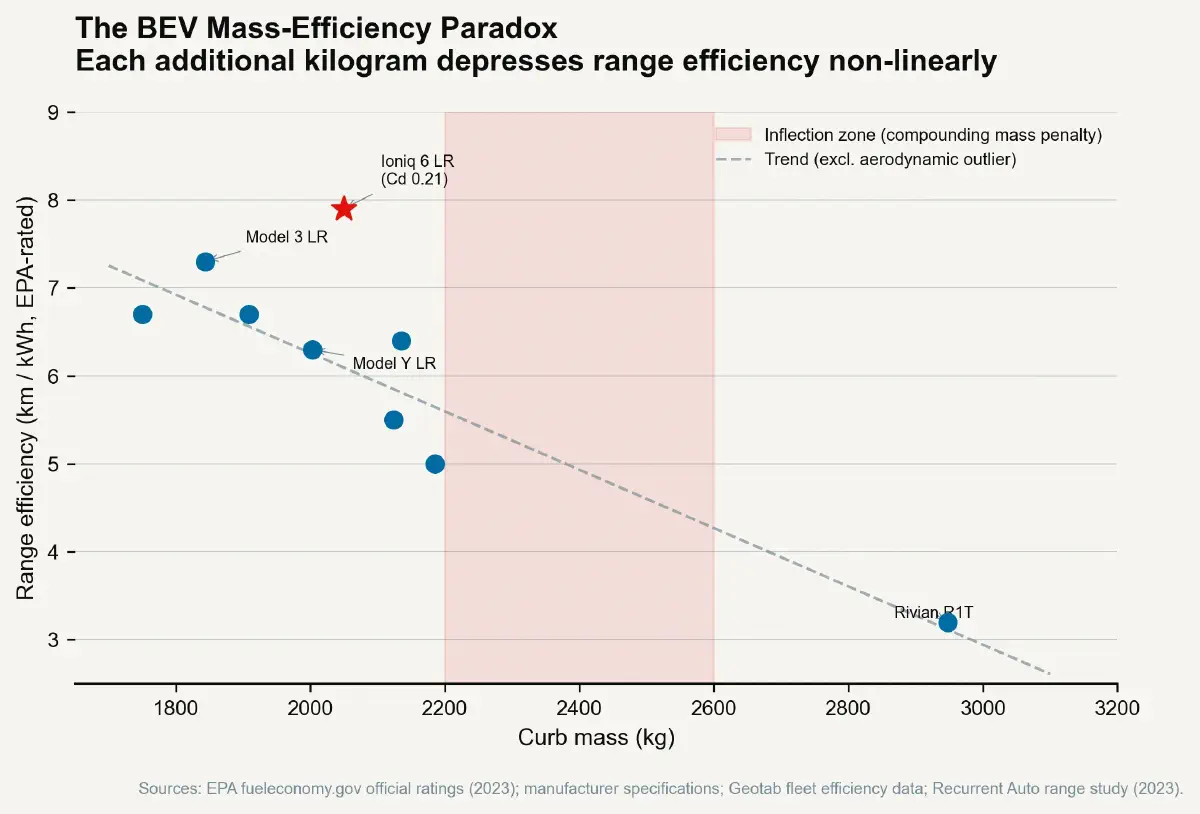
The inflection point — where the marginal range from additional battery capacity is declining faster than the additional capacity is growing — occurs at approximately 2,400–2,600 kg total vehicle mass for current battery energy density and vehicle aerodynamics. Above this mass, each additional 100 kWh of battery generates less additional range than the previous 100 kWh did. The range curve bends.
Where the Production Fleet Sits#
The 10 best-selling BEVs by global volume in 2022–2023 provide a real-world dataset for MAF analysis:
- Tesla Model Y (Long Range): 2,003 kg, 82 kWh usable, EPA rating ~514 km
- BYD Atto 3 (standard range): 1,750 kg, 49.9 kWh usable, WLTP rating ~420 km
- Tesla Model 3 (Long Range): 1,844 kg, 82 kWh usable, EPA rating ~602 km
- Volkswagen ID.4 Pro: 2,124 kg, 77 kWh usable, WLTP rating ~520 km
- Tesla Model Y (Standard Range): 1,909 kg, 57.5 kWh usable, EPA rating ~386 km
- Hyundai Ioniq 6 (Long Range): 2,050 kg, 77.4 kWh usable, EPA rating ~614 km
- BYD Seal: 2,150 kg, 82.56 kWh usable, CLTC rating ~700 km (WLTP significantly lower)
- Kia EV6 (Long Range): 2,135 kg, 77.4 kWh usable, EPA rating ~499 km
- BMW iX3: 2,185 kg, 74 kWh usable, WLTP rating ~461 km
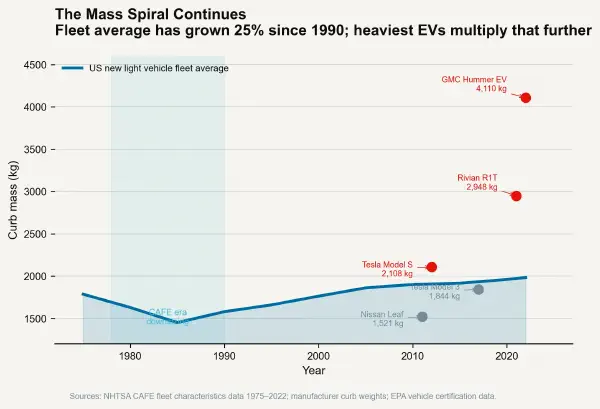
- Rivian R1T (Standard): 2,948 kg, 135 kWh usable, EPA rating ~434 km
The mass distribution is revealing. The majority of mainstream sedan and crossover BEVs are clustered in the 1,900–2,200 kg range — below the inflection point but trending toward it with each successive platform generation. The R1T, at 2,948 kg, sits well above the inflection point; its 135 kWh pack produces only 434 km EPA range, meaning the effective range per kWh is approximately 3.2 km at 2,948 kg, compared with approximately 6.3 km per kWh for the Model 3 at 1,844 kg. Mass has already compressed the R1T’s range efficiency by approximately 50% relative to the lighter sedan platform.
The coming generation of entry-market BEVs — targeting price points that require smaller batteries — will be lighter and will sit comfortably below the inflection point. The coming generation of premium long-range and full-size SUV BEVs — targeting range parity with ICE vehicles — will sit at or above it. The market segment most likely to hit the MAF ceiling is the American full-size pickup and SUV segment, where consumer demand for range, towing capacity, and interior space creates vehicle mass requirements that are structurally incompatible with range efficiency at any current battery chemistry.
The Tire and Road Load Reality#
The MAF inflection for BEV range is the most discussed mass-related constraint. It is not the only one. Transport & Environment published analysis in 2021 documenting that EVs above approximately 2,200 kg curb weight generate significantly higher tire wear particulate emissions than equivalent ICE vehicles, because tire wear is proportional to contact force (which is proportional to mass) and regenerative braking does not eliminate tire wear from acceleration, cornering, and aerodynamic loading manoeuvres. The Emissions Analytics consultancy found in 2022 that a heavy EV like the Rivian R1T generates tire wear particle emissions approximately 2× higher per kilometre than a typical mid-size ICE sedan.
Tire wear and brake dust are now recognised as significant sources of non-exhaust particulate matter (PM2.5 and PM10) in urban air quality inventories. The PM emission profile of a high-mass EV per kilometre driven may exceed that of an ICE vehicle whose size the EV was intended to replace — a consequence of the mass penalty that no currently proposed emissions regulation addresses.
The Mass Budget Problem#
The EV mass paradox is not primarily an engineering failure — it is a market structure problem. Consumers in the primary EV growth markets (North America, Western Europe, China) have demonstrated strong revealed preference for vehicle features that add mass: longer range, larger passenger compartment, higher ground clearance, larger battery buffers for towing capacity. Manufacturers have responded to these preferences with platform designs that accommodate them.
The result is a fleet average EV mass significantly higher than would be required by a transportation-optimised design. The mass is not waste — it is paid for by customers because it delivers attributes they value. But the engineering consequence is a fleet operating with MAF values closer to the structural mass spiral inflection than the range efficiency inflection, burning future range improvements against mass growth rather than translating them into lower cost or longer range. The next post examines the discipline that aerospace uses to prevent this — and what a mass budget culture would mean applied to ground transport.