The Letter That Changed Engineering Forever#
In 1903, Konstantin Tsiolkovsky — a schoolteacher in Kaluga, Russia, largely self-educated and stone deaf since age nine — published a paper in a small scientific journal called Nauchnoye Obozreniye (Science Review). The paper, titled “The Exploration of Cosmic Space by Means of Reaction Devices,” was read by approximately no one at the time of publication. The journal had a small circulation, the subject matter was considered eccentric, and Tsiolkovsky himself was an obscure provincial educator who had never attended university and had no professional affiliation with any institution involved in aerospace research.
The paper contained a mathematical equation. In its modern notation: $\Delta v = v_e \cdot \ln(m_0/m_f)$. Where $\Delta v$ is the change in velocity achievable by the rocket, $v_e$ is the exhaust velocity of the propellant, $m_0$ is the initial mass (vehicle plus propellant), and $m_f$ is the final mass (vehicle only, after propellant is consumed). The equation is now called the Tsiolkovsky rocket equation, or simply the rocket equation. It is the most consequential single equation in the history of transport engineering — and it contains a lesson that applies not only to rockets but to every vehicle that must carry its own propellant or energy store.
The lesson is brutal: the useful work a vehicle can do is a logarithmic function of the ratio of its initial to final mass. To double the velocity capability of a rocket, you must not double the fuel load — you must square it. Mass compounds against itself, and the compounding is inescapable.
The Mass Amplification Factor as a Generalised Statement#
The rocket equation applies in its precise form only to vehicles that expel reaction mass, because the logarithm enters from the continuous consumption of propellant during acceleration. But the underlying principle — that the energy carrier (fuel, battery, compressed gas) has mass that must itself be moved against gravity and aerodynamic drag, and that carrying more energy carrier reduces the fraction of total mass that does useful work — applies to every vehicle that carries its energy store onboard.
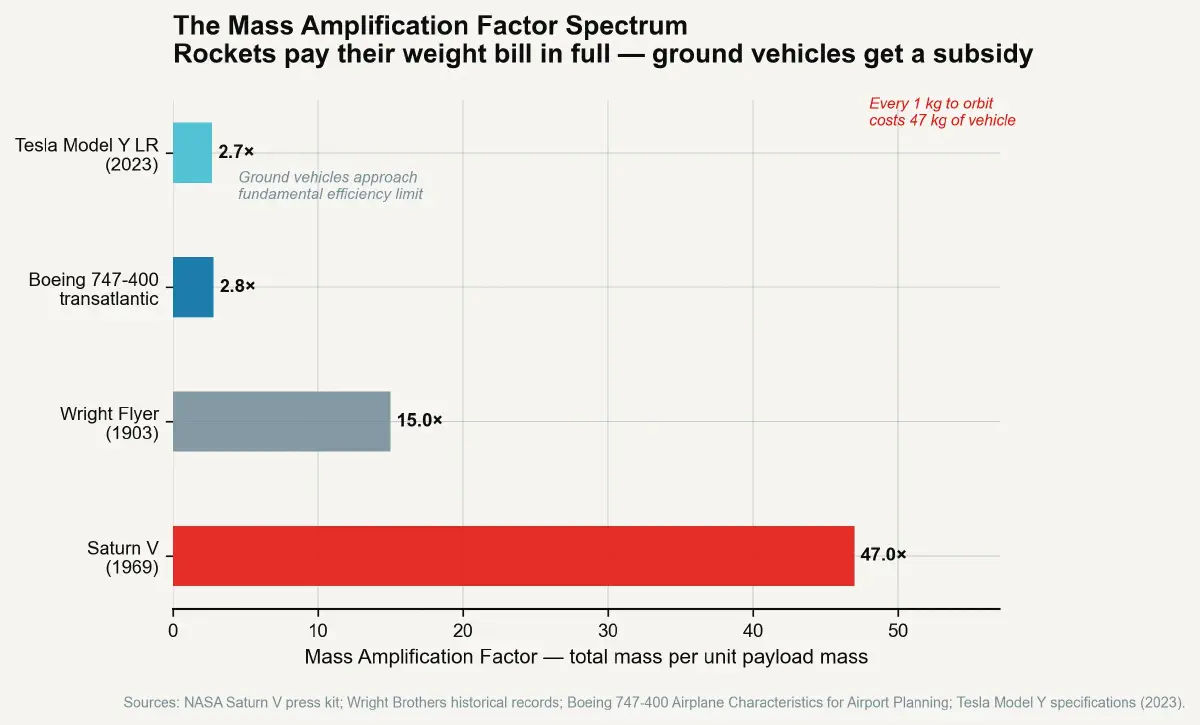
The Mass Amplification Factor (MAF) generalises this principle across all transport: MAF = Total system mass ÷ Payload mass for a defined transport mission. For a Saturn V rocket launching the Apollo lunar stack, MAF was approximately 47: the total launch mass of 2,970 tonnes carried a payload of approximately 63 tonnes to low Earth orbit — a ratio of 47:1. For a Boeing 747-400 on a transatlantic route, MAF is approximately 2.5–3.0: roughly 175 tonnes of fuel and aircraft structure per 65–70 tonnes of payload (passengers, cargo, crew). For a Tesla Model Y carrying a driver and three passengers, MAF is approximately 2.7: 2,003 kg of vehicle for 300–350 kg of human payload.
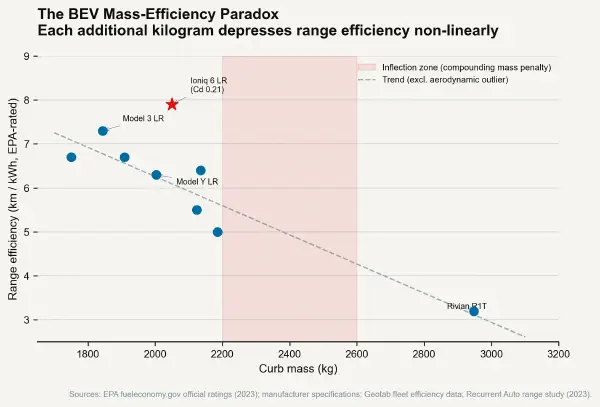
The difference between the rocket and the car is not the MAF principle — it is the exponent at which MAF grows with performance. For a rocket, the growth is exponential with delta-v: every additional 1,000 m/s of velocity capability requires a roughly 2.7-fold increase in mass ratio for hydrogen/oxygen propellant. For a surface vehicle, the growth is roughly linear with range and much slower because atmospheric drag is manageable and the vehicle does not discard its structure at each stage. But the growth is never zero, and for battery-electric vehicles specifically, the mass-range relationship has a critical inflection point where adding battery capacity begins to cost more in structural mass overhead, tire wear, and road load than the energy it provides.
Inside the Rocket Equation’s Practical Consequence#
Why Staging Exists#
The inescapability of MAF growth with increasing performance requirement is why staging — building rockets from multiple discardable sections — was the central engineering innovation that made orbital spaceflight practical. A single-stage-to-orbit (SSTO) rocket carrying sufficient propellant to reach low Earth orbit must have an extremely high initial-to-final mass ratio because it carries all its structural mass to orbit. Every kilogram of first-stage structure that contributes nothing to second-stage performance is penalised at the full propellant cost of accelerating it to orbital velocity.
The Saturn V’s three-stage design reduced this penalty by discarding the first stage (which consumed most of the propellant and provided most of the early velocity gain) at an altitude of approximately 67 km and a velocity of approximately 2,750 m/s, and discarding the second stage at approximately 185 km altitude. Only the third stage, lunar module, command/service module, and payload continued to the Moon. The first stage’s structural mass — approximately 140 tonnes of tanks, engines, turbopumps, and plumbing — contributed to its own work and was then released rather than carried forward. The orbital MAF was dramatically reduced by not requiring early-stage structure to reach the destination.
Staging is the engineering response to the compounding cost of mass in high-delta-v applications. There is no equivalent staging option on the motorway.
The MAF Calculation Across Transport Modes#
MAF values across transport modes tell a history of engineering trade-offs. The Wright Flyer at Kitty Hawk in 1903 had an MAF of approximately 15 for its two-pilot payload in still air: 274 kg total mass for 2 × ~75 kg = 150 kg crew. The Boeing 747-400 has a MAF of approximately 2.8 on a full-capacity transatlantic mission. The improvement over 70 years of aviation development is not the physics changing — it is materials science (aluminium, titanium, composites), propulsion efficiency (turbofan bypass ratios), and aerodynamic refinement delivering dramatically higher payload fractions.
The comparison between the Wright Flyer and the 747 is instructive because it demonstrates that MAF is not technologically fixed — it is a function of materials, efficiency, and design discipline. MAF can be improved, and the aerospace industry has improved it dramatically. The question for the EV industry is whether a comparable trajectory of MAF improvement is possible, or whether the physics of battery chemistry creates a floor below which MAF reduction cannot proceed without sacrificing energy density.
The current answer suggests the latter. Battery pack energy density (at the cell level) has improved approximately 5–7% annually over the 2010–2023 period, from approximately 100–120 Wh/kg to approximately 250–270 Wh/kg for leading-edge production cells (NMC 811, NCA). This is significant improvement, but the structural mass overhead required to safely house, cool, and protect a large-format battery pack is roughly proportional to the battery’s total mass and cannot be reduced as fast as energy density improves. The floor on pack-level MAF overhead appears to be approximately 10–15 kg of structure, cooling, and BMS hardware per 100 kg of cell mass — a ratio that has not improved substantially as cells have become denser.
The Ground Vehicle MAF and the Range Paradox#
For a battery-electric vehicle, the direct payload of the transport mission is typically passengers and cargo. The energy carrier — the battery pack — is also onboard payload, and a heavier battery pack requires a heavier structure to carry it, which increases the road load, braking requirements, and tire wear, which further penalises efficiency. This loop is not rocket-equation exponential, but it is compounding.
At current energy density and structural overhead ratios, adding approximately 100 kWh to a vehicle battery pack adds approximately 400–480 kg of battery mass and approximately 60–100 kg of additional structural, thermal, and electronics mass. The additional energy enables approximately 300–350 km of additional range under standard conditions. But the additional mass of the larger pack increases rolling resistance by approximately 1.5%, increases braking energy by approximately 1.5%, and increases all structural mass requirements by a proportional amount.
The inflection point — where the additional range from a larger pack is exceeded by the range cost of carrying a heavier pack structure — does not occur within current production EV specifications for most use cases. But the efficiency penalty of high-mass EVs is real, measurable, and growing. The next post examines how this compounding mass penalty has manifested across the history of vehicle and aircraft development — including the systematic weight growth that occurs during design and production programs.