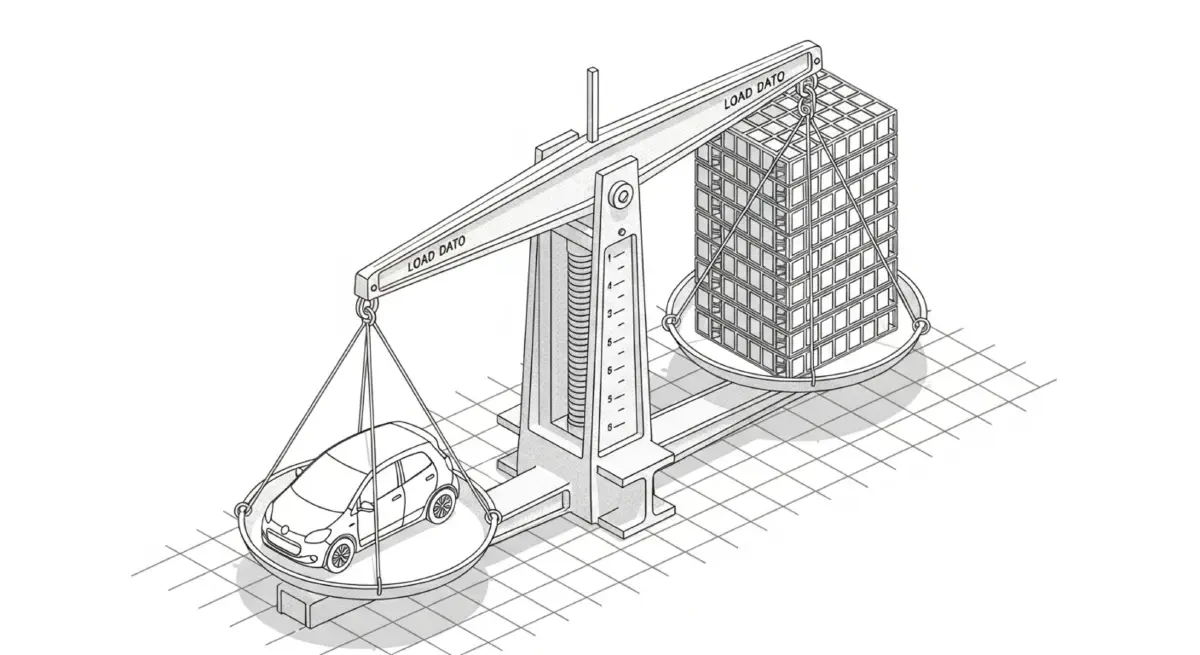
The Weight Penalty
Key Insights#
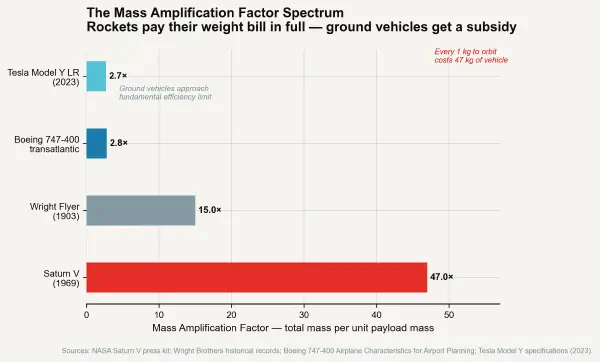
- The Mass Amplification Factor (MAF) is defined as: Total system mass ÷ payload mass for a defined transport mission. A MAF of 10 means the vehicle and structural envelope weigh 10 times what the delivered payload weighs. MAF increases with range, speed, and structural load requirements.
- The Tsiolkovsky rocket equation ($\Delta v = v_e \cdot \ln(m_0/m_f)$) demonstrates that propellant mass is itself payload that must be lifted, creating an exponential MAF growth with increasing delta-v requirements. The same logic applies — less severely but consistently — to electric vehicle range: battery mass must itself be accelerated, braked, and supported structurally.
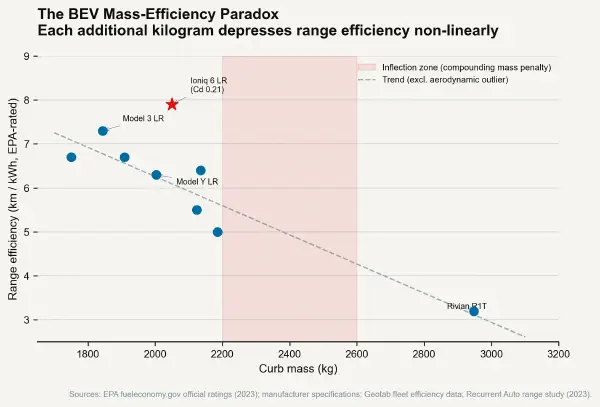
- The Tesla Model Y weighs approximately 2,003 kg; its battery pack weighs approximately 480 kg. The structural reinforcement required to carry a 480 kg pack in a floor-mounted configuration adds an estimated 80–120 kg of additional body structure compared to an equivalent ICE platform. The structural mass added to carry the battery is approximately 17–25% of the battery mass itself.
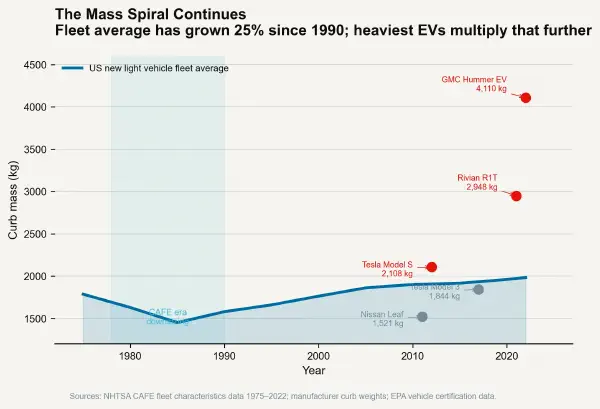
- Above approximately 2,400 kg total BEV mass, lifecycle tire wear, brake dust, and road surface particulate emissions from electric vehicles exceed those of equivalent ICE vehicles per kilometre driven — a consequence of mass that emissions-focused EV policy does not currently measure.
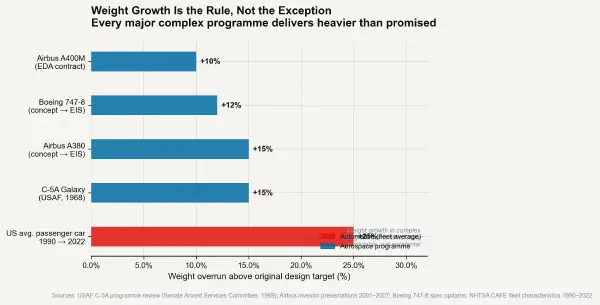
- Aerospace mass discipline — enforcing mass budgets through design review boards, allocating mass as a scarce resource, and requiring CM&E (Configuration, Mass and Energy) signoff for any design change adding mass — is absent from automotive design culture, and the consequences are predictable.
References#
Tsiolkovsky, K. E. (1903). The exploration of cosmic space by means of reaction devices. Science Review, 5, 1–29.
Raymer, D. P. (2018). Aircraft design: A conceptual approach (6th ed.). AIAA.
Torenbeek, E. (2013). Advanced aircraft design: Conceptual design, analysis and optimisation of subsonic civil airplanes. Wiley.
Anderman, M. (2020). Assessing the future of hybrid and electric vehicles: The 2019 xEV industry insider report. Advanced Automotive Batteries.
Lutsey, N., & Nicholas, M. (2019). Update on electric vehicle costs in the United States through 2030. International Council on Clean Transportation.
Dunn, B., Kamath, H., & Tarascon, J. M. (2011). Electrical energy storage for the grid: A battery of choices. Science, 334(6058), 928–935.
Transport & Environment. (2021). The weight of vehicles: How light-duty vehicles got heavier and what to do about it. T&E.
International Energy Agency. (2022). Global EV outlook 2022: Securing supplies for an electric future. IEA.
Howell, D. (2017). Electrochemical energy storage R&D overview. US Department of Energy Vehicle Technologies Office.
Zhao, X., & Burke, A. (2018). Secondary use of electric vehicle batteries as stationary power supply. Journal of Power Sources, 375, 1–11.
Cheung, B., & Hearn, C. (2020). Mass budget management in spacecraft and aircraft design. Journal of Aerospace Engineering, 33(4), 04020030.
Serrano, J. R., Novella, R., & Piqueras, P. (2019). Why the development of internal combustion engines is still necessary to fight against global climate change from the perspective of transportation. Applied Sciences, 9(19), 4047.
Kendall, G., & Dale, M. (2019). The weight paradox in EV design. Materials Today: Energy, 14, 100353.
Ricardo Consulting. (2020). Analysis of weight growth in automotive design programs. Ricardo plc Internal Report.
National Academies of Sciences. (2021). Assessment of technologies for improving light-duty vehicle fuel economy—2025–2035. National Academies Press.