Key Insights
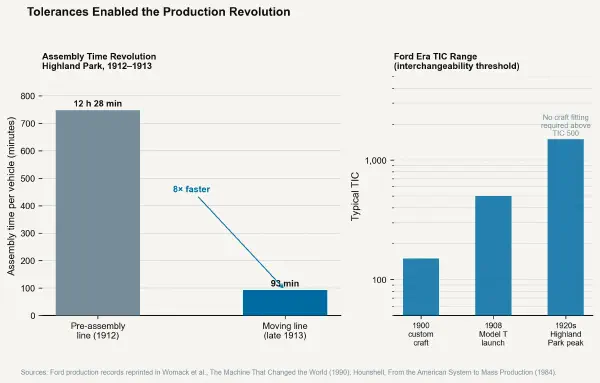
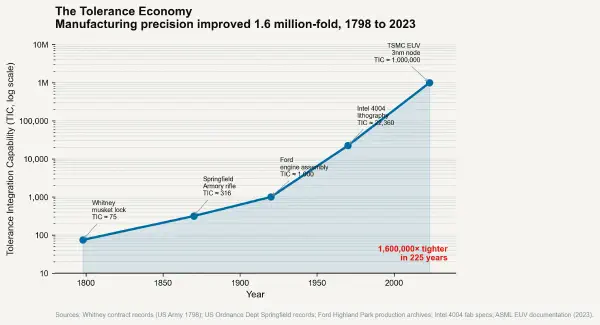
#- The Tolerance Integration Complexity (TIC) is defined as: the geometric mean of (nominal dimension_i / tolerance_i) across all critical interfaces in an assembly stack. Higher TIC means tighter tolerances relative to part dimensions — a more demanding precision requirement. TIC for Whitney's musket lock was approximately 50–100; for a modern TSMC 3nm chip, TIC exceeds 1,000,000.
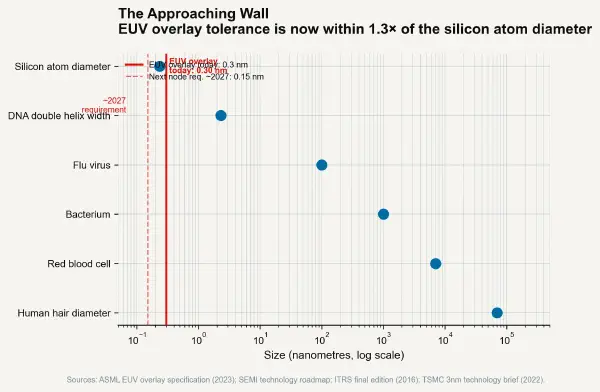
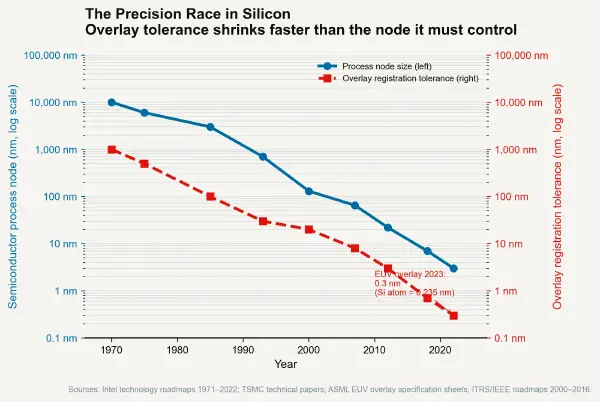
- The precision revolution from 1800 to 2023 represents approximately a 1,600,000-fold tightening in the most demanding manufacturing tolerances (from ±500µm in Whitney's era to ±0.3nm in EUV lithography). This improvement consumed most of the 19th and 20th centuries' investment in metrology, machine tools, and materials science.
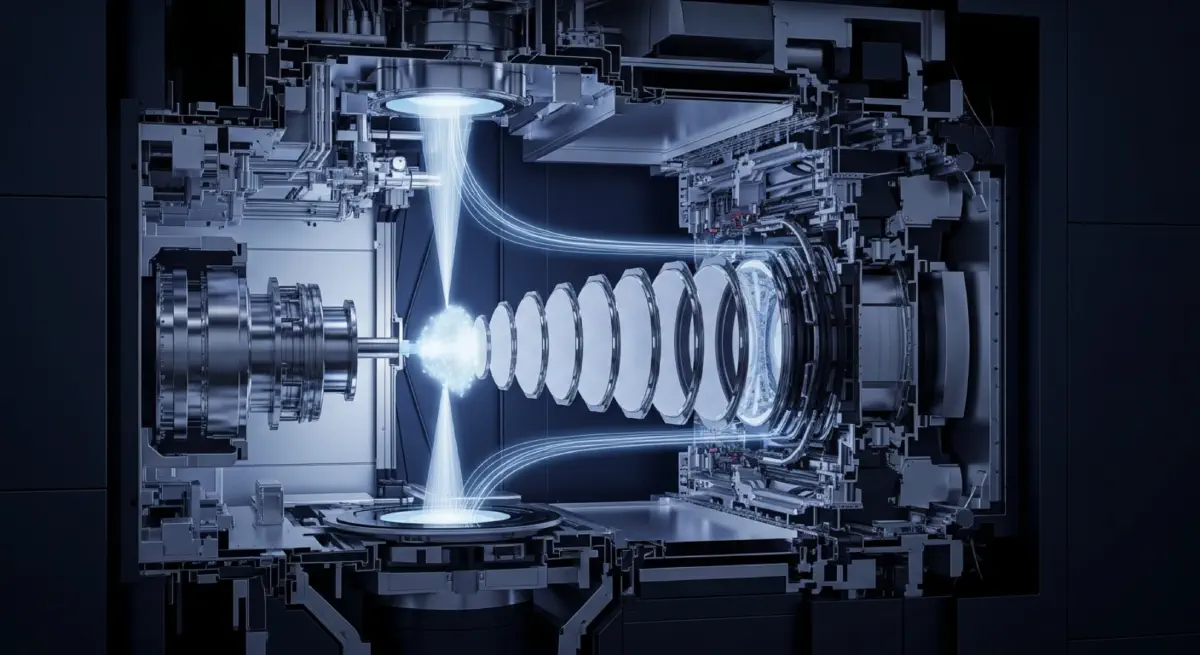
- TSMC's ability to manufacture at 3nm and below creates a geopolitical precision dependency: the equipment, know-how, and calibration infrastructure required to achieve EUV overlay at ±0.3nm is concentrated in approximately three supply chain entities globally (ASML for exposure tools, Carl Zeiss SMT for optical subsystems, and TSMC/Samsung/Intel for process integration), with zero viable rapid substitutes for any of them.
- Tolerance stacking — the cumulative dimensional variation across multiple parts assembled in series — is the primary manufacturing engineering challenge that EUV multi-patterning and directed self-assembly approaches are attempting to manage. Each additional patterning step in a multi-patterning process adds its overlay registration uncertainty to the cumulative stack.
- Nuclear fuel pin dimensional tolerances (wall thickness ±12µm, pellet diameter ±25µm, cladding tube straightness ±0.1mm/m) are among the most demanding in any non-semiconductor industry and are primarily safety constraints rather than performance optimisation constraints.
References
#Hounshell, D. A. (1984). From the American system to mass production, 1800–1932: The development of manufacturing technology in the United States. Johns Hopkins University Press.
Smith, M. R. (1977). Harper's Ferry armory and the new technology: The challenge of change. Cornell University Press.
Nye, D. E. (1990). Electrifying America: Social meanings of a new technology, 1880–1940. MIT Press.
Womack, J. P., Jones, D. T., & Roos, D. (1990). The machine that changed the world. Rawson Associates.
Quirk, M., & Serda, J. (2001). Semiconductor manufacturing technology. Prentice Hall.
Levinson, H. J. (2011). Principles of lithography (3rd ed.). SPIE Press.
Mack, C. A. (2007). Fundamental principles of optical lithography: The science of microfabrication. Wiley.
ASML. (2022). EUV technology overview: High-NA EUV lithography for sub-3nm nodes. ASML.
International Roadmap for Devices and Systems (IRDS). (2022). IRDS 2022 edition: Lithography. IEEE.
Miller, C. (2022). Chip war: The fight for the world's most critical technology. Scribner.
Stokes, D. E. (1997). Pasteur's quadrant: Basic science and technological innovation. Brookings Institution Press.
Van Noppen, L. (2020). Dimensional metrology at the nanoscale. Measurement Science and Technology, 31(4), 042001.
Ruoff, J. (2014). Large-range scanning interferometry for e-beam overlay metrology. Journal of Micro/Nanolithography, MEMS, and MOEMS, 13(3), 031304.
National Institute of Standards and Technology. (2019). The NIST precision measurement research programme: Review and strategy 2019–2024. NIST.
O'Brien, K. (2020). Tolerance stack-up analysis in precision assembly. Precision Engineering, 63, 88–102.