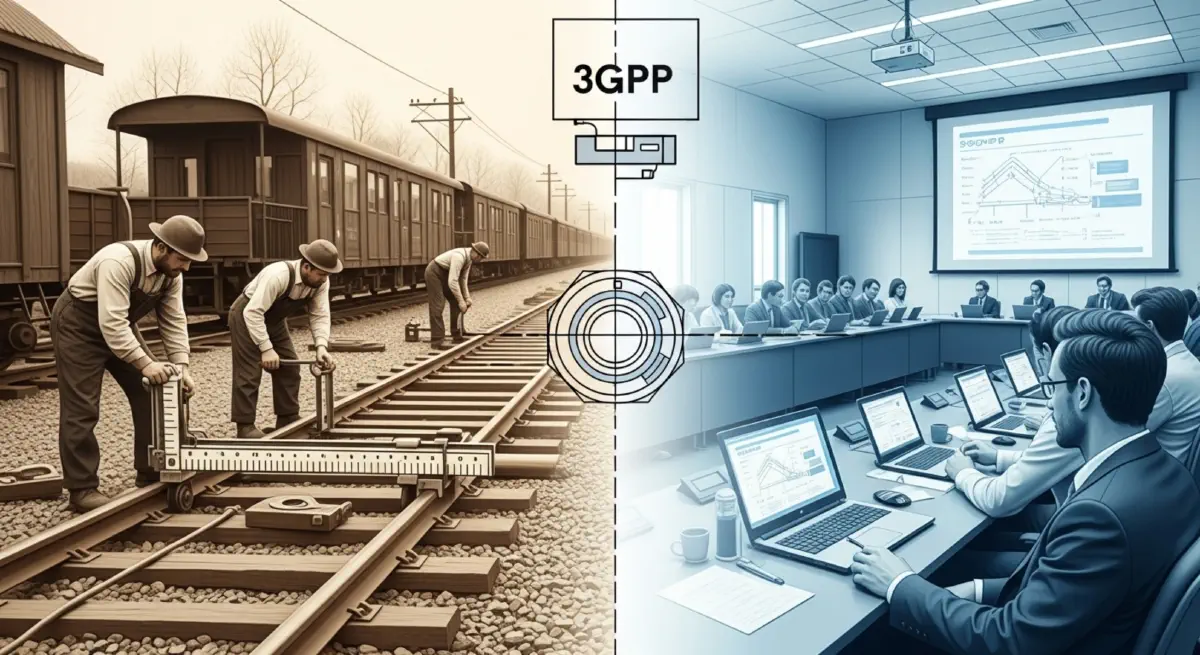
The Standard Bearer
Key Insights#
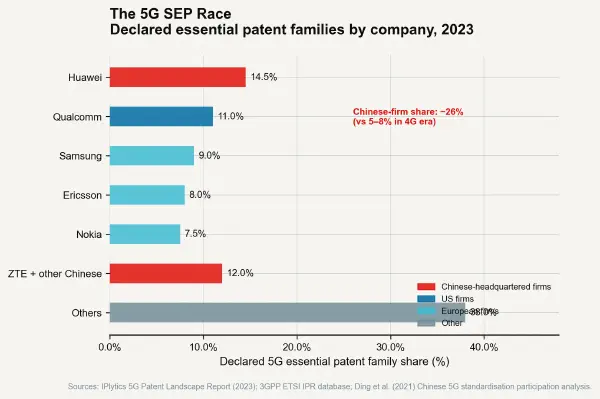
- The Standard Capture Index (SCI) is defined as: Annual economic value of standards-mandatory licensing (USD/yr) ÷ cost of achieving standard-essential patent dominance in that standard (USD). High-SCI standards are perpetual annuities: the patent pool investment is front-loaded; the licensing revenue runs as long as the standard is deployed.
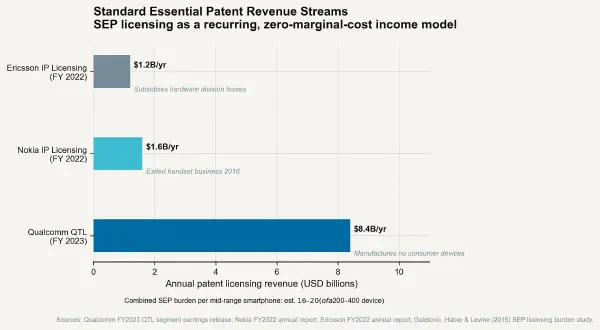
- Qualcomm’s estimated annual licensing revenue from cellular standard-essential patents exceeds $8 billion — generated from a patent estate built primarily through 3G and 4G standards participation that concluded in the early 2000s. The SCI of Qualcomm’s cellular SEP portfolio is among the highest of any single intellectual property investment in industrial history.
- FRAND (Fair, Reasonable and Non-Discriminatory) licensing obligations, intended to cap SEP holder pricing, are systematically ambiguous in rate determination and have produced decades of litigation without producing a consistent global royalty rate for any standard.
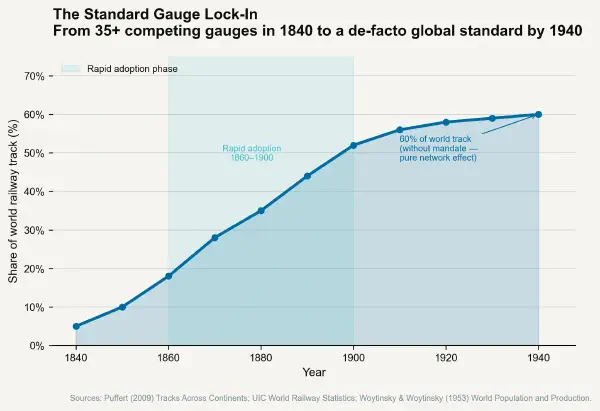
- The Betamax/VHS, HD-DVD/Blu-ray, and CDMA/GSM format wars demonstrate that technical superiority is not the determinant of standard victory; coalition size, licensing terms for downstream manufacturers, and first-mover adoption among major OEMs are more predictive.
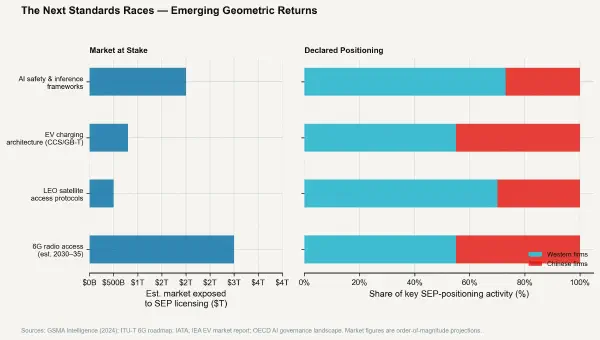
- AI model safety evaluation standards, EV charging connector mandates (including CCS/CHAdeMO/NACS competition), and low-Earth-orbit satellite spectrum allocation represent live standard competitions whose SCI outcomes are being set in the next 3–5 years.
References#
Shapiro, C., & Varian, H. R. (1999). Information rules: A strategic guide to the network economy. Harvard Business School Press.
Lemley, M. A., & Shapiro, C. (2007). Patent holdup and royalty stacking. Texas Law Review, 85(7), 1991–2049.
Dolmans, M., & Layne-Farrar, A. (2008). The open source model and the standards setting process. Journal of Competition Law and Economics, 4(3), 693–735.
Bekkers, R., & West, J. (2009). The limits to IPR standardization policies as evidenced by strategic patenting in UMTS. Telecommunications Policy, 33(1–2), 80–97.
Simcoe, T. (2012). Standard setting committees: Consensus governance for shared technology platforms. American Economic Review, 102(1), 305–336.
Galetovic, A., Haber, S., & Zaretzki, L. (2016). An estimate of the average cumulative royalty yield in the world mobile phone industry. Criterion Journal on Innovation, 1(2016), 797–842.
Layne-Farrar, A., & Lerner, J. (2011). To join or not to join: Examining patent pool participation and rent sharing rules. International Journal of Industrial Organization, 29(2), 294–303.
Bekkers, R., Birkman, L., Canoy, M., Eklund, M., & Langus, G. (2021). Intellectual property and standardisation. Publications Office of the European Union.
Creemers, R. (2020). China’s conception of cyber sovereignty. In Governing cyberspace: Behavior, power and diplomacy. Rowman & Littlefield.
Ding, J. (2018). Deciphering China’s AI dream. Future of Humanity Institute, University of Oxford.
Rosen, A. (2022). The infrastructure of influence: China’s standards strategy and the future of global technology. Washington Quarterly, 45(1), 65–83.
Spindler, G. (2016). Standard-essential patents and FRAND terms in Europe. International Review of Intellectual Property and Competition Law, 47(8), 889–918.
Teece, D. J. (2018). Profiting from innovation in the digital economy: Enabling technologies, standards, and licensing models in the wireless world. Research Policy, 47(8), 1367–1387.
IHS Markit. (2020). 4G/5G SEP licensing — revenue and royalty analysis. IHS Markit Technology Research.
World Intellectual Property Organization. (2022). World intellectual property report 2022: The direction of innovation. WIPO.