The Number That Took Forty Years to Earn#
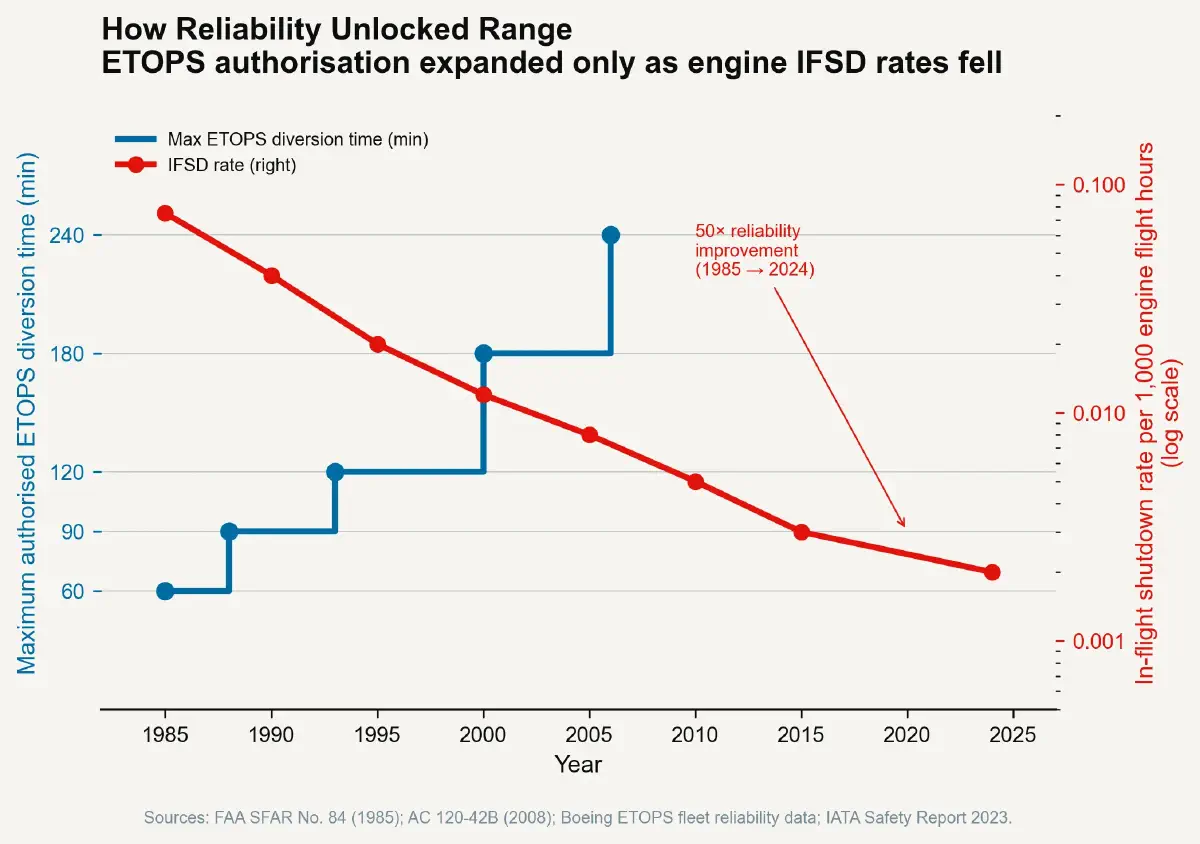
On June 1, 1985, the FAA issued Special Federal Aviation Regulation 84 (SFAR 84), authorising limited extended-range twin-engine operations — ETOPS — for the first time in civil aviation history. The regulation allowed specific twin-engine jetliners, initially the Boeing 767 operated by TWA and El Al, to fly routes that took them more than 60 minutes' flying time from the nearest diversion airport. This was a profound departure from the prior rule, which had limited twin-engine aircraft (as distinct from three or four-engine types) to routes no further than 60 minutes from an airport — in practical terms, to overland and coastal routes. The ETOPS authorisation was based on a demonstration that the statistical reliability of modern high-bypass turbofan engines, combined with a specifically engineered validation process for the aircraft and operator, produced an independent-failure probability sufficiently low that twin-engine operations at range were statistically safer than the alternatives.
The decision was controversial. Industry voices, including some at Boeing itself, initially opposed it. The historical basis was persuasive: the in-flight shutdown (IFSD) rate for turbojet engines in 1985 was approximately 0.05–0.10 per 1,000 engine flight hours. For a two-hour ETOPS flight with two engines, the probability of both engines failing independently was approximately (0.05/1,000)² × 2 hours × 2 engines² = roughly 10⁻⁸ per flight — well within the FAR 25.1309 catastrophic failure threshold of 10⁻⁹ per flight hour. By 2006, the FAA's Advisory Circular 120-42B extended ETOPS authorisation to 240-minute diversion time for operators with qualified aircraft and maintenance programmes. The modern turbofan IFSD rate has declined to approximately 0.002 per 1,000 engine flight hours — fifty times lower than the 1985 figure. The aviation industry had built, over four decades, the most successful large-scale demonstration of high-Safety Return on Redundancy (SRR) architecture in the history of complex systems manufacturing.
The Engineering of Independence#
The ETOPS record is not primarily a story about engine reliability. It is a story about what happens when the independence of redundant systems is designed in at the component level, validated through prescribed procedures, and monitored continuously against a performance threshold that aircraft and operators must maintain to retain their authorisation. The lesson of ETOPS is specifically applicable to the Fukushima and MCAS cases — not as a contrast in industry or technology, but as a contrast in method.
Three Principles That Separate High-SRR From Low-SRR Architecture#
Physical Independence, Enforced by Drawing#
A commercial twin-engine aircraft's two engines are independent in the sense that matters: their failure modes are physically uncorrelated. Each engine has its own fuel system, fed from dedicated tank volumes with cross-feed capability available but closed by default. Each engine drives its own hydraulic system, its own electrical generator, and its own thrust reverser actuation system. An engine failure — whether from a bird ingestion event, a turbine blade fracture, a fuel control unit failure, or a combustion instability — cannot propagate to the other engine through any shared system. The independence is not declared in an operations policy; it is enforced by the aircraft's physical architecture, by separate routings and separate components that are required to be physically segregated by the type design.
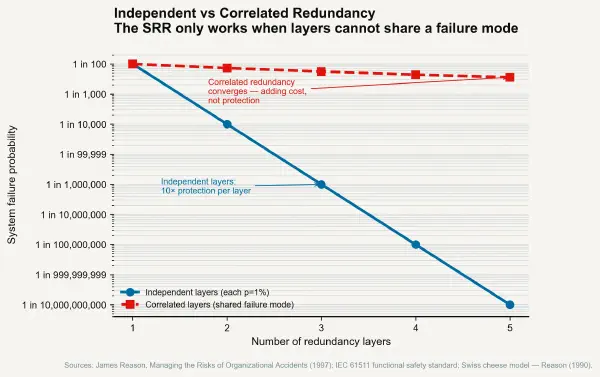
ETOPS certification requirements formalise this segregation. FAA ETOPS certification under AC 120-42B requires, among many other provisions, that no single failure or combination of failures that could be caused by a common cause can disable more than one of the systems required for ETOPS operation. This is a direct translation of the SRR independence requirement into a certification standard: if a common triggering event can cause both systems to fail, the second system is not providing the failure probability reduction it appears to provide, and the SRR calculation for that redundancy architecture is wrong.
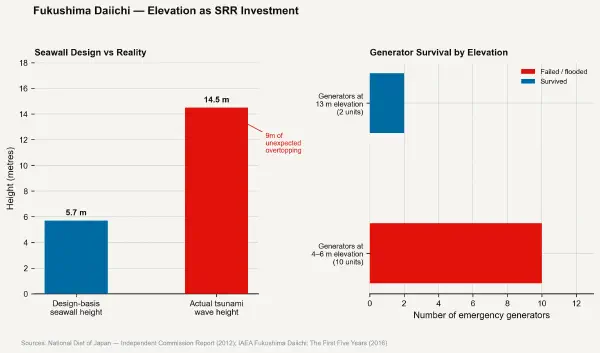
The comparison with Fukushima Daiichi is direct. The diesel generators and the main grid power — two nominally separate layers of the backup power architecture — shared a common failure mode: tsunami inundation. In the ETOPS framework, this co-location of both power systems within the tsunami inundation envelope would constitute a violation of the "no common cause failure" requirement, and the plant's ETOPS-equivalent certification would require relocation of at least one layer to a location not subject to the same inundation scenario. That the nuclear regulatory framework applicable to Fukushima Daiichi in 2011 did not impose an equivalent common-cause analysis requirement was identified by the National Diet commission as a fundamental regulatory failure.
The Validated Failure Rate as a Certification Condition#
ETOPS authorisation is conditional on demonstrated in-service reliability, not merely on design analysis. An airline and aircraft type combination seeking ETOPS-180 authorisation must have accumulated an in-service record demonstrating an IFSD rate at or below the regulatory threshold appropriate to the requested diversion time. The FAA's ETOPS performance standards require that IFSD rates be calculated on a rolling basis from actual fleet experience and reported to the FAA at defined intervals. If an aircraft type's IFSD rate rises above the threshold — whether through emerging failure modes or operational factors — the ETOPS authorisation can be revoked until the rate returns to compliance.
This is a continuous, outcome-based safety governance mechanism. It does not rely solely on the design analysis performed at certification; it incorporates actual operational performance and closes the loop between predicted failure probability and observed failure probability. The gap between predicted and actual failure probability — corresponding to the MPDI (Measurement-Performance Divergence Index) framework introduced in the series on measurement apparatus — is tracked in real time and acted upon when it exceeds defined thresholds.
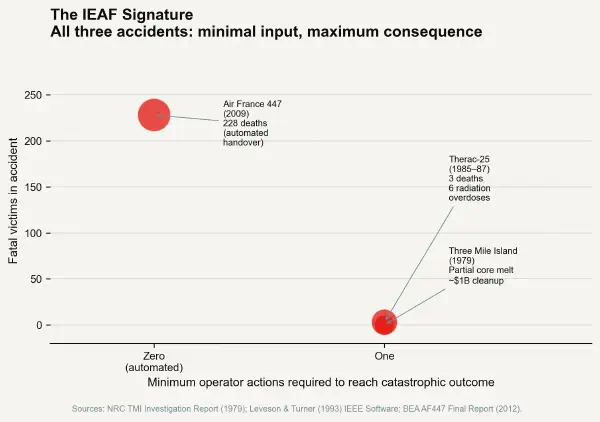
The Boeing MCAS certification process had no equivalent mechanism. The failure hazard classification of MCAS as "major" rather than "catastrophic" was a pre-delivery analysis performed once, at certification, with no monitoring requirement that would detect if the AoA sensor failure rate or the crew response time distribution in-service deviated from the certification assumptions. The first signal in the operational data was the Lion Air 610 accident — which killed 189 people before the failure rate was re-observed. An ETOPS-equivalent monitoring framework for MCAS would have required Boeing and operators to track erroneous MCAS activation events in service, compare the rate to the certification assumption, and act when the observed rate exceeded the threshold. No such framework was required or implemented.
The Institutional Mechanism That Forces the Honest Calculation#
The FAA's ETOPS regulatory structure creates an institutional mechanism — mandatory performance monitoring with revocation authority — that forces honest SRR calculation. An airline that wants to operate a profitable transoceanic route with twin-engine aircraft must maintain a real, measured IFSD rate meeting the standard. The incentive to maintain high-SRR architecture is direct and continuous: fail to achieve the IFSD threshold, lose the route authority.
This institutional mechanism does not exist in all safety-critical industries, and its absence correlates with the frequency of low-SRR disasters. Compare the ETOPS mechanism with the Fukushima design basis validation process: the design basis tsunami height of 5.7m was established in the 1960s and had not been updated by 2011, despite geological evidence that informed upward revision of the basis was available by 2008. There was no regulatory mechanism that required TEPCO to demonstrate, on a periodic basis, that the plant's backup cooling architecture still met a validated failure-probability threshold against the current best estimate of the tsunami hazard distribution. The safety case was written once, approved by a regulator embedded in a culture of deference, and not revisited until the event showed it was wrong.
The institutional contrast maps directly onto the SRR framework. ETOPS creates a market mechanism (route authority) that financially rewards operators for maintaining high-SRR architecture, verified continuously against actual performance data. The Fukushima licensing framework created institutional comfort without performance validation — and the measured SRR of its backup architecture was consequently unknown until the measurement was made by the tsunami itself.
The Resilience Premium, Accounted#
The history traced across this series — from Reason's Swiss Cheese model through Fukushima, MCAS, and ETOPS — converges on a quantitative principle with qualitative consequences. Redundancy that generates SRR > 1 requires three structural features: failure mode independence physically enforced in the system's architecture; a failure probability characterised against the realistic hazard distribution rather than the convenient one; and an institutional mechanism that continuously validates the actual in-service performance against the designed-in assumption.
The cost of these features is not zero. Physical independence requires more engineering, more components, more routing — the ETOPS aircraft's twin independent hydraulic systems, dual fuel feed architectures, and separate electrical generation networks add mass and cost over a minimally provisioned single-engine equivalent. The validated failure rate monitoring programme requires data infrastructure, regulatory reporting, and periodic fleet-level analysis. The institutional oversight mechanism requires regulatory authority with revocation teeth — a structure that faces constant pressure from industry to reduce its scope.
Against this cost, the measured return is large. The modern aviation industry transports approximately 4.5 billion passengers per year on commercial aircraft with a hull loss rate (fatal accidents involving aircraft loss) of approximately 0.07 per million departures — the lowest in the history of commercial aviation, and a factor of ten lower than the rate of the early jet era. The ETOPS programme specifically enabled transoceanic twin-engine operations that now constitute a majority of long-haul commercial flights worldwide, with an in-flight dual-engine shutdown event remaining a theoretical scenario that has never occurred in commercial ETOPS operations at scale.
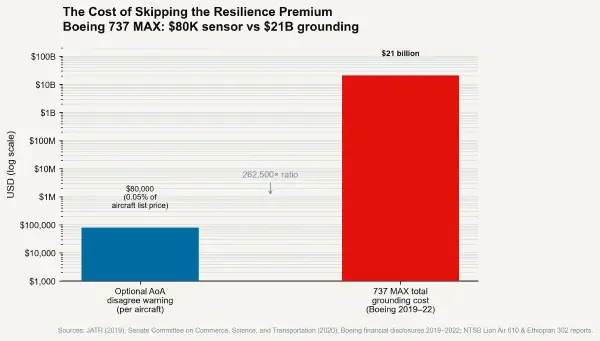
The resilience premium — the additional investment in genuine independence, honest hazard characterisation, and continuous performance validation — is not primarily a cost. It is the capital that purchases the right to operate complex systems at scale without killing the people who depend on them. The Fukushima disaster cost the Japanese economy an estimated $200 billion in direct and indirect costs, triggered the shutdown of Japan's entire nuclear fleet, and produced an energy transition whose economic consequences extend to the present day. The Boeing 737 MAX grounding generated direct costs to Boeing of approximately $21 billion — against which the cost of the optional AoA disagree warning system at $80,000 per aircraft and a few thousand training hours is a rounding error. The arithmetic of the resilience premium has always been clear. The challenge — as James Reason understood when he drew his cheese in Manchester in 1990 — is the institutional will to perform the calculation honestly, before the holes align.