The Professor With the Unusual Prop#
In 1990, James Reason, then a cognitive psychologist at the University of Manchester, was trying to communicate why complex system accidents are almost never caused by a single failure. He had been studying industrial accidents — chemical plant explosions, aircraft crashes, nuclear incidents — and had noticed a consistent pattern: the accidents that killed people and destroyed machinery were invariably the product of multiple simultaneous failures, each of which was unremarkable in isolation. A valve that leaked was not unusual. An alarm that had been silenced by a fatigued operator was not unusual. A maintenance procedure that had been skipped because of a production deadline was not unusual. But when these three mundane failures aligned in a single moment — when the holes in the cheese lined up — the consequence was catastrophic.
Reason published his Swiss Cheese model in Human Error in 1990. The model depicted each defensive barrier in a complex system as a slice of Swiss cheese: mostly solid, capable of blocking most hazards, but perforated with holes that represent weaknesses, gaps in procedures, lapses in attention, design limitations. An accident path requires a hazard to find a trajectory from external threat through all the defensive layers simultaneously — each hole in sequence aligned with the trajectory. The model was immediately adopted by aviation safety, then nuclear safety, then healthcare, then industrial safety worldwide. It became, arguably, the single most influential conceptual framework in applied safety science of the twentieth century.
Reason gave safety science a vocabulary. What it lacked was an equation — a way to quantify whether a redundancy investment actually reduced accident probability, and by how much per unit of cost.
The Probability of Not Failing#
The Safety Return on Redundancy (SRR) is a quantitative extension of Reason's model. SRR is defined as the reduction in system failure probability per redundancy layer, divided by the cost of that redundancy layer as a fraction of the total system cost. A SRR greater than 1.0 means the redundancy layer reduces failure probability by more per unit cost than the investment represents — it is a productive safety investment. A SRR less than 1.0 means the redundancy layer costs more per unit of failure probability reduction than its proportional share of system cost — it is an inefficient or even counterproductive investment. A SRR near zero means the redundancy layer costs money but does not reduce failure probability — and at SRR below zero, the redundancy layer has created additional failure modes that make the overall system less reliable.
The Mathematics of Layered Defense#
How Independent Layers Multiply Protection#
James Reason's Swiss Cheese model contains an implicit probabilistic assumption: that the holes in adjacent cheese slices are not correlated. If the holes in each slice are independent of the holes in other slices — if the failure modes of each defensive layer are uncorrelated with the failure modes of other defensive layers — then the probability of a hazard finding a path through all layers simultaneously is the product of the individual layer failure probabilities.
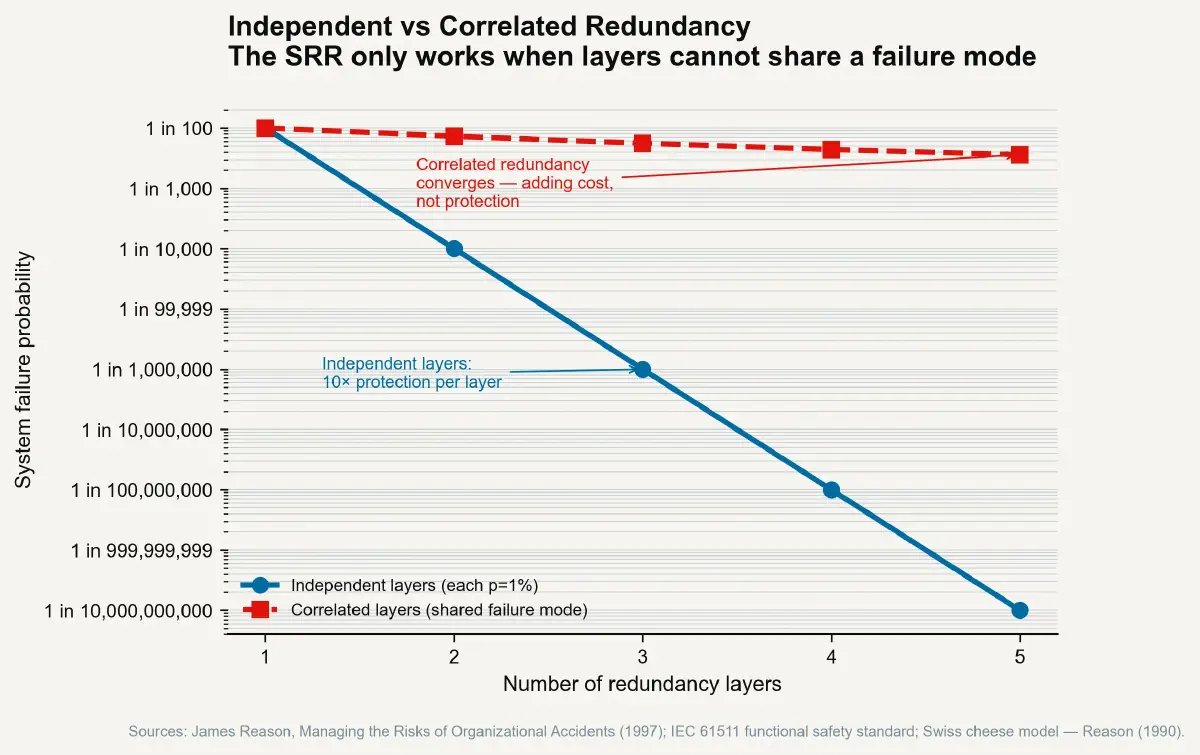
Consider a system with three defensive barriers, each with an independent failure probability of 0.01 (1% chance of failing when a hazard is presented). The probability of all three failing simultaneously is 0.01 × 0.01 × 0.01 = 0.000001 — one in a million. The first barrier alone reduces risk from 1.0 to 0.01 — a factor of 100. The second barrier reduces it from 0.01 to 0.0001 — another factor of 100. The third barrier reduces it from 0.0001 to 0.000001 — a further factor of 100. Each layer contributes an equal multiplicative reduction in failure probability. If each layer costs 1% of total system cost, the SRR for each layer is (failure probability reduction) / (cost fraction) = (reduction from 0.01 to 0.0001) / (0.01 cost fraction) = 0.0099 / 0.01 = 0.99 per unit. At this threshold, the investment is roughly breaking even in probabilistic terms.
The independence assumption is not merely a mathematical convenience — it is the functional requirement that determines whether a redundancy layer delivers its designed protection. If the failure modes of two redundant layers are correlated — if the same event that causes Layer A to fail also causes Layer B to fail — then the combined failure probability of the two layers is not P(A) × P(B) but approximately P(A) = P(B) = the fundamental probability of the shared triggering event. The second layer adds cost but not protection.
This is the Swiss Cheese model's most important — and most frequently overlooked — implication. Adding more layers of cheese does not improve safety unless those layers have genuinely independent failure modes. Reason himself emphasised this in his 1997 follow-up Managing the Risks of Organizational Accidents: the quality of the defensive layers — their independence from each other's failure modes — matters far more than their number.
The SRR Formula in Practice#
Translating Reason's framework into operational terms requires answering three questions for each proposed redundancy layer: What is the layer's failure probability when the hazard is presented? What is the correlation between this layer's failure mode and the failure modes of other layers in the system? What is the cost of this layer as a fraction of total system cost?
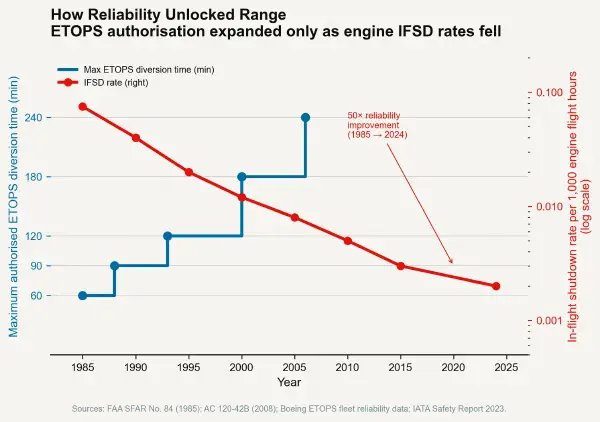
The first question is answered by component reliability data — mean time between failures, failure mode and effects analysis (FMEA), or historical incident statistics. Aviation, nuclear power, and offshore petrochemical industries maintain historical failure databases organised by component type, failure mode, and operational environment. A modern turbofan engine's in-flight shutdown (IFSD) rate is approximately 0.002 per 1,000 engine flight hours — a well-characterised number derived from decades of fleet experience. For a system layer with 0.002 failures per 1,000 operational hours, the failure probability under any given operational hour is approximately 0.000002.
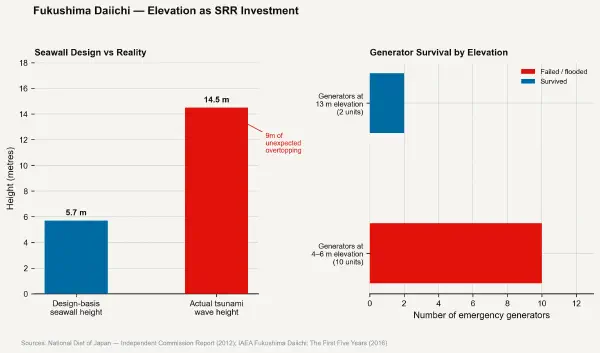
The second question — correlation between failure modes — is the hardest to answer and the most consequential. Correlation is not always visible during design Reviews. It becomes apparent when two layers fail together in the triggering event and analysts retroactively recognise the shared vulnerability. The pattern is consistent across major accidents: Challenger (two O-ring segments in the same joint, both compromised by the same cold-temperature exposure), Chernobyl (multiple reactor safety systems simultaneously bypassed for the same test procedure), Fukushima (diesel generators and main power grid both interrupted by the same tsunami event). In each case, the correlation between layer failures was present during design and became apparent only after the event.
The third question — cost fraction — is answered by the engineering cost estimate for the redundancy investment. A backup diesel generator suite for a nuclear plant coastal facility costs approximately $3–8 million installed. For a plant with a total capital cost of approximately $5–8 billion, the generator suite represents a cost fraction of approximately 0.05–0.15%. A SRR calculation based on this cost fraction requires that the generator suite reduce core damage probability by approximately (0.05–0.15%) of its proportional share for the investment to break even. Whether it achieves this depends entirely on whether its failure modes are independent of the primary power loss scenario it is intended to back up.
SRR > 1: The Conditions for Genuine Protection#
The conditions that produce SRR > 1 are enumerable and consistent across industries. First, failure mode independence must be physically enforced, not procedurally declared. Independence that exists in the operating manual but not in the physical design — shared power supplies, shared cooling systems, shared geographic location — fails under correlated triggering events. Second, the layer failure probability must be explicitly characterised in the operational environment specific to the hazard scenario being designed against. A backup generator with a lab-validated MTBF of 10,000 hours has a materially different failure probability in a coastal flood environment than in a temperate inland facility. Third, the cost of the redundancy layer must be proportional to the actual failure probability reduction it delivers — not the notional reduction from its nominal specification, but the realistic reduction after accounting for its actual failure mode distribution and its correlation with other layers.
Industries that consistently achieve SRR > 1 — aviation's ETOPS programme, nuclear defense-in-depth architecture as implemented at facilities that passed the Fukushima design standard, Deepwater Horizon's pre-incident loss-of-control failures share a common institutional characteristic: independent safety oversight with authority to reject redundancy designs that fail the independence test. The mechanism by which this authority is exercised differs by industry — the FAA's Safety Analysis requirements under AC 25.1309, the NRC's design basis threat framework, the HSE's ALARP standard in UK offshore operations — but the common principle is external validation of failure mode independence before the redundancy layer is credited in the safety case.
The Accountant in the Room#
The SRR framework is, at its core, a capital allocation discipline applied to safety investment. It asks: given limited design resources, which redundancy layers deliver the greatest reduction in failure probability per unit cost? The question is not merely technical — it is also ethical. Reason's model was developed in the aftermath of disasters that killed people in industries where safety investment competed with schedule, cost, and production pressure. The Swiss Cheese model gave safety professionals a framework to argue that accident pathways needed to be closed. The SRR framework gives them a quantitative argument to make that case: this layer, with its specified failure probability and demonstrated mode independence, produces a measured return on safety investment, and that return exceeds its cost.
The next post examines a case where the SRR calculation was not performed — where the redundancy investment appeared substantial, where the official safety case declared multiple layers of defence, and where all of the layers failed simultaneously in a three-hour window. On March 11, 2011, the operative SRR for Fukushima Daiichi's core cooling backup system was approximately zero, because every layer designed to protect the reactor cores shared a single unexamined vulnerability: a seawall that was fourteen metres too short.