The Drive That Nobody Takes#
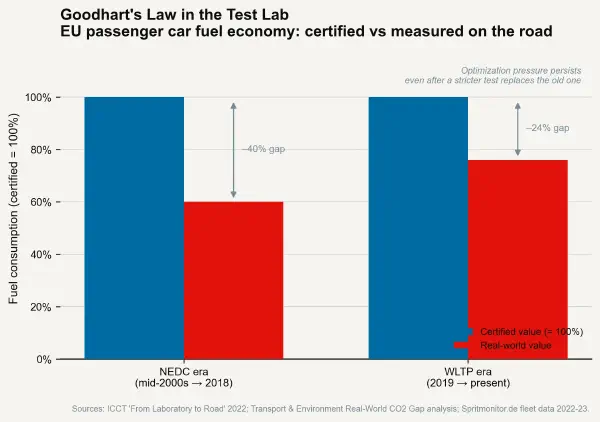
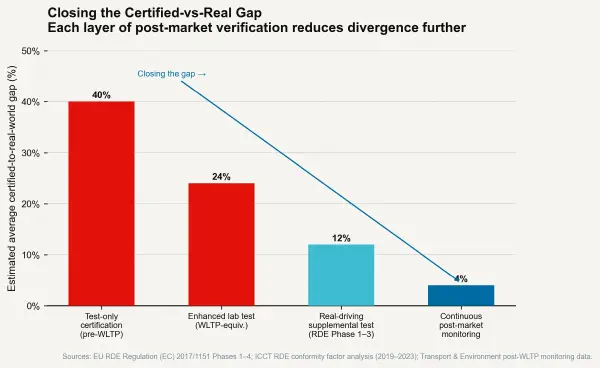
The WLTP — Worldwide Harmonised Light Vehicles Test Procedure — is the current European regulatory standard for measuring vehicle fuel consumption and CO2 emissions. It replaced the previous NEDC (New European Driving Cycle) standard in 2017 for type-approval purposes and in 2019 for all new vehicle registrations in the EU. The WLTP cycle includes higher speeds (up to 131 km/h), more dynamic acceleration profiles, and optional equipment consideration (heavier configurations are tested with higher resistance settings) than its predecessor. It was designed explicitly to reduce the gap between certified and real-world fuel consumption that had grown to approximately 40% under NEDC by the mid-2010s.
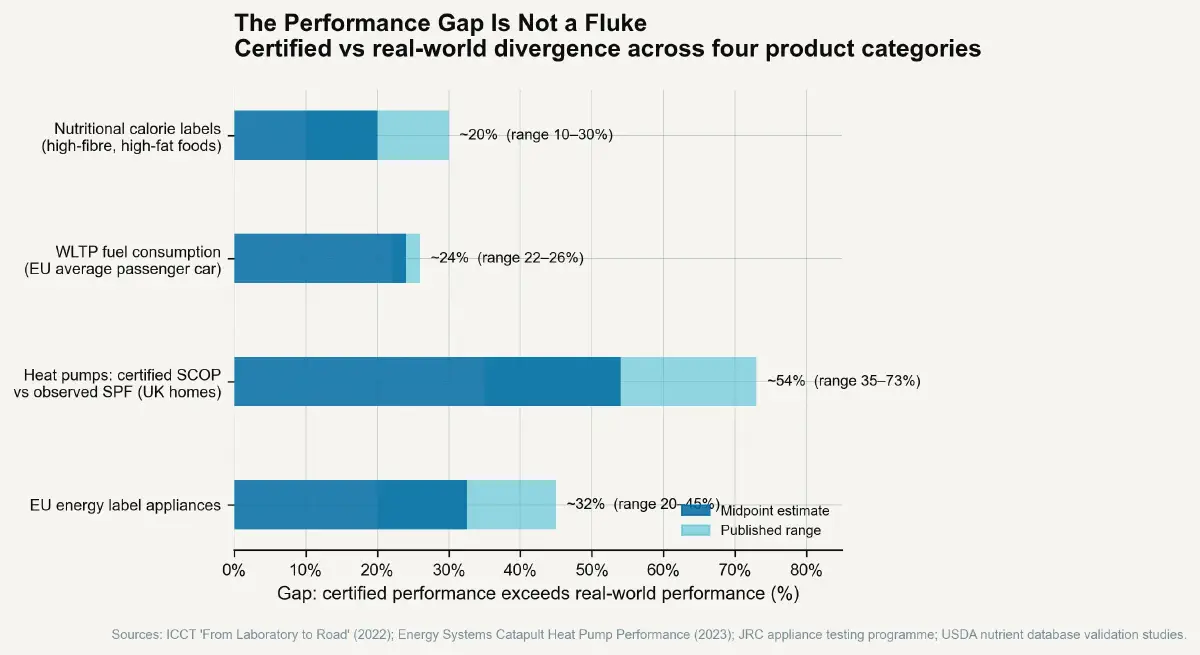
It has not closed that gap. The German independent real-world monitoring platform Spritmonitor.de, which aggregates fuel consumption records from approximately 280,000 registered vehicle users, shows an average divergence between WLTP-certified fuel consumption and user-reported real-world consumption of approximately 20–35% as of 2022–2023, with some models showing divergence exceeding 40%. The International Council on Clean Transportation (ICCT), in its 2022 "From Laboratory to Road" report, found that the real-world CO2 performance gap for new passenger cars registered under WLTP averaged approximately 22–26% across the EU market. The gap was smaller than NEDC had produced, but it was not closed, and it was not random — it was consistently in one direction: certified performance was consistently better than real-world performance, reflecting the continued optimisation of production vehicles for the test cycle rather than for actual driving conditions.
Why Test Cycles Cannot Track Real Use#
The Immovable Standardisation Problem#
A test cycle must be standardised to be legally defensible as a regulatory measure — different results from different testers, weather conditions, or equipment configurations would make certification meaningless. Standardisation requires fixing the test conditions: a defined speed profile, a defined temperature range (23°C ±5°C for WLTP), defined road gradient (flat), defined vehicle loading, and defined ambient conditions. These fixed conditions are, by design, a compromise across the range of actual vehicle use.
The compromise works acceptably when real vehicle use is similar to the test conditions. When real use systematically diverges from test conditions — as it does for vehicles used in cold climates, urban stop-start traffic more aggressive than the WLTP urban phase, high-speed motorway cruising above 131 km/h, or in hot desert conditions that activate air conditioning at full load — the MPDI grows in direct proportion to the divergence. The test cycle is not wrong; it is by construction not correct for any specific use, and in aggregate, the specific use patterns that generate high fuel consumption (cold weather, aggressive driving, high-speed highways) are precisely those that diverge most from standard test conditions.
For EV range specifically, the WLTP divergence is more severe because battery thermal management — which has a high energy consumption impact in cold weather as this series discussed in the cooling series — is not captured adequately by a test conducted at 23°C. EV driving range in winter conditions at −5°C has been measured at 20–40% below WLTP ratings in independent testing by the Norwegian EV Association, which operates in a market where cold weather is the normal operating environment rather than an edge case.
The Optional Equipment Paradox#
The WLTP test protocol includes a provision for optional equipment: features that add aerodynamic drag (sunroofs, roof rails) or mass (premium seat packages, large wheels) must be accounted for through a "delta correction" that adjusts the certified fuel consumption upward to reflect the standard variant's configuration. In practice, the correction methodology allows manufacturers to certify the lowest-consumption configuration as the primary certification benchmark and apply corrections that, independent testing has found, systematically underestimate the fuel consumption impact of the most commonly ordered configurations.
The most significant example is wheel and tire size. Low-rolling-resistance tires on minimum-width steel wheels are dramatically more efficient than the large-profile alloy wheel and performance tire combinations that many vehicle owners select. The WLTP delta correction for wheel variants is calculated from standardised rolling resistance measurements; it does not fully capture real-world tire wear, the higher road noise that motivates owners to select harder compounds with higher rolling resistance, or the consumer tendency to under-inflate larger tires. Independent research by Transport & Environment (2019) found that the wheel size delta correction accounted for approximately 60% of the actual fuel consumption difference between minimum and maximum wheel/tire configurations in tested vehicles — meaning 40% of the real-world fuel consumption difference from wheel choice was not captured in the MPDI correction.
MPDI Beyond Automotive#
The MPDI phenomenon in automotive certification is the most quantitatively documented, but it is not sector-specific.
Energy Performance Labels#
The EU Energy Label system for white goods — refrigerators, washing machines, heat pumps, and other domestic appliances — uses standardised energy consumption tests conducted under defined laboratory conditions to assign energy class ratings (A to G on the current scale). Studies by the European Commission's Joint Research Centre found that actual energy consumption of appliances in-use diverges from laboratory ratings by an average of approximately 20–45% depending on product category, with higher divergence for products whose in-use conditions vary significantly from test conditions.
Heat pumps are the most consequential current example. EU building energy policy relies significantly on heat pump deployment as a decarbonisation tool, and heat pump performance is certified through a Seasonal Coefficient of Performance (SCOP) — a weighted average efficiency across the European climate's season distribution. The SCOP for a given heat pump model is measured using a standardised climate bin distribution that reflects central European weather conditions. Actual in-use Coefficient of Performance (COP) varies significantly with local climate, installation quality, and distribution system hydraulics. Independent monitoring of installed heat pump performance in the UK, conducted by the Energy Systems Catapult (2023), found mean SPF (Seasonal Performance Factor) of 2.6 for UK domestic heat pump installations — compared with typical SCOP certifications of 3.5–4.5 for the same models. The MPDI for heat pump energy labels in UK conditions is approximately 35–73%.
Nutritional Labelling#
Food energy content on nutritional labels in the EU and US is calculated using the Atwater factor conversion system, which assigns standard energy conversion factors to protein (4 kcal/g), carbohydrate (4 kcal/g), fat (9 kcal/g), and alcohol (7 kcal/g) and calculates total food energy by multiplying detected macronutrient weights by these factors. The system, developed in the 1890s by Wilbur Atwater at the US Department of Agriculture, provides a standardised method for energy labelling that has been adopted substantially unchanged for over a century.
Research on actual physiological energy extraction from foods — particularly from whole foods with intact cellular structure, high fibre content, and complex carbohydrate matrices — has consistently found that Atwater factor calculations overestimate usable caloric content by 10–30% compared with direct calorimetric measurement of actual digestive absorption. The MPDI for nutritional labelling of high-fibre foods is approximately 10–30% in the direction of overcounting calories — meaning dietary restriction programmes based on calorie counting from labels systematically underestimate achievable intake reduction.
The regulatory consequence of this MPDI is small for individual meals and non-trivial for population-level dietary policy. A 10% systematic overcount of calories in high-fibre foods biases dietary recommendations toward lower fibre consumption than would be optimal for satiety and metabolic health — not because any actor is gaming the measurement, but because the Atwater system is a 130-year-old proxy that was never validated against the full complexity of food matrix effects on digestive absorption.
The MPDI Cannot Be Closed from the Measurement Side#
The consistent pattern across automotive, energy label, financial, and nutritional MPDI cases is that iterative refinement of the test — making it more realistic, more complex, more representative — reduces the MPDI but does not eliminate it. The WLTP was more realistic than the NEDC. The EU A–G appliance label replaced a simpler A++/A+++ system that had accumulated MPDI over years of optimisation. Each revision narrows the gap; the next generation of optimisation for the new test begins immediately.
The MPDI is not, fundamentally, a problem that measurement refinement can solve. It is a property of any incentive system where the regulated entity — the vehicle manufacturer, the appliance maker, the financial institution, the drug sponsor — has information about their product's real-world performance that they apply to optimise test performance specifically. The solution, if there is one, does not come from the test — it comes from restructuring the incentive. The next post examines the theoretical framework that explains why, and what the history of measurement gaming reveals about the conditions under which MPDI can be controlled.