Key Insights
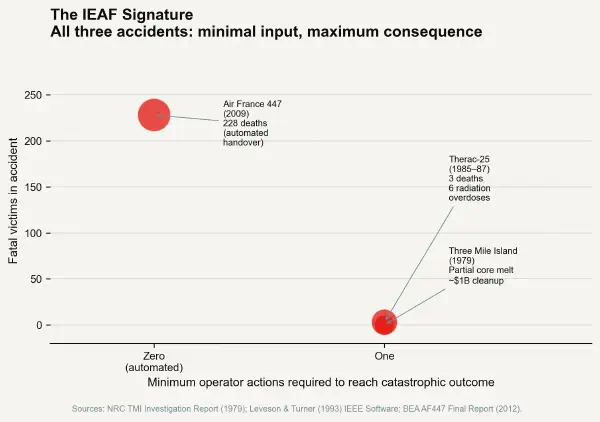
#- The Interface Error Amplification Factor (IEAF) is defined as: Maximum consequence severity of an interface error ÷ Minimum action complexity required to reach that error state (measured in control inputs, keystrokes, or clicks).
- The IEAF of a single-cursor EHR dose-entry field with a 10× unit dropdown is higher than the IEAF of the locked glass medication cabinet it replaced, because the physical key created mandatory action complexity the GUI removed.
- Boeing 737 MAX MCAS had an effective IEAF approaching infinity for any single angle-of-attack sensor failure: one faulty sensor input, zero required pilot actions, and maximum consequence.
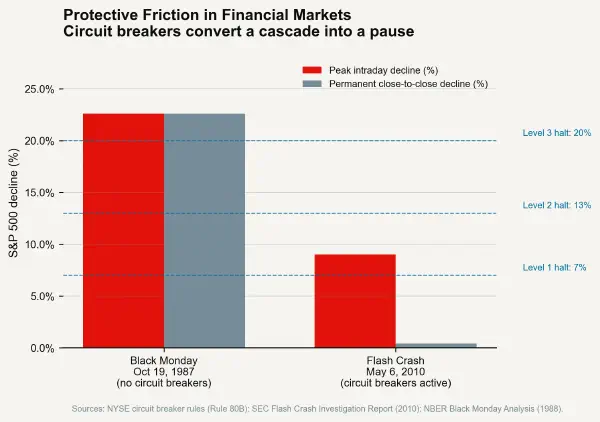
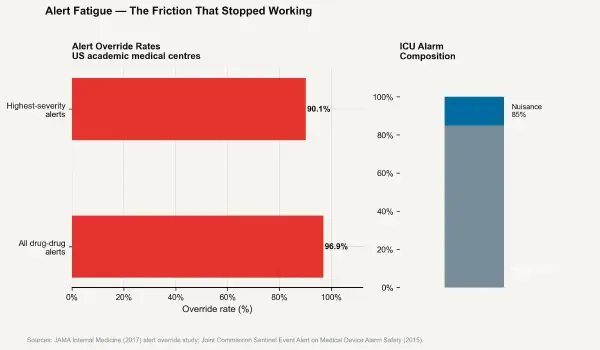
- Protective friction — deliberately inserted action complexity between a user and a dangerous outcome — is the design principle that produces low-IEAF systems; it is absent from most commercial digital interface design doctrines.
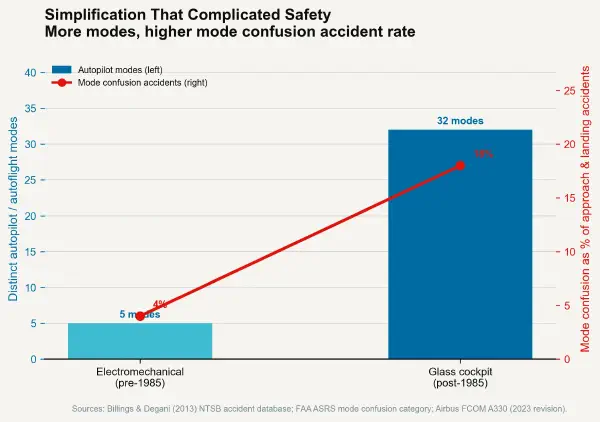
- The most dangerous interface designs are not those that require the most steps — they are those that route the fewest steps to the most severe outcomes.
References
#Leveson, N. G. (2012). Engineering a safer world: Systems thinking applied to safety. MIT Press.
Reason, J. (1990). Human error. Cambridge University Press.
Norman, D. A. (2013). The design of everyday things (Revised ed.). Basic Books.
Wickens, C. D., Hollands, J. G., Banbury, S., & Parasuraman, R. (2015). Engineering psychology and human performance (4th ed.). Psychology Press.
Casey, S. (1993). Set phasers on stun: And other true tales of design, technology, and human error. Aegean.
Nuclear Regulatory Commission. (1979). Investigation into the March 28, 1979 Three Mile Island accident (NUREG-0600). US NRC.
International Atomic Energy Agency. (1992). Therac-25 accidents: Case study. IAEA Safety Series.
Bureau d'Enquêtes et d'Analyses. (2012). Final report on the accident to Air France flight AF 447 (BEA-F-CP090601). BEA.
Joint Commission. (2018). Sentinel event alert: Preventing inadvertent retained foreign objects. The Joint Commission.
Bates, D. W., Cullen, D. J., Laird, N., Petersen, L. A., Small, S. D., Servi, D., ... & Leape, L. L. (1995). Incidence of adverse drug events and potential adverse drug events. JAMA, 274(1), 29–34.
Singh, H., Schiff, G. D., Graber, M. L., Onakpoya, I., & Thompson, M. J. (2017). The global burden of diagnostic errors in primary care. BMJ Quality & Safety, 26(6), 484–494.
Spear, B. B., Heath-Chiozzi, M., & Huff, J. (2001). Clinical application of pharmacogenetics. Trends in Molecular Medicine, 7(5), 201–204.
Hollnagel, E. (2004). Barriers and accident prevention. Ashgate.
Dekker, S. (2014). Safety differently: Human factors for a new era. CRC Press.
Endsley, M. R., & Garland, D. J. (Eds.). (2000). Situation awareness analysis and measurement. Lawrence Erlbaum Associates.