Key Takeaways
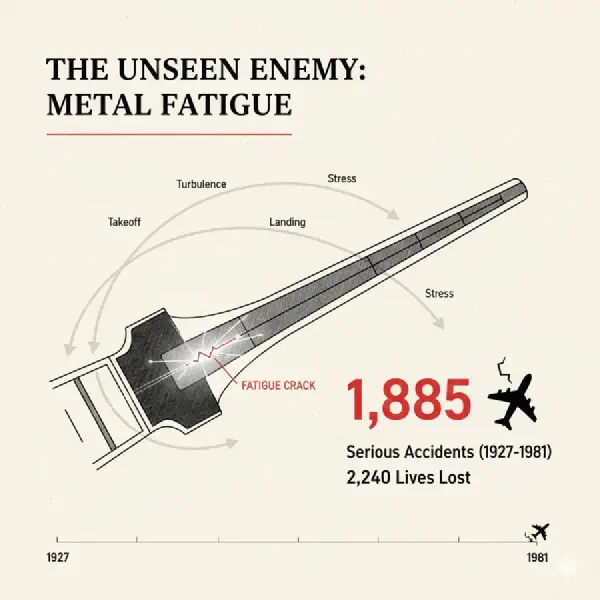
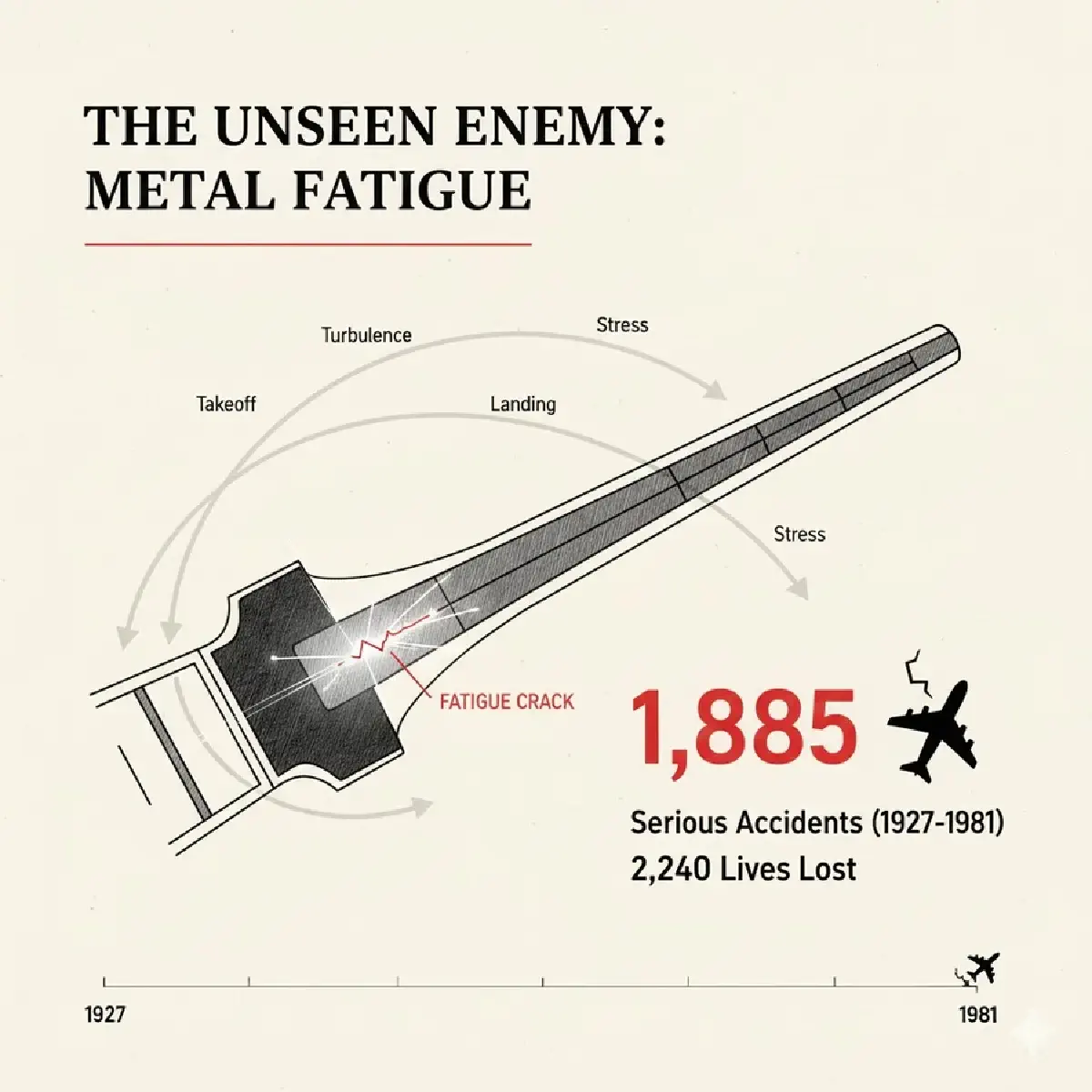
- Metal Fatigue Crisis: Between 1927-1981, metal fatigue caused 1,885 serious aircraft accidents worldwide, resulting in 2,240 fatalities.
- Vulnerable Components: Fasteners (bolts, screws) are the primary initiation sites for fatigue cracks, accounting for 24-26% of cases.
- Recurring Failures: Certain aircraft models, like the Cessna 182 and Bell 47 helicopter, experienced repeated fatigue-related accidents due to design flaws.
- Inspection Imperative: Ongoing vigilance through inspections and maintenance is crucial, as fatigue-related accidents still occur at a rate of ~100 per year.
- Engineering Challenge: Understanding and mitigating metal fatigue remains a key focus in aviation safety engineering.
1,885 Metal fatigue caused 1,885 serious accidents between 1927-1981, claiming 2,240 lives – with 100+ incidents still occurring annually.
From the Archives of Aviation Safety#
It’s one of the great miracles of modern life: stepping onto a jet, soaring above the clouds, and landing safely hundreds or thousands of miles away. We trust the steel and aluminum that hold us aloft. But there’s a sneaky, relentless enemy lurking inside every aircraft part: metal fatigue.
A comprehensive worldwide survey recently dug into the cold, hard facts of this invisible foe, revealing just how serious metal fatigue is to flight safety.
The Secret Life of a Crack#
What is fatigue? It’s simply the effect of repeated use. Every flight—every takeoff, bump of turbulence, and firm landing—puts stress on the metal components. Over years and thousands of hours, tiny, almost invisible cracks can start to grow, even if the part never sees a single overwhelming load.
If this crack develops in a part critical for flying safely, the result is a serious accident. In fact, between 1927 and 1981, fatigue fracture was a factor in an astonishing 1,885 serious aircraft accidents globally, claiming the lives of 2,240 people.
Where Airplanes Are Most Vulnerable#
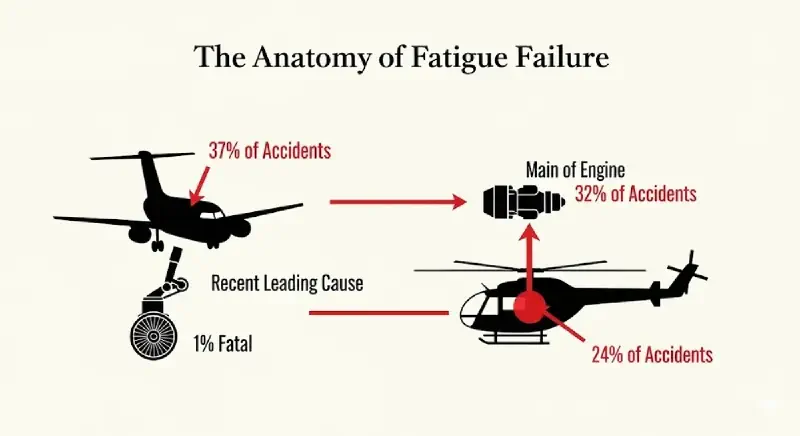
Which parts are most likely to get “tired”? The survey offers a clear picture:
- Fasteners: Bolts, studs, and screws are the number one initiation site for fatigue cracks
- Holes and Notches: Any fastener hole or sharp design feature like fillets or radii
- High-Stress Areas: Components experiencing repeated loading cycles
The data shows that fasteners are responsible for 24% of fatigue failures in fixed-wing aircraft and 26% in rotary-wing aircraft (helicopters).
The Recurring Nightmare#
Perhaps the most unsettling finding is the sheer number of repeated accidents due to the exact same problem on the same model of aircraft.
- Cessna 182: 21 accidents due to nose gear fork failure
- Bell 47 Helicopter: 42 accidents over 19 years due to failed tail rotor blade
These repeated incidents highlight why designers and maintenance crews must constantly chase and solve these ongoing fatigue issues.
The Tiny Culprits#
Where does the fatal crack usually begin? It’s almost always at a spot that experiences high stress:
Fasteners: The bolt, stud, or screw is the number one initiation site for both fixed-wing (24% of cases) and rotary-wing aircraft (26% of cases).
Holes and Notches: Any fastener hole or a sharp design feature like a fillet or radius is a high-risk area where a crack can start growing.
The Continuous Battle for Safety#
The researchers ultimately concluded that even with modern engineering, serious fatigue-related accidents are still occurring at a rate of about 100 per year.
But don’t panic! This research isn’t meant to ground us; it’s the foundation of modern aviation safety. These findings are what drive aircraft inspectors, maintenance engineers, and airworthiness directives to hunt down and fix these known problems—often requiring airlines to replace parts or inspect them more frequently—long before that invisible crack can grow into a disaster.
When you fly, rest assured that the battle against metal fatigue is constant, detailed, and ongoing. The engineers and safety experts are always watching.