The Dashboard Warning That Appears on Hot Asphalt#
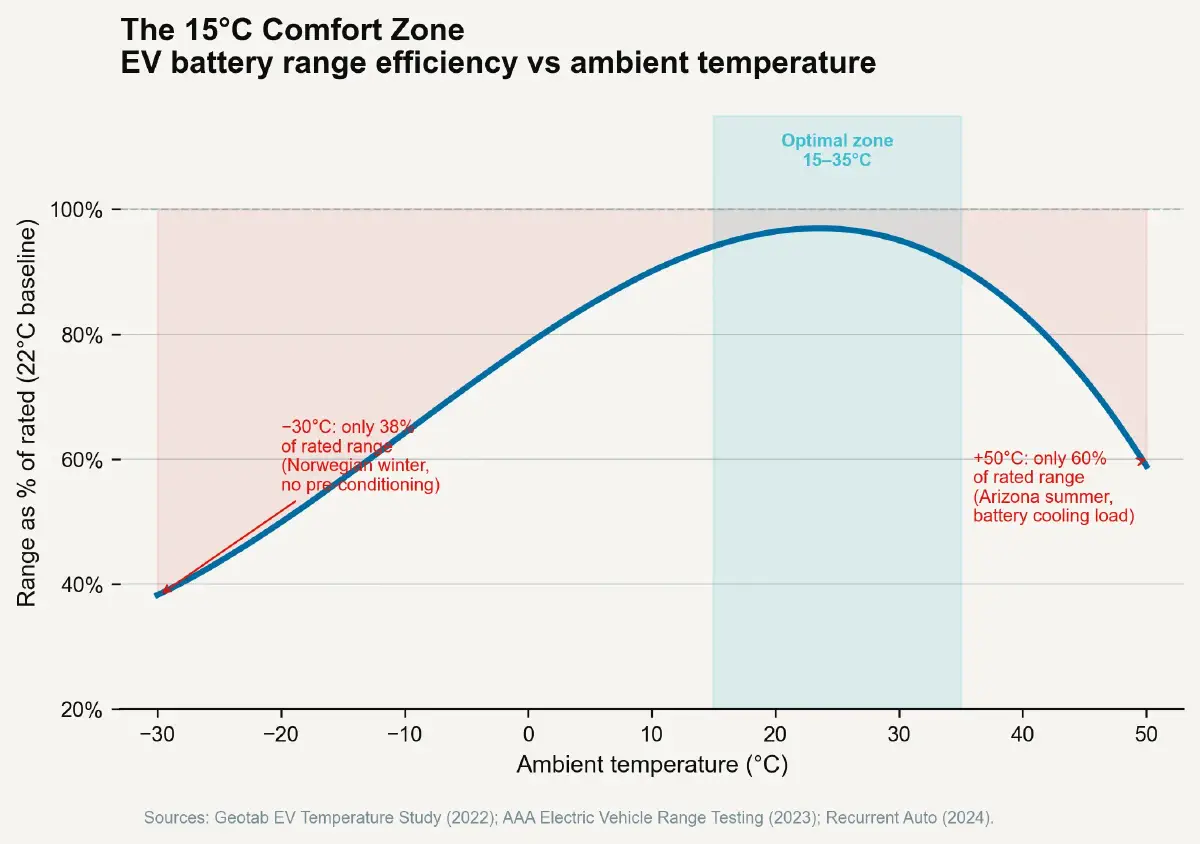
In the summer of 2021, a Tesla Model S owner in Phoenix, Arizona, posted a charge log showing a predicted range of 217 miles from a full charge under 109°F ambient conditions — compared with the EPA-rated 405 miles for the same vehicle under standardised testing conditions. The vehicle was not malfunctioning. The battery management system was operating exactly as designed: it had reduced the usable state of charge range, limited the peak charge rate, and activated the thermal management system to draw air conditioning capacity away from the cabin and toward the battery pack. Each of these responses was a correct engineering decision. Together they produced a range figure that was 46% below the number printed on the window sticker.
The Model S battery pack had not failed. It had encountered the fundamental electrochemical reality that governs every lithium-ion cell ever manufactured: battery performance, longevity, and safety are narrow functions of temperature, and the window within which all three parameters remain acceptable is surprisingly small. The lithium-ion revolution in portable electronics, electric vehicles, and grid storage is, at its core, an exercise in thermal containment.
The Temperature Coefficient Is the Product#
An electric vehicle's battery is not a passive energy reservoir in the way a fuel tank is. It is an active electrochemical system whose round-trip energy efficiency, charge acceptance rate, discharge rate, and long-term calendar degradation are all strong functions of temperature. The dominant constraint on range the EV owner experiences on any given day is not the battery's stated energy capacity — it is the thermal management system's ability to keep that capacity within an operational temperature band that, in practical terms, spans roughly 20 degrees Celsius. Outside that window, the engineering is handling a thermal problem. The Thermal Density Ratio measures the cost of that handling: for every watt of battery capacity maintained within the window, there is an infrastructure cost in mass, power, and component complexity that travels with the vehicle permanently.
Inside the Electrochemistry of Temperature#
Why Battery Cells Are Temperature-Sensitive by Design#
The lithium-ion cell operates through the reversible insertion and extraction of lithium ions between an anode (typically graphite) and a cathode (typically a lithium metal oxide compound — NMC, LFP, or NCA depending on application). The movement of ions is governed by diffusion kinetics, and diffusion kinetics obey Arrhenius temperature dependence: every 10°C increase in temperature roughly doubles the reaction rate. This is advantageous up to a point — higher temperatures improve charge acceptance, reduce internal resistance, and increase peak power output. It is catastrophically disadvantageous above approximately 40°C for consistent operation, because elevated temperature accelerates electrolyte decomposition, promotes lithium plating at the anode, and accelerates the growth of the solid-electrolyte interphase (SEI) layer that consumes cyclable lithium and degrades long-term capacity.
The empirically observed capacity fade rate above 40°C averages approximately 2% of total capacity per degree Celsius per defined cycle count, varying with chemistry and exact cell design. At 55°C — a temperature that a dark-coloured EV pack, exposed to summer sun on parked asphalt in Orlando or Phoenix, can reach without active cooling — calendar degradation rates run 3–5 times higher than at the 25°C reference temperature used in manufacturer lifetime specifications. A vehicle whose lifetime is rated at 70% retained capacity after 150,000 miles under standard conditions may reach that threshold at 100,000 miles if it routinely parks in direct sun in high-ambient-temperature climates without active thermal management during parking.
At the cold end of the performance curve, the mechanisms are different but the consequences are equally significant. Below approximately 10°C, electrolyte ion conductivity drops substantially, and below 0°C the viscosity of liquid electrolytes increases enough to reduce charge acceptance dramatically. The most damaging failure mode at low temperature is lithium plating during fast charging: if lithium ions cannot insert into the graphite anode fast enough — because low temperature has slowed diffusion kinetics — they deposit as metallic lithium on the anode surface. Metallic lithium is not reversibly cyclable, and lithium dendrites can grow across the cell separator, creating an internal short circuit. This is the mechanism behind the category of battery failures triggered by cold-weather fast charging. It is why every major EV manufacturer has implemented fast-charge lockouts at low state-of-charge and low temperature — and why these lockouts generate user complaints every winter.
The Thermal Management System Engineering Trade-off#
The Thermal Management System (TMS) in an EV battery pack is one of the most mechanically complex subsystems in the vehicle. A fully specified active TMS for a large-format battery pack typically consists of a closed refrigerant circuit coupled to the main air-conditioning compressor, a liquid cooling plate or array of cooling channels interwoven through the module structure, a chilled water loop, resistive heating elements distributed through the pack, and an electronic control system that monitors individual cell string temperatures through dozens to hundreds of thermistor channels and adjusts coolant flow, compressor speed, and heater output in real time.
The mass penalty for this system is substantial. A production active TMS for a 75–100 kWh battery pack typically adds 25–45 kg to pack mass, depending on the extent of integrated cooling hardware. The power draw of the TMS under extreme thermal conditions — active cooling in summer, active preheating in winter — can represent 3–8% of pack capacity per hour of operation, directly reducing driving range. In a Phoenix summer, the combination of reduced usable state of charge (the battery management system protects the upper and lower thermal SOC margins) and active cooling power draw can reduce effective range by 25–35% relative to the EPA rating. In a Norwegian winter, resistive heating of the pack to bring it to operational temperature before departure, combined with increased internal resistance reducing peak discharge capacity, can reduce range by 30–40%.
The alternative to an active TMS — passive thermal management using conductive foam, phase-change materials, or simple thermal mass without an active heat exchange circuit — is used in some lower-cost applications and in the LFP-chemistry packs of entry market EVs, where the chemical stability advantage of LFP at elevated temperatures permits somewhat relaxed thermal management. Passive TMS is adequate for moderate climates operating within a narrower SOC window. It is not adequate for vehicles facing the combination of high ambient temperature and fast-charging demands simultaneously.
Real-World Consequences Across Climates#
The thermal management challenge bifurcates across the global EV deployment map into two distinct engineering regimes. Hot-climate deployment — the US Sun Belt, the Middle East, South and Southeast Asia, sub-Saharan Africa — faces the degradation and cooling-power-draw problem. Cold-climate deployment — Northern Europe, Canada, northern China, Alaska — faces the lithium plating, range reduction, and fast-charging limitation problem. The same vehicle, with identical pack chemistry and TMS calibration, will behave fundamentally differently across these regimes — a fact that is rarely communicated clearly in EV marketing or mainstream consumer journalism.
The TDR implications are significant. Every joule of cooling capacity added to a production EV battery pack to extend its operating window into challenging climates adds mass, cost, and power draw — and those additions must be justified against the use-case distribution of actual purchasers. A TMS designed for Phoenix performance will be oversized for a fleet predominantly operating in Seattle. A TMS calibrated for Nordic winters will be running its heating elements continuously for months in ways that its duty cycle assumptions may not fully account for. The engineering compromise is a TMS designed for a global deployment of heterogeneous climates, calibrated against duty cycles that aggregate wildly different use patterns into a single design point.
The Window Is Not Getting Wider#
Advances in battery chemistry offer some thermal performance improvements at the margins. Solid-state electrolytes, which replace the flammable liquid organic electrolyte with a solid ceramic or polymer conductor, are expected to improve thermal stability at elevated temperatures and reduce or eliminate the cold-weather lithium plating risk. Commercial solid-state cells at the volumetric energy density and price point required for automotive deployment are not yet in production, though Toyota, Samsung SDI, and QuantumScape have published roadmaps targeting the late 2020s.
Within the liquid electrolyte cell paradigm that dominates current production, the thermal window is a hard constraint. The electrochemical fundamentals — Arrhenius kinetics, SEI growth thermodynamics, lithium plating thresholds — are not engineering design choices that can be optimised away. They are physical properties of the materials. The battery industry is not managing a parameter that can be designed out; it is managing a constant that must be accommodated.
The commercial implication is that TMS mass, cost, and power draw will be permanent features of EV design for the duration of the current cell chemistry paradigm. The constraint is not a manufacturing defect or a technology gap waiting to be closed — it is the thermal window of the electrochemistry itself. The TDR for battery-dependent systems reflects a fundamental trade-off between energy density and thermal stability that does not have an obvious engineering resolution within the current materials set. The next post travels to an extreme version of this constraint: the jet engine turbine, where the material operates permanently above its own melting point, sustained only by the cooling architecture built into the blade itself.