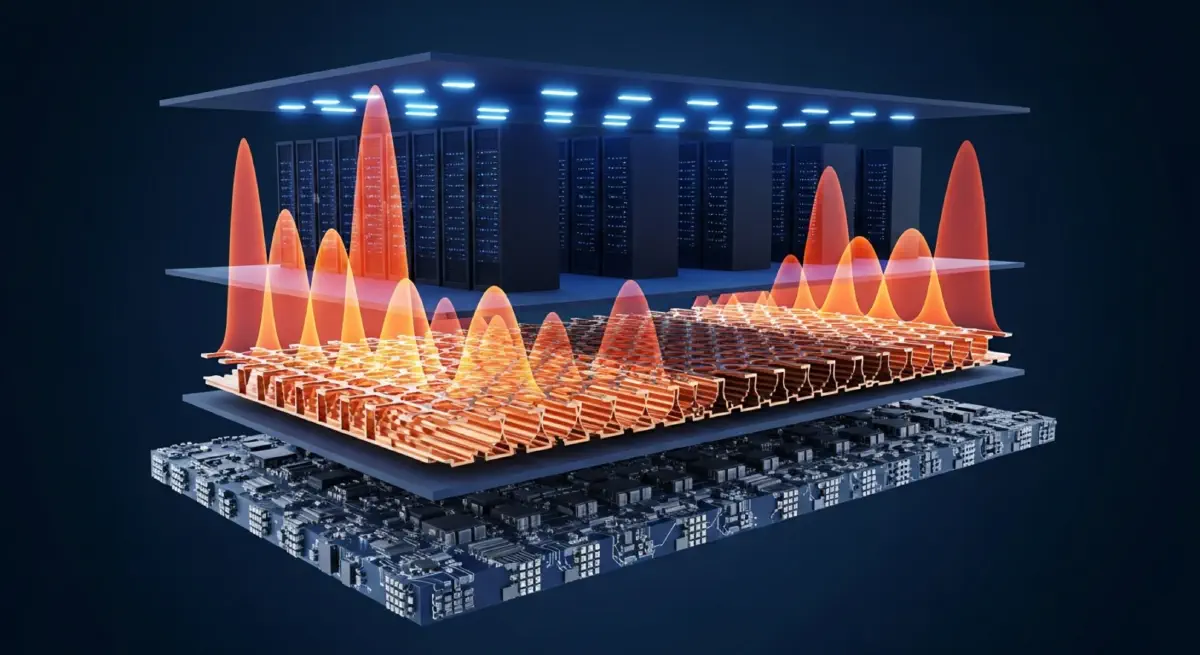
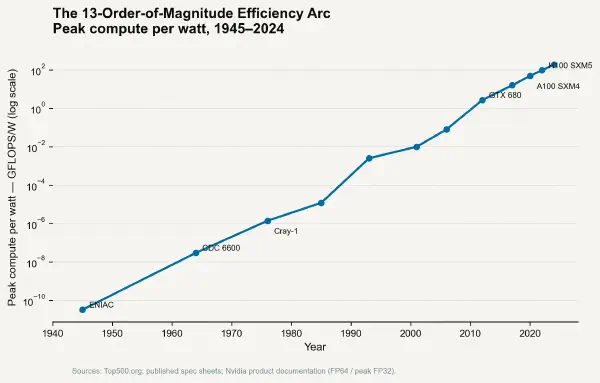
The Thermal Density Ratio (TDR = peak heat flux (W/cm²) ÷ cooling infrastructure cost per watt dissipated) reveals that Moore's Law is not fundamentally a transistor law — it is a thermal management law; every successful doubling of transistor density in the semiconductor roadmap required a commensurate improvement in heat extraction capacity, and when cooling innovation slowed after 2005, single-core clock speeds plateaued simultaneously.
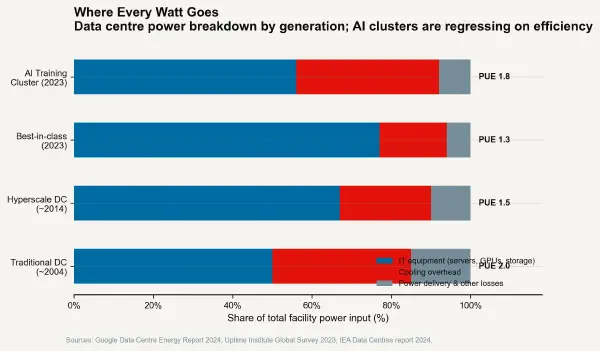
Modern AI GPU clusters operate at heat flux densities of approximately 100 W/cm² — comparable to nuclear reactor fuel rod surface flux — requiring liquid cooling infrastructure that now represents 40–50% of total data center capital expenditure for hyperscale AI facilities; the energy cost of cooling rivals the energy cost of computation.
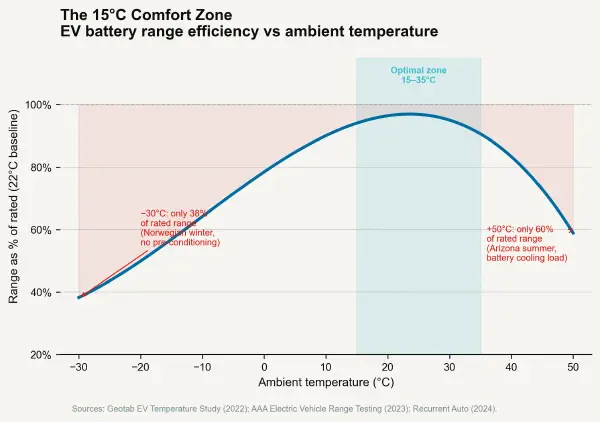
The lithium-ion battery cell operates at peak electrochemical efficiency within a thermal window of approximately 15–35°C; outside this window, capacity fade accelerates at a rate of approximately 2% per degree Celsius above 40°C and internal resistance rises sharply below 0°C, meaning the thermal management system of an EV battery pack is as critical to long-term range as the chemistry of the cell itself.
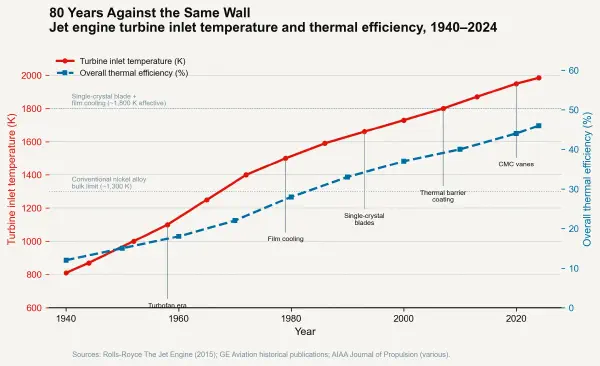
The turbine inlet temperature (TIT) of a civil aviation gas turbine has risen from approximately 1,100K in early 1950s engines to approximately 1,950K in current LEAP and GEnx engines — sustained only by single-crystal nickel superalloy blades with internal cooling channels machined to tolerances of ±50 micrometres and thermal barrier coatings 100–200 micrometres thick; this 850K increase is responsible for the majority of aviation fuel efficiency improvements across eight decades.
Every major technological system that has hit a scaling plateau in the modern era — semiconductor clock speeds (2005), aviation fuel efficiency improvement rates (ongoing), EV fast-charging speeds, and AI training throughput per watt — has done so at a thermal boundary, not a design boundary; the engineering discipline of thermal management is the invisible governor of technological progress.
Bergman, T. L., Lavine, A. S., Incropera, F. P., & Dewitt, D. P. (2011). Fundamentals of heat and mass transfer (7th ed.). Wiley.
Garimella, S. V., Fleischer, A. S., Murthy, J. Y., Keshavarzi, A., Prasher, R., Patel, C., Bhavnani, S. H., Venkatasubramanian, R., Mahajan, R., Joshi, Y., Sammakia, B., Myers, B. A., Chorosinsky, L., Mroczka, B., Sherwood, G., & Schmidt, R. (2008). Thermal challenges in next-generation electronic systems. IEEE Transactions on Components and Packaging Technologies, 31(4), 801–815. https://doi.org/10.1109/TCAPT.2008.2001197
Patterson, D. A., & Hennessy, J. L. (2021). Computer organization and design: ARM edition (2nd ed.). Morgan Kaufmann.
Bandhauer, T. M., Garimella, S., & Fuller, T. F. (2011). A critical review of thermal issues in lithium-ion batteries. Journal of the Electrochemical Society, 158(3), R1–R25. https://doi.org/10.1149/1.3515880
Reed, J. (2023). AI data centers and energy consumption. Lawrence Berkeley National Laboratory.
Rolls-Royce Holdings. (2022). Technology and innovation: Turbine temperature history [Internal engineering briefing, published in annual report supplementary materials]. Rolls-Royce.
Pollock, T. M., & Tin, S. (2006). Nickel-based superalloys for advanced turbine engines: Chemistry, microstructure, and properties. Journal of Propulsion and Power, 22(2), 361–374. https://doi.org/10.2514/1.18239
Keshavarzi, A., & De, V. (2001). Challenges and design opportunities for nanoscale subthreshold and near-threshold operation. IEEE Micro, 30(4), 9–17.
Moore, G. E. (1965). Cramming more components onto integrated circuits. Electronics, 38(8), 114–117.
Dennard, R. H., Gaensslen, F. H., Yu, H.-N., Rideout, V. L., Bassous, E., & LeBlanc, A. R. (1974). Design of ion-implanted MOSFETs with very small physical dimensions. IEEE Journal of Solid-State Circuits, 9(5), 256–268. https://doi.org/10.1109/JSSC.1974.1050511
Traces 80 years of jet engine efficiency improvement, showing that every breakthrough circles back to the same constraint: turbine inlet temperature versus the thermal limits of available materials.
Examines the 15°C comfort zone of lithium-ion battery operation and what happens at thermal margins — in the Arizona summer and the Norwegian winter — for EV range performance.
Applies cooling constraint analysis to AI data centre scaling, showing that the binding limit on trillion-dollar compute ambitions is not lithography chemistry or chip economics but the physics of cooling a building-sized computer.
Traces how heat extraction became the true pacemaker of the computing revolution — from vacuum tube thermal envelopes to the thermal ceiling of modern nanometre-scale silicon.