Key Insights#
- The efficiency of the quadruple expansion engine relied on four progressively larger cylinders that extracted work from steam at decreasing pressure levels.
- The ship functioned as a closed hydrological circuit, utilizing condensers to recycle limited freshwater supplies for the boilers throughout the 3,000-mile Atlantic journey.
- Structural stability in heavy seas was managed through a double-bottom hull design that allowed for the dynamic adjustment of water ballast to offset the weight of consumed coal.
- Navigation in a steel-hulled vessel required complex magnetic calibration via soft iron spheres and permanent magnets to counteract the ship’s own magnetic field.
- The social stratification of the vessel was dictated by mechanical noise and vibration, with premium accommodations located at the ship’s center to minimize the effects of the propellers and rudder.
- Communication and command distribution were facilitated by a “steam plumbing” network that snaked through the ship, powering auxiliary systems from cargo winches to steering motors.
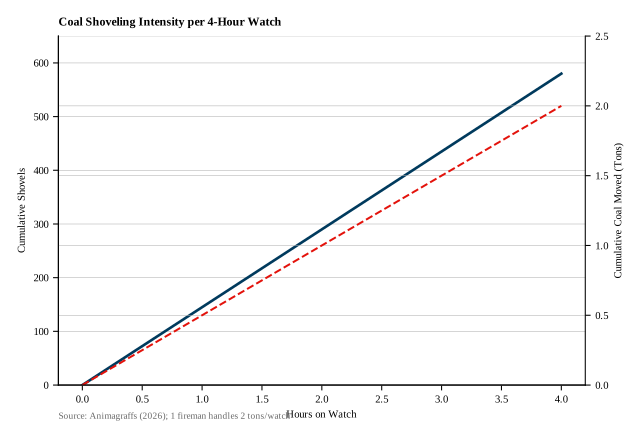
In a four-hour watch, a single fireman aboard an early 20th-century steamship would manually heave approximately two tons of coal into a boiler furnace, a task requiring exactly 580 rhythmic shovels to maintain the vessel’s momentum. This grueling human labor was not merely a primitive requirement but a precisely timed metabolic input for a 500-foot steel organism that would otherwise become a drifting, powerless island in the mid-Atlantic. The tension between this manual exertion and the ship’s sophisticated engineering defines the era of the industrial workhorse.
Riveted steel construction provided structural flexibility before the advent of welding#
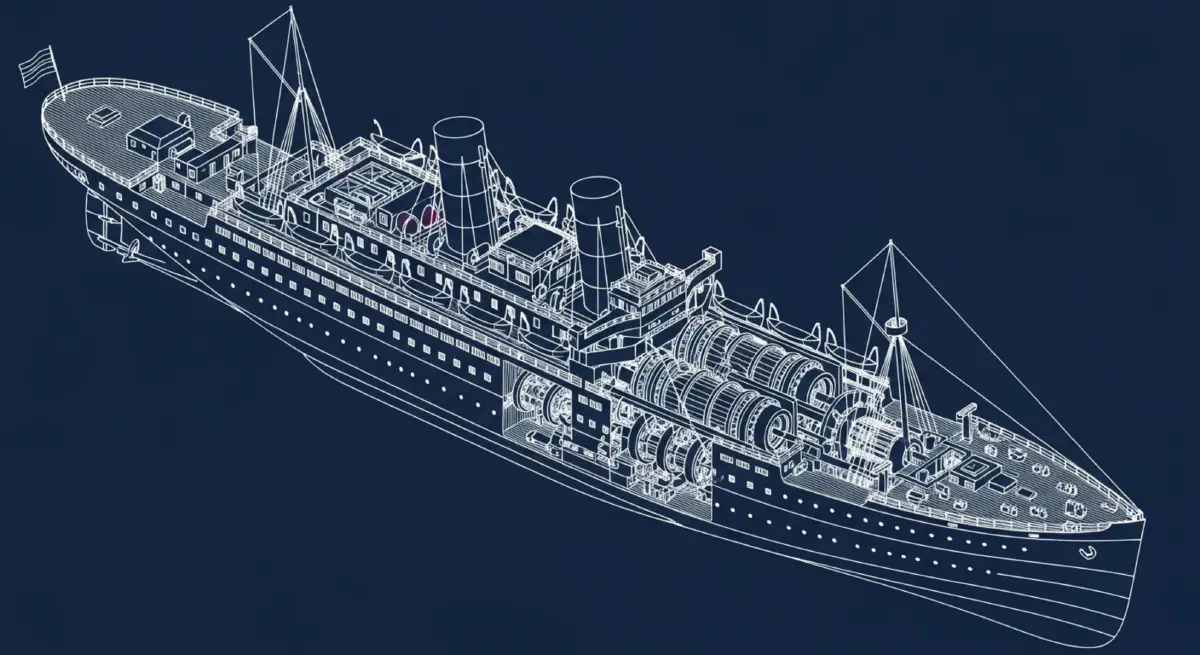
The skeleton of the ship is built from steel plates riveted together into beams and frames, as metal welding remained an experimental and unproven technology during this period. Even the main outer shell, or hull, consists of alternating riveted rows of steel plating known as strakes, which cover every contour from the bow to the complex propeller shaft supports at the stern. This modular assembly allowed the ship to absorb the immense stresses of ocean travel, though it necessitated a massive workforce of riveters during construction. The reliance on discrete plates generated a structural paradox where the ship was a single unit composed of thousands of individual points of failure.
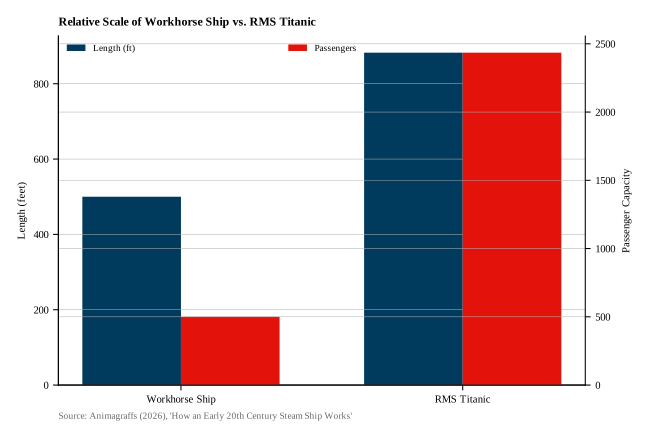
Figure 1 displays a dual-axis bar chart comparing the physical and logistical dimensions of the workhorse steamship against the RMS Titanic. The primary axis measures length in feet, highlighting the 500-foot workhorse’s significant scale relative to the 882.5-foot luxury liner, while the secondary axis tracks passenger capacity. This relationship is linear yet distinct; while the workhorse is roughly 56% the length of the Titanic, it carries only about 20% of the passengers, emphasizing its primary role as a cargo-heavy transport vessel. This comparison anchors the argument that efficiency in this class of ship was prioritized over the density and luxury of the “regal” liners.
Magnetic navigation required complex calibration to overcome the ship’s own metal mass#
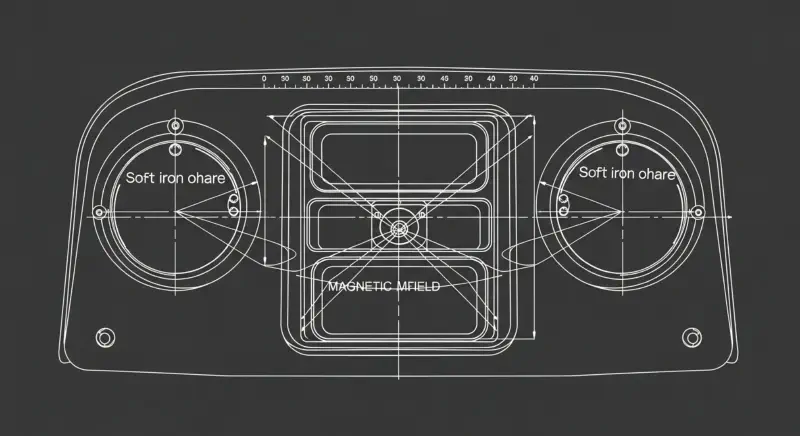
As ships transitioned from wood to metal, the massive quantity of steel began to interact with the Earth’s magnetic field, rendering standard magnetic compasses inaccurate. To solve this, the binnacle—the pedestal housing the compass—was equipped with soft iron spheres and permanent magnets on movable trays to tune the magnetic forces and allow the needle to point to magnetic north. These compensators accounted for permanent magnetism induced during the ship’s construction and the changing magnetic influence as the vessel moved across the equator. This requirement for constant calibration highlights the shift from intuitive seafaring to a technologically mediated discipline where every instrument had to account for the vessel’s own interference.
The fiddley acted as the central respiratory system for the ship’s coal-fired metabolism#
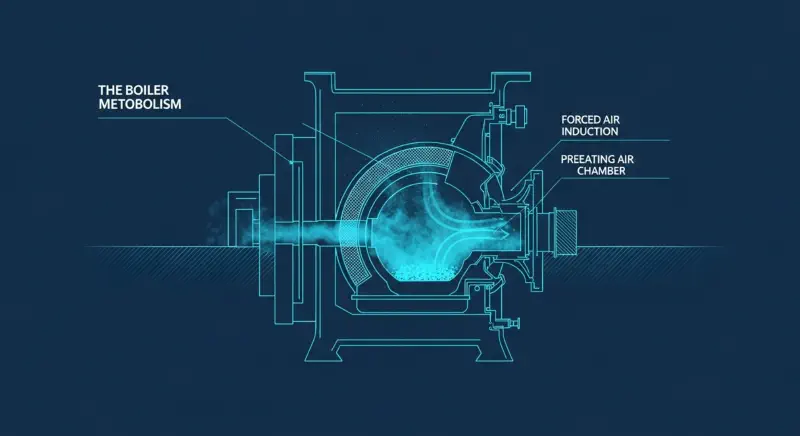
Deep in the belly of the boat, six coal-burning boilers generate the steam necessary for propulsion, but their operation depends entirely on a vertical passage called the fiddley. The fiddley extends from the boiler room floor to the top of the ship, providing crucial ventilation and allowing natural light to filter down into an otherwise dark and austere environment. This shaft also served a structural purpose, as the massive boilers and engines were actually lowered into the heart of the vessel through this opening during construction. The efficiency of the boilers was further enhanced by a forced induction system where steam-driven fans pushed fresh air through preheated tubes, effectively supercharging the furnaces.
Quadruple expansion engines maximized work through staged pressure reduction#
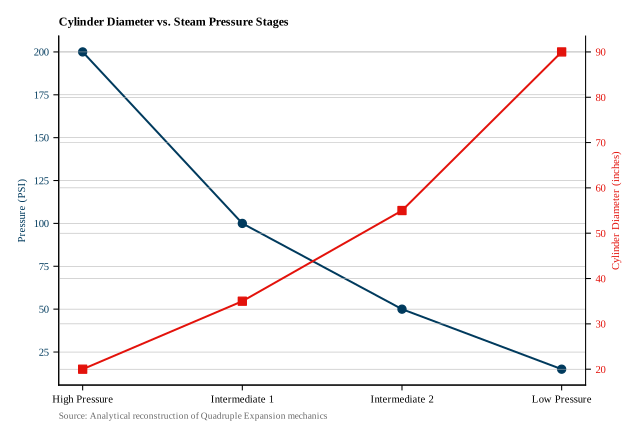
Propulsion is generated by two huge steam engines that output 4,000 horsepower each, utilizing a process known as quadruple expansion to extract maximum energy from the steam. Instead of exhausting steam after a single stroke, the engine passes it through four progressively larger cylinders: one high-pressure, two intermediate, and one low-pressure unit. Because steam expands as its pressure drops, the cylinders are sized to provide the same pushing force regardless of the varying pressure levels, preventing the explosive forces of fresh boiler steam from shattering smaller parts. This staging transformed the engine from a simple pump into a sophisticated thermodynamic harvester.
Figure 2 illustrates the inverse relationship between steam pressure and mechanical surface area within a quadruple expansion engine. As steam progresses through the four expansion stages (High Pressure to Low Pressure), the pressure drops from 200 PSI to near-atmospheric levels, while the cylinder diameter must increase significantly to maintain a constant output force. This monotonic relationship demonstrates the thermodynamic necessity of the engine’s tiered design, proving the post’s claim that staged expansion was the only way to harness the energy of highly compressed boiler steam without mechanical failure.
A closed hydrological loop prevented the buildup of salt in high-pressure systems#
Fresh water is a finite and precious resource on a 3,000-mile journey, as ocean salt water cannot be used in sensitive high-pressure boilers without causing catastrophic damage. To conserve every drop, exhaust steam from the engines flows into a condenser, where cold ocean water is pumped through small tubes to cool the steam back into liquid water. This process creates a powerful suction that pulls steam through the engine, increasing its overall efficiency before the water is filtered for lubricating oil and reheated for re-entry into the boilers. The water cycle represents a masterful example of resource management, where waste heat is recaptured to prevent thermal shock to the boiler plates.
Social hierarchy was geographically mapped to the ship’s mechanical stressors#
The interior layout of the ship was not merely a matter of luxury but a response to the physical realities of steam propulsion. First-class cabins and social areas were situated near the center of the ship where the ride was smoothest and the noise from the engines was most muffled. In contrast, the steerage or third-class accommodations were located at the very back of the ship, directly over the noisy steering components and the vibration of the propellers. This spatial arrangement reinforced social divisions by assigning the most physically taxing environments to those with the least economic power, effectively making the ship’s mechanical output a social determinant.
Figure 3 visualizes the physical demands of maintaining a ship’s metabolism through a line graph of coal consumption over a single four-hour watch. The chart tracks cumulative shovels on the primary axis and total tonnage on the secondary axis, showing a steady, non-stochastic workload of 145 shovels per hour. This visualization reinforces the hook’s assertion that the ship’s motive power was inextricably linked to precise human intervals. The graph quantifies the “metabolic input” required to sustain the 8,000-horsepower output of the engines, providing an empirical basis for the discussion of the fireman’s role in the thermodynamic circuit.
Steam-driven auxiliary systems formed a ship-wide nervous system#
The reach of steam power extended far beyond the main engines, powering a “nervous system” of plumbing that operated winches, whistles, and steering motors. At the back of the ship, a steam-powered steering engine assisted the rudder, using a telemotor setup filled with water and glycerin to transmit commands from the wheelhouse without freezing. Cargo handling also relied on this network, with steam winches using galvanized steel cables and rotating drums to lift crates, bales, and barrels into the nine cargo hatches. This pervasive reliance on steam meant that even the ship’s most minor functions were tied to the central metabolism of the boiler room.
Conclusion#
The early 20th-century steamship was a monument to the integration of human labor and thermodynamic precision, where the reuse of every calorie and every drop of water was the only path to crossing an ocean. This era of engineering proves that the most enduring systems are those that find efficiency not in the abundance of resources, but in the exhaustive exploitation of their own waste.