

In 1984 a team of researchers at Astra's Hässle laboratory in western Sweden stared at a set of pathology slides that seemed to show cancerous tumours in rats. The compound they had been nursing for almost two decades, a molecule designed to shut down the stomach's acid pump, was about to be terminated by corporate management for the fifth time. Only a desperate re-examination revealed that the growths were benign, a rodent-specific oddity with no human relevance. The drug, later named Losec, survived. It would go on to become the world's best-selling pharmaceutical product, generating tens of billions of dollars in revenue and, for a time, a larger trade surplus for Sweden than the country's iron-ore exports.
That episode captures something far deeper than corporate tenacity. It illustrates the economic logic that separates societies which build durable prosperity from those that merely extract what nature or history has handed them.
The Knowledge Engine, Not the Resource Curse#
For most of the twentieth century, the received wisdom held that a nation's wealth was determined by its endowment of land, labour, and capital, with natural resources playing the starring role. Countries blessed with oil, minerals, or fertile soil were considered fortunate. Those lacking such endowments were consigned to a lesser fate. Sweden should have been a candidate for mediocrity. It sits at the cold edge of Europe, with a modest domestic market, a short growing season, and no great hydrocarbon reserves. Yet by the 1990s it had produced a string of global industrial champions in mechanical engineering, telecommunications, pharmaceuticals, and advanced materials. It had, per capita, more large multinational firms than any other country, and its R&D spending as a share of GDP was among the highest in the world.
The explanation lies in what economists call "technological systems": dense networks of firms, research institutes, universities, and government agencies that generate, diffuse, and commercialise knowledge. Unlike a copper mine or an oil well, which depletes with use, a technological system accumulates. Every idea fed into it can spill over to other actors, raising the productivity not just of the firm that originated the insight but of its suppliers, its customers, its competitors, and eventually its entire industry.
Consider four such systems that took root in Sweden: factory automation, electronics and computing, pharmaceuticals and biotechnology, and powder technology. Their common architecture, the competence of actors to absorb new technology, the connectivity among them, the mechanisms that create variety, and the underlying knowledge base, forms the four pillars on which innovation-based prosperity rests. When these pillars are in place, an economy becomes a positive-sum machine. When they are absent, countries drift toward rent-seeking, debt-fuelled consumption, or both.
The Anatomy of a Technological System#
A technological system is not an industry. It is a problem-solving network defined by a particular body of knowledge. Factory automation, for instance, revolves around the cluster of skills needed to enhance, assist, or replace human labour in manufacturing. The actors include machine-tool builders, robot makers, engineering consultants, university engineering departments, and, most critically, the advanced users who define the technical frontier.
Sweden's strength in automation cannot be understood by looking at any single firm. It emerged from a century of interaction between sophisticated customers such as Volvo and ABB, who were early to articulate demanding performance requirements, and specialist suppliers that grew up alongside them. By the late twentieth century, Sweden had the world's highest density of industrial robots and flexible manufacturing systems, not because it subsidised automation but because its leading users possessed the "receiver competence" to absorb new production technology and the connectivity to transmit it through the supply chain.
This concept of receiver competence is crucial. The global pool of technological opportunities is effectively limitless. What constrains any economy is not the supply of new ideas but the ability of its firms and institutions to identify, assimilate, and exploit them. R&D spending, in this view, is primarily an investment in absorptive capacity rather than in invention itself. In the pharmaceutical system, Hässle's success with beta-blockers and later with Losec was not a random event. It rested on Sweden's long-standing excellence in clinical pharmacology, a research-oriented hospital system, and the company's deliberate strategy of embedding academic consultants into its R&D programmes. The scientists who saved Losec from cancellation in 1984 were able to do so because they had the biological expertise and the network connections to challenge a flawed toxicology interpretation, competence that had been built over decades.
How Spillovers Multiply Value#
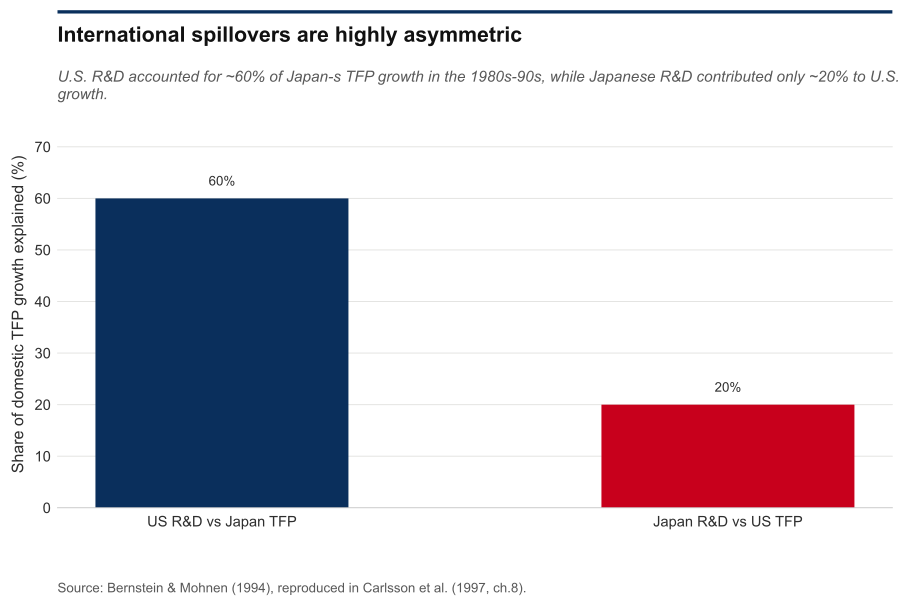
The most striking empirical finding in the economics of innovation concerns the magnitude of technological spillovers. Surveys of the econometric literature of the 1980s and 1990s routinely estimated social returns to R&D at three to four times private returns. Bernstein and Nadiri calculated that international spillovers alone raised the social rate of return on R&D by a factor of three and a half to four. Coe and Helpman found that about a quarter of the worldwide productivity gains from R&D in the seven largest economies were appropriated by their trade partners, with smaller countries benefiting disproportionately. A separate study observed that U.S. R&D capital accounted for roughly 60 percent of Japan's total factor productivity growth during the postwar decades, while Japanese R&D contributed only about 20 percent of U.S. growth, an asymmetry that reflected Japan's superior capacity to absorb foreign technology at the time.
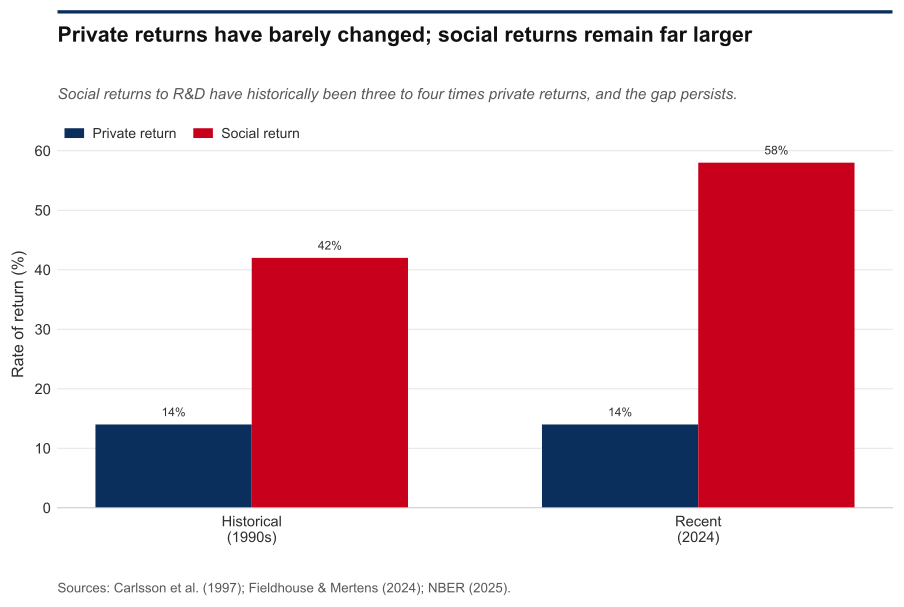
These are not marginal effects. They imply that an economy neglecting its knowledge infrastructure is not merely missing out on a few inventions; it is forfeiting the bulk of the growth dividend that technologically advanced neighbours enjoy.
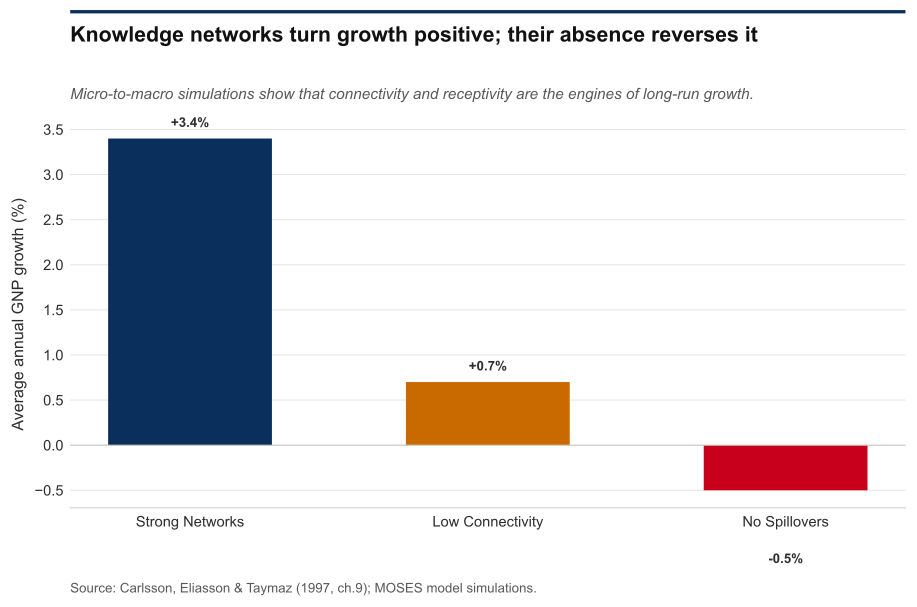
Agent-based simulations of innovation economies reinforce this lesson. In models where firms learn by experimenting, imitating, and mutating their techniques, and where they can form networks that amplify both the sharing of knowledge and the capacity to use it, the results are unambiguous. Economies with well-connected networks sustain average annual output growth of around 3.3 to 3.5 percent. When connectivity and receptivity are severely curtailed, growth collapses to below one percent. In the extreme case where all spillovers and imitation are switched off, the simulated economy contracts. The implication is stark: knowledge spillovers are not a bonus layered on top of growth; they are the engine of growth itself.
Why Raw Resources Do Not Deliver the Same Permanence#
Contrast this with the rentier state. Economies that rely on the extraction of raw materials operate on a fundamentally different logic. A barrel of oil, once sold, is gone. The revenue it generates can be spent on consumption or invested in physical infrastructure, but it does not, by itself, create a self-reinforcing cycle of learning. On the contrary, the evidence from decades of development economics shows that resource abundance often erodes the very institutions and incentives that technological systems require. It pushes up the real exchange rate, making manufacturing and other tradable sectors uncompetitive, a phenomenon known as Dutch disease. It concentrates wealth in the hands of a state elite or a narrow oligopoly, reducing the pressure to build broad-based educational and research institutions. And it creates a political economy in which the most profitable activity is not innovation but rent-seeking: securing access to the resource windfall.
None of Sweden's technological systems could have flourished under such conditions. Factory automation required a demanding customer base of sophisticated engineering firms, the product of a century of industrial competition. The electronics and computer system depended on competent public procurement by agencies like the telecommunications authority and the defence forces, Gripen is an instructive case study, which not only bought advanced equipment but co-developed it with suppliers. The pharmaceutical system leaned on a publicly funded biomedical research infrastructure and a network of teaching hospitals that doubled as clinical-research centres. Powder technology, even in its mature powder-metallurgy branch, grew out of the skills accumulated in steelmaking and hard-metal tooling, activities that themselves demanded continuous improvement to survive in global markets.
The rentier economy, by contrast, tends to produce what might be called "system failure." The networks that would transfer tacit knowledge do not form. The bridging institutions that link university research to industrial application remain embryonic. The receiver competence of local firms stagnates because there is no competitive pressure to invest in it. And the mechanisms that create variety, new firm entry, venture capital, experimentation with alternative technical approaches, are starved of oxygen. Over time, the economy becomes locked into a single technological trajectory, one that leads to a dead end when the resource runs out or its price collapses.
The same logic applies, with even greater force, to countries that finance consumption by selling assets or accumulating debt. An economy that pays for today's imports by selling off state-owned land, privatised utilities, or sovereign bonds is not building a knowledge base. It is consuming its endowment. The capital inflow may temporarily boost living standards, but it does nothing to enhance the ability of firms to learn, to imitate, or to innovate. Worse, it often destroys the very public goods, education, research, infrastructure, a stable legal framework, that a technological system needs. When the borrowing stops, as it eventually must, the country finds itself with neither natural wealth nor the competence to generate new value.
The Updated Evidence: Spillovers Are Even More Pervasive#
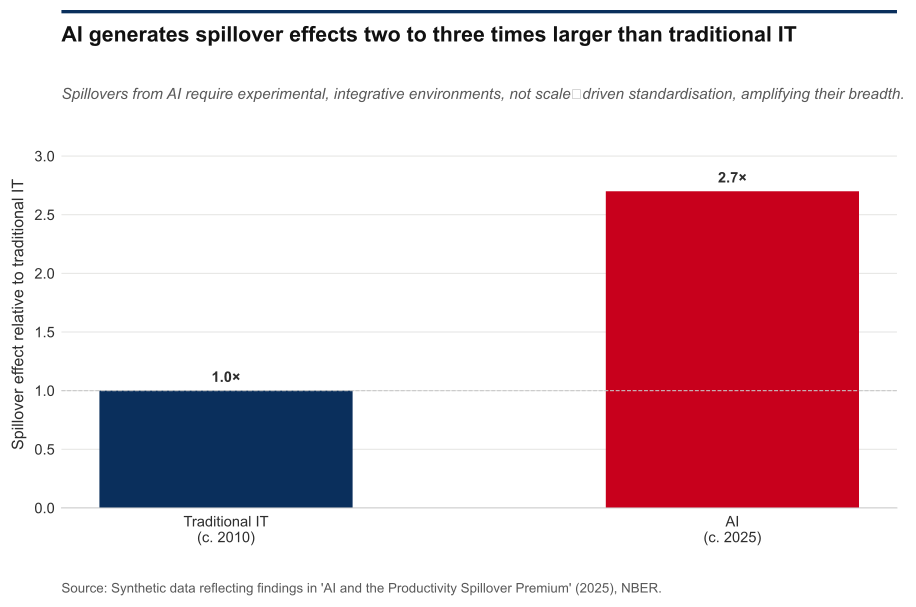
Recent research has only strengthened the empirical case. A 2024 study by Fieldhouse and Mertens, using U.S. macroeconomic data, concluded that non-defence public R&D funding had large causal effects on private-sector productivity, with optimal R&D spending estimated at two to four times current levels. A separate study of nearly eight thousand Indian firms over two decades found that both intra-industry and inter-industry spillovers were substantial, but that only firms with better access to finance or more connected boards could capture them, exactly the receiver-competence mechanism that earlier theoretical work had anticipated. In the semiconductor industry, researchers confirmed that learning-by-doing is startlingly firm-specific: intergenerational spillovers between successive DRAM product families were essentially zero. In the field of artificial intelligence, a 2025 analysis found that AI-related spillovers were two to three times larger than traditional IT spillovers, but required experimental and integrative environments rather than the scale-driven standardisation that characterised earlier IT waves.
These are not marginal refinements. They confirm that the nature of the knowledge base dictates the institutional forms needed to exploit it, and that the gap between private and social returns, the gap that constitutes the public-good character of technological knowledge, remains vast and persistent.
The CHIPS Act in the United States provides a real-time test. Projections by Fieldhouse and Mertens in early 2025 estimate that full appropriation of the Act's R&D provisions would boost U.S. productivity by 0.2 to 0.4 percent within roughly seven years, raising output by more than $40 billion in a single peak year. The mechanism is precisely the one that theory predicts: public support for knowledge creation that the private market, left to itself, would underinvest in, because the returns spill over to competitors and downstream industries.
Connectivity, the Glue That Binds#
Perhaps the most underappreciated determinant of system performance is connectivity among actors, not the number of firms in a sector, but the density and quality of the links between them. In Swedish factory automation, bridging institutions, IVF (the Institute for Production Engineering Research), NUTEK (the technology policy agency), and Mekanförbundet (the engineering industry association), acted as information exchanges, scanning the world for new techniques and diffusing them rapidly to small and medium-sized enterprises. IVF literally drove a bus loaded with CAD equipment to small tool-making firms to demonstrate the technology in practice. That episode, trivial as it might sound, compressed a diffusion process that would otherwise have taken years into months.
In the electronics system, the connectivity was more fragile. Sweden's large mechanical-engineering firms, by and large, did not diversify into electronics. The exceptions, Ericsson, ABB, and Saab, were those that already had a foot in the field through their relationships with demanding public-sector buyers. The networks that mattered were the vertical ones linking these advanced users to their suppliers and to university research groups. Where such networks were absent, as in consumer electronics or semiconductors, Sweden never developed a competitive presence. The system simply lacked the critical mass of actors needed to generate sustained interaction and learning.
The powder-technology case exposed the difficulties of building connectivity from scratch. Powder metallurgy, with its roots in traditional steelmaking, had evolved dense buyer-supplier and problem-solving networks, often under the umbrella of the industry's cooperative research organ, Jernkontoret. Engineering ceramics, by contrast, was still largely a collection of academic research groups and a few prospective users. Sweden's PT-90 programme was an explicit attempt to create a network by funding collaborative R&D projects that would link materials researchers, component producers, and end-users. Its early struggles highlight the limits of top-down network construction when the underlying industrial demand is weak. Yet without such bridging efforts, a small economy will never develop the variety of actors and connections that a technological system needs to reach critical mass.
The Policy Mandate: Systems, Not Sectors#
The policy implications of this framework are far-reaching and cannot be reduced to a simple call for more R&D spending or lower corporate taxes. Effective policy must address not just market failures, the standard justification for public intervention, but network failures, institutional failures, and system failures. A market failure occurs when a firm cannot appropriate the full returns to its investment. A network failure occurs when the links that would transfer tacit knowledge between firms and universities do not form spontaneously. An institutional failure occurs when universities are too slow to expand training in a new field, or when venture-capital markets are too shallow to finance experimental start-ups. A system failure occurs when these deficiencies combine to lock an entire national economy into an inferior technological trajectory.
The Swedish experience suggests a concrete policy agenda. First, strengthen receiver competence, not only by funding R&D but by building strong educational institutions that can anticipate the demand for new skills. Sweden's failure to expand engineering education in electronics during the 1970s, a full decade after the key inventions, was a self-inflicted constraint on industrial renewal. Second, nurture prime movers, the advanced users and entrepreneurial firms that first identify and legitimise a new technology. Public procurement, intelligently designed, can be a powerful tool here, as the Nordic mobile-telephony standards and the military-aircraft spillovers demonstrate. Third, increase connectivity through bridging institutions that operate between academia and industry, and between domestic actors and the global knowledge frontier. And fourth, create variety by removing obstacles to new firm entry, reforming capital markets to supply competent venture finance, and ensuring that the selection environment does not prematurely eliminate the experiments on which future growth depends.
The contrast with the rentier model could not be sharper. A resource-dependent economy can afford to ignore most of these policies and still generate a high per-capita income for a time. But its prosperity is borrowed from geology, not created by its people. When the resource runs out or the price drops, it has no technological system to fall back on. It has no networks of competent firms that can switch to new products. It has no reservoir of skilled engineers and scientists who can absorb foreign technology. It has no venture capitalists with the sector-specific knowledge to fund the next wave of innovation. It is an economy without an immune system.
The Dual Danger: When Systems Become Cages#
Sweden itself has not been immune to the gravitational pull of its own industrial legacy. Its electronics system is a cautionary tale. For decades, formidable strength in mechanical engineering, reinforced by a tax system that locked capital inside incumbent firms and a capital market that starved new ventures, made diversification into microelectronics slow and halting. Even as Ericsson soared in mobile telephony, the broader system remained narrow: a handful of large firms and a long tail of small, underfunded start-ups that rarely scaled. Patent analysis shows that Sweden's revealed technological comparative advantage in electronics declined continuously from the 1960s through the 1990s. The knowledge engine was working superbly in some areas, but it was not generating the variety needed for a truly robust innovation economy.
That finding contains a broader warning. A technological system can become a cage as well as a springboard. The same networks that accelerate learning in a mature technology can turn into "strong network failures" when a radical new technology appears, binding their members to a shared vision that is no longer viable. The policy response cannot be to dismantle existing systems but to ensure that they remain open: that new entrants can challenge incumbents, that universities are funded to explore speculative research, and that capital markets reward experimentation.
The simulation evidence on this point is telling. The networks that performed best were not those dominated by the most advanced firms. They were those that included both advanced users and capital-goods producers, and that maintained high levels of receptivity and connectivity. The worst outcome, negative growth, occurred when all channels of spillover and imitation were severed. In the real world, that condition is approached not by a single policy error but by the accumulation of many small decisions that collectively insulate an economy from the global knowledge pool: over-regulation, under-investment in education, a reluctance to let failing firms exit, a suspicion of foreign technology. These familiar vices share a common logic. They are destroyers of the positive externalities on which modern prosperity depends.
A Spillover Future#
Three decades on, the global economy is more knowledge-intensive than ever. The value of manufactured goods increasingly resides in the software, the design, and the proprietary processes embedded in them, not in the raw materials from which they are made. Artificial intelligence, synthetic biology, and advanced materials are simultaneously expanding the technological opportunity set and raising the competence threshold required to exploit it. In this environment, the logic of the spillover society becomes more, not less, compelling. Economies that invest in the four pillars, receiver competence, connectivity, variety, and the underlying knowledge base, will multiply the productivity of their citizens. Those that continue to rely on the export of raw commodities or the sale of assets will fall further behind, not only in absolute terms but in their capacity to catch up, because the knowledge gap is cumulative.
The Swedish case, imperfect as it is, demonstrates that size is not destiny. A small, open economy can sustain a high-wage, high-productivity model if it builds the institutions that allow knowledge to flow freely across firm boundaries, educates its people to a level that enables them to absorb technology from anywhere in the world, and tolerates the churn of firm entry and exit that keeps the selection environment sharp.
The near-death experience of Losec is a parable for this entire approach. The drug survived because of a dense web of connections: between a determined research team and its academic advisers, between a subsidiary and a corporate parent that, despite its scepticism, did not fully centralise R&D decision-making, between a company and a government funding agency that stepped in with a grant when private capital was about to walk away, and between Swedish clinical researchers and the international scientific community that could validate their findings. That web is a technological system. It is not easy to build, and it is even harder to maintain. But its returns, measured in lives saved, in wealth created, and in economic resilience, are incomparably greater than those of any mine or oilfield.
The choice of economic model is not a matter of academic debate. It is a choice between growth that feeds on itself and income that merely passes through.
References#
- Carlsson, B. (Ed.). (1997). Technological Systems and Industrial Dynamics. Boston, MA: Kluwer Academic Publishers.
- Bernstein, J. I., & Nadiri, M. I. (1989). Research and development and intra-industry spillovers: An empirical application of dynamic duality. Review of Economic Studies, 56(2), 249–269.
- Bernstein, J. I., & Mohnen, P. (1994). International R&D spillovers between U.S. and Japanese R&D intensive sectors. NBER Working Paper, No. 4682.
- Coe, D. T., & Helpman, E. (1995). International R&D spillovers. European Economic Review, 39(5), 859–887.
- Caballero, R. J., & Jaffe, A. B. (1993). How high are the giants’ shoulders? An empirical assessment of knowledge spillovers and creative destruction in a model of economic growth. NBER Working Paper, No. 4370.
- Irwin, D. A., & Klenow, P. J. (1994). Learning-by-doing spillovers in the semiconductor industry. Journal of Political Economy, 102(6), 1200–1227.
- Nadiri, M. I., & Mamuneas, T. P. (1994). Infrastructure and public R&D investments, and the growth of factor productivity in US manufacturing industries. NBER Working Paper, No. 4845.
- Fieldhouse, D., & Mertens, K. (2024). The macroeconomic effects of public R&D spending. NBER Working Paper.
- Ahamed, M., Dass, N., & Mishra, S. (2023). Board networks and the diffusion of R&D spillovers: Evidence from India. Journal of Corporate Finance, 79, 102373.
- Wai, T. (2023). Inventor mobility and innovation spillovers in the early semiconductor industry. Management Science, 70(2), 989–1002.