
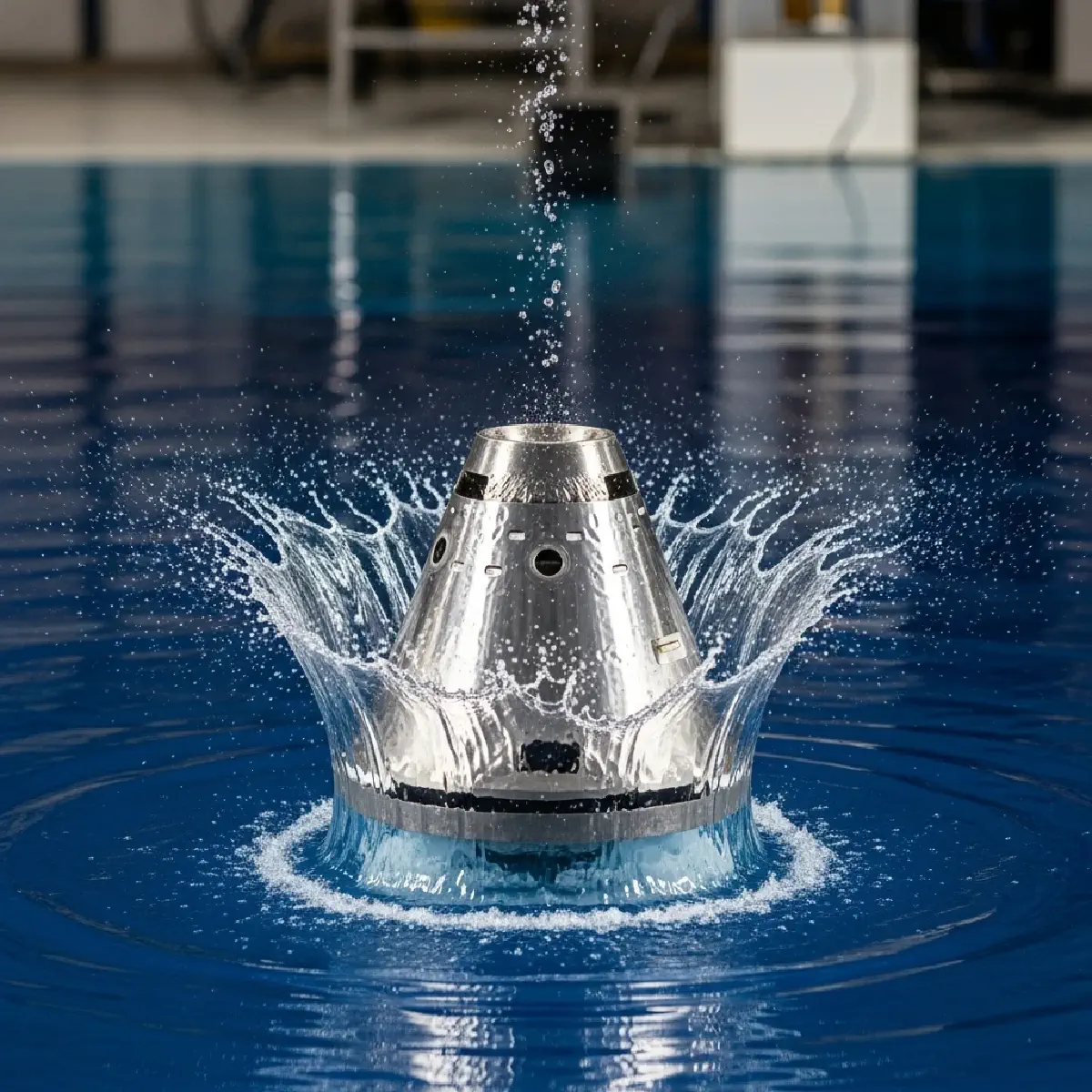
Orion’s Watery Impact#
On August 24, 2016, a test version of the Orion spacecraft crashed into a pool at NASA’s Langley Research Center. This water impact test was not a failure but a critical step in the Product Verification process, providing the objective evidence that the design could withstand the violent loads of an ocean splashdown. Realization is the phase where models and simulations are replaced by hardware that must survive the unforgiving environment of space. It is the movement from the bottom of the product hierarchy upward, where plans and drawings are realized into actual products through buying, making, or reusing.
The Verification-Validation Divide#
NASA makes a fundamental distinction between two evaluation processes: Product Verification and Product Validation. Verification answers the question, “Was the end product realized right?” by proving compliance with specific requirements and specifications. Validation addresses the more profound question, “Was the right end product realized?” by ensuring the system meets the actual expectations of the customer in the intended environment. A product can pass every technical test—meeting its 40,000-pound (18,143.69-kilogram) thrust requirement exactly—and still fail validation if it does not fulfill its mission purpose. Combined, these processes form the crucible that separates a functioning machine from a successful mission.
The Recursive Assembly Loop#
Product realization begins with implementation, where the lowest-level products are created through coding software or fabricating hardware. These products are then integrated into higher-level assemblies, a process that manages the interactions between subsystems and their environment. The systems engineer must be vigilant for adverse emergent behaviors—unanticipated system-level reactions that only appear when components interact. By balancing the functions of these subsystems, the engineer optimizes the total system performance over any single component. This integration continues through the operations phase, bringing together hardware, software, and human operators.
The Pedigree of Heritage Systems#
A significant risk in realization is the over-reliance on “heritage” hardware or software. There is a common tendency to overestimate the maturity of a technology because it has flown before. However, if the new mission architecture or environment differs from the original, the Technology Readiness Level (TRL) drops, often to TRL 5. NASA uses a formal assessment team to quantify these “judgment calls” based on past experience. Reused products often require the same level of rigorous verification and validation as a newly built component to ensure mission success. The “pedigree” of a heritage part should never be taken as a substitute for testing in a relevant environment.
The Bridge to the Stars#
The final stage of realization is Product Transition, the bridge that delivers the verified and validated system to the end user. This process involves preparing sites, training operators, and ensuring the system is ready for the transition from development to operations. For large flight projects, this might involve transporting massive solid rocket boosters to the Kennedy Space Center. After installation, acceptance testing ensures that no damage occurred during the shipping and handling process. Transition occurs during all phases of the life cycle, starting with the dissemination of research reports and ending with the delivery of the flight-ready vehicle.
The Evidence of Truth#
The realization process is complete only when objective evidence of compliance is documented and all discrepancies are resolved. This phase transforms the “Architecture of Ambition” into a realized end product that has been implementation-tested against the harsh realities of physics. However, even a perfectly built machine requires constant oversight to navigate the unpredictable nature of mission execution. Verification and validation are iterative, continuing as the system matures and progresses. This ongoing assessment ensures that the sentinel’s engine remains tuned for the journey ahead, moving from the test pools of Langley to the void of the solar system.