Engineering as Political Theater and the Lethal Shortcut of the Tu-104#
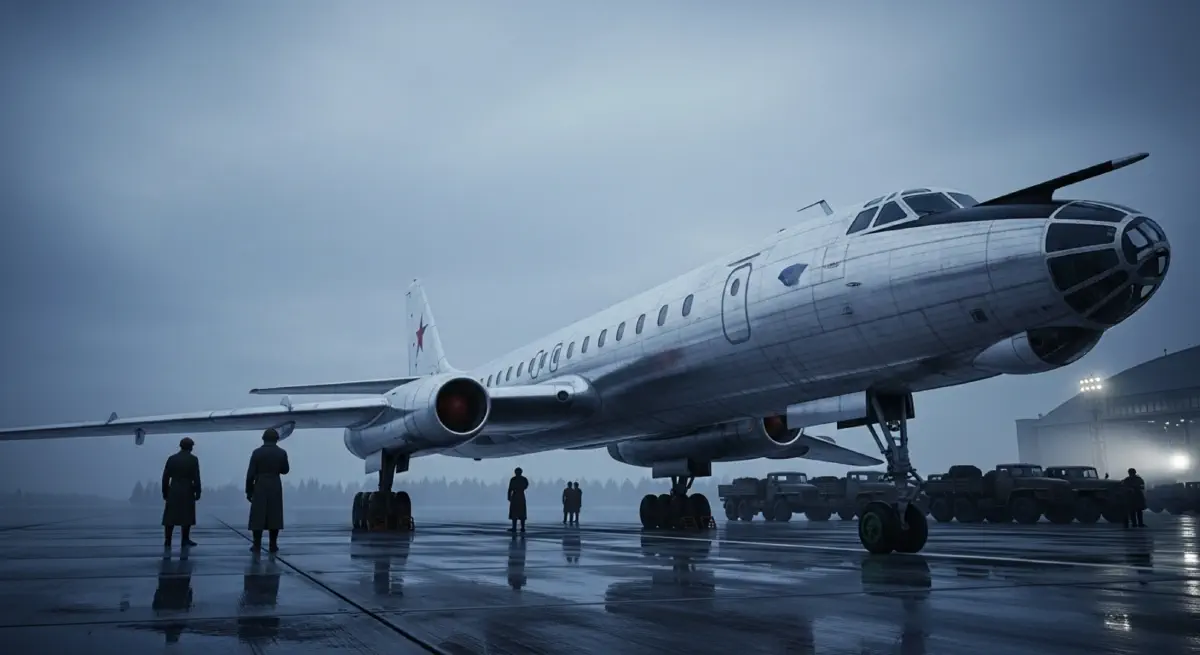
In March 1956, a sleek, silver projectile descended upon London’s Heathrow Airport, effectively shattering the Western illusion of technical supremacy. This was the Tupolev Tu-104. It was the pride of the Soviet Union, a jet-powered airliner that appeared, at least to the stunned British press, to have leapfrogged decades of incremental Western progress. At a time when the British De Havilland Comet was grounded following a series of catastrophic structural failures, the Soviets were not merely flying; they were parading a machine that looked larger, faster, and more robust than anything the capitalists had managed to keep in the air.

The deception was masterful. To the crowds and the dignitaries, the Tu-104 represented a new golden age of socialist mobility. To the pilots and engineers who operated it, however, the aircraft was a volatile hybrid—a heavy-duty weapon of war masquerading as a vessel for the traveling public. It was a plane designed to reach its destination by any means necessary, even if those means occasionally involved being hurled 4,000 ft (~1,219 m) into the stratosphere by a stray updraft before tumbling back to Earth.
The reality of Soviet aviation in the early 1950s was grimly utilitarian. While Western travelers were beginning to experience the dawn of pressurized, long-range flight, Soviet citizens remained trapped in a pre-war paradigm. Crossing the vast expanse of the Soviet Union—from Moscow to Vladivostok—was an ordeal of endurance rather than a convenience of travel. The journey required at least six refueling stops and could stretch to 50 hours. Passengers were crammed into noisy, unpressurized cabins that lacked the ceiling to fly above the weather. Every flight was a battle against turbulence and the sheer, exhausting scale of the Russian geography.
Andre Tupolev, the dean of Soviet aircraft design, understood that catching up to the West through traditional research and development was a fool’s errand. The British had spent nearly ten years and millions of pounds developing the Comet. The Soviet leadership, perpetually suspicious of “expensive capitalist excesses,” viewed jet engines as fuel-thirsty liabilities. Tupolev did not attempt to sell them a dream of passenger comfort; he sold them a shortcut. He promised a jet airliner in just three years.
To achieve this, he did not design a new airplane. He simply gutted an existing one.
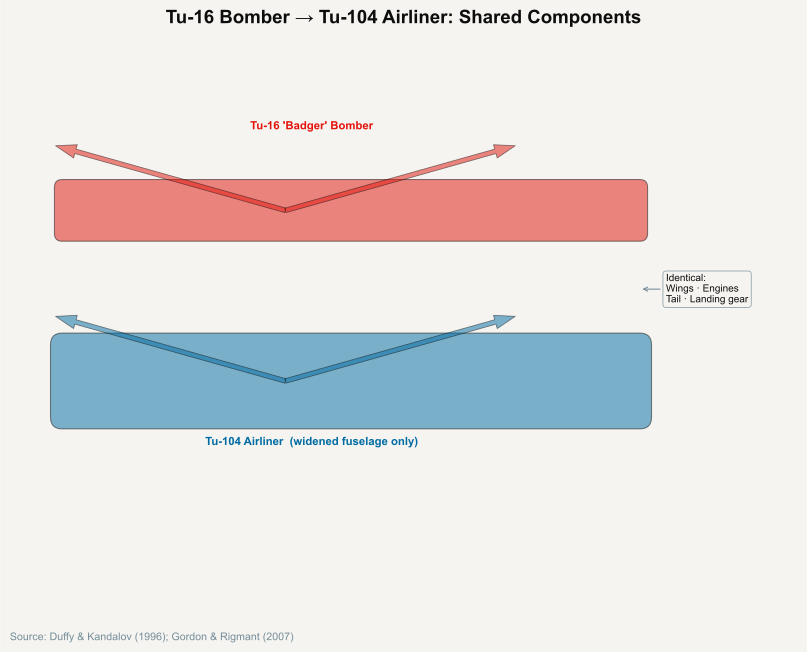
The Tu-16 “Badger” was a strategic bomber designed to rain nuclear fire across Europe. It was sturdy, fast, and already in mass production. Tupolev’s “innovation” was to widen the fuselage to accommodate passengers while retaining the bomber’s wings, engines, tail, and landing gear. This was not engineering in the service of efficiency; it was a desperate act of re-branding. By plucking components directly off the bomber’s assembly line, Tupolev created a 100,000 lb (~45,359 kg) airliner in record time.
The consequences of this shortcut were immediate and physical. The Tu-104 inherited the Tu-16’s high-speed swept wings, which were optimized for high-altitude bombing runs, not for the delicate business of taking off and landing at civilian airports. Pilots found the controls heavy and unresponsive. Because the aircraft lacked modern aerodynamic aids like air brakes or thrust reversers, landing was a high-stakes gamble. Pilots, terrified of stalling the heavy machine, frequently landed at speeds far exceeding the design limits. To stop the 100,000 lb (~45,359 kg) beast before it ran out of tarmac, they had to deploy a military-grade parachute—a jarring, improvised solution that became a standard feature of Soviet “commercial” flight.
By 1958, the propaganda victory began to curdled into a series of inexplicable disasters. The Tu-104 had developed a habit of self-destructing in clear weather. In February of that year, a Tu-104 encountered turbulence that caused both engines to flame out simultaneously. The aircraft plummeted 20,000 ft (~6,096 m) before the crew managed a desperate restart. Weeks later, another aircraft was seized by a powerful updraft and hurled to 44,000 ft (~13,411 m)—an altitude far beyond its operational ceiling. It stalled and began a terrifying tumble toward the ground.
Soviet authorities, consistent with the institutional reflex of the era, blamed the pilots. They dismissed the incidents as “operator error” and kept the fleet in the air. This refusal to acknowledge a systemic flaw led directly to the tragedy of August 1958, and again in October, when a Tu-104 flying from Beijing to Moscow was swept upward and destroyed. In that final moment, the pilot, Harold Kuznetsov, did something the Soviet system was not designed to handle: he spoke the truth. As the aircraft stalled and began its death spiral, Kuznetsov remained on the radio, calmly describing the failure of the control surfaces as it happened. He provided the evidence that the state could no longer suppress.
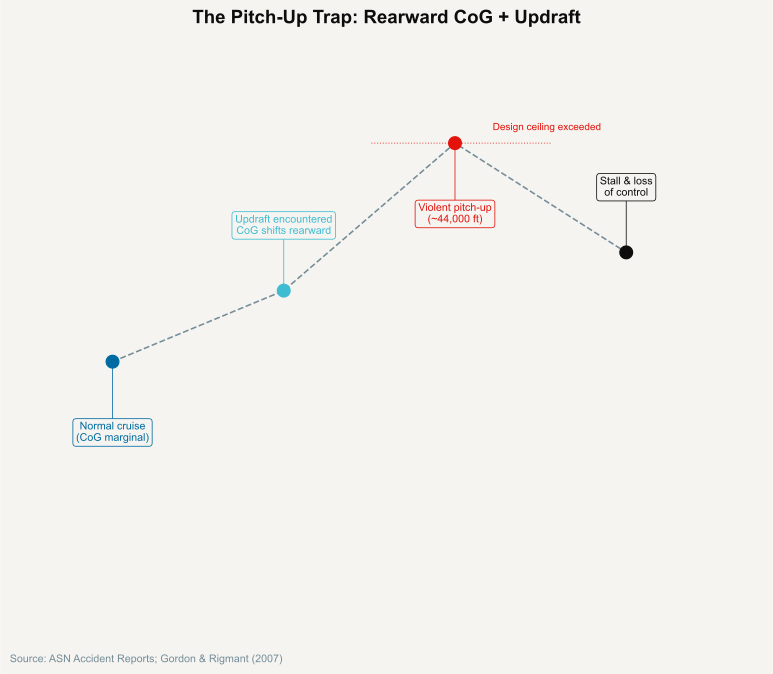
The investigation revealed that the Tu-104’s center of gravity was dangerously prone to shifting rearward. When hit by an updraft, the aircraft didn’t just bounce; it pitched up violently. Because it lacked the engine power and elevator authority to counteract this force, the pilots were passengers in their own demise. The plane was, quite literally, designed to crash under specific, common atmospheric conditions.
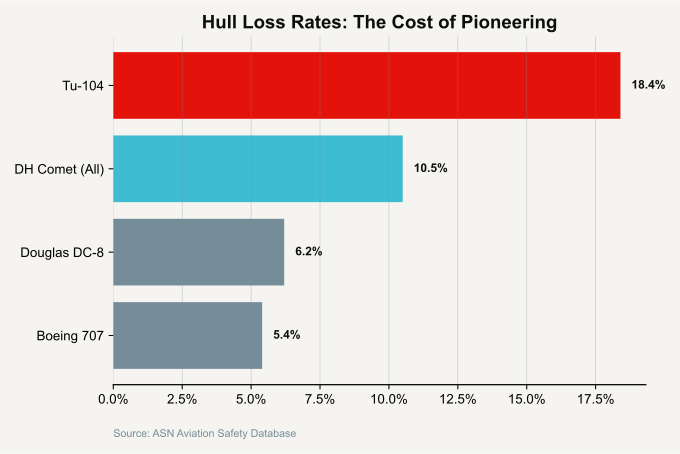
Despite the “fixes” implemented afterward, the Tu-104’s reputation was permanently stained. It became the subject of dark folk songs and gallows humor among the Soviet public. The statistics justify the cynicism: nearly one out of every five Tu-104s ever built was destroyed in an accident. In a transparent society, such a loss rate would have grounded the fleet forever. In the Soviet Union, it was merely the price of maintaining the appearance of progress.
The Tu-104 was eventually superseded by more refined designs, but its legacy was not entirely one of failure. It forced the Soviet Union to modernize its infrastructure. To accommodate the jet, runways across the Eastern Bloc were lengthened, air traffic control systems were digitized, and new terminals were constructed. The country was dragged into the jet age by a machine that was as likely to kill its passengers as it was to deliver them.
The $1 a month subscription to a streaming service like Curiosity Stream might offer thousands of documentaries on the “triumphs” of aviation, but the Tu-104 remains a stark reminder of what happens when the demands of propaganda override the laws of physics. It was a pioneering aircraft, certainly, but it was a pioneer that treated its crew and passengers as expendable data points in a geopolitical ledger. The Tu-104 did not usher in a golden age of travel; it simply proved that if you are willing to ignore the bodies, you can make a bomber look like a bus for just long enough to fool the world.
The final irony is that by the time the Tu-104 was “safe” to fly, the West had already moved on. The Boeing 707 and the Douglas DC-8 arrived, rendering the Tu-104’s brute-force engineering obsolete. The Soviet Union had spent its blood and its prestige on a shortcut that led, ultimately, to a dead end. The plane stopped flying, the folk songs faded, and the only thing that remained was the realization that in the race to look advanced, the Soviets had forgotten to actually be advanced.
References#
- Aviation Safety Network. (n.d.). Tupolev Tu-104 Statistics. Flight Safety Foundation. Retrieved October 2023, from https://aviation-safety.net/database/type/type.php?id=T104
- Duffy, P., & Kandalov, A. (1996). Tupolev: The Man and His Aircraft. SAE International.
- Gordon, Y., & Rigmant, V. (2007). Tupolev Tu-104: The Soviet Union’s First Jet Airliner. Midland Publishing.