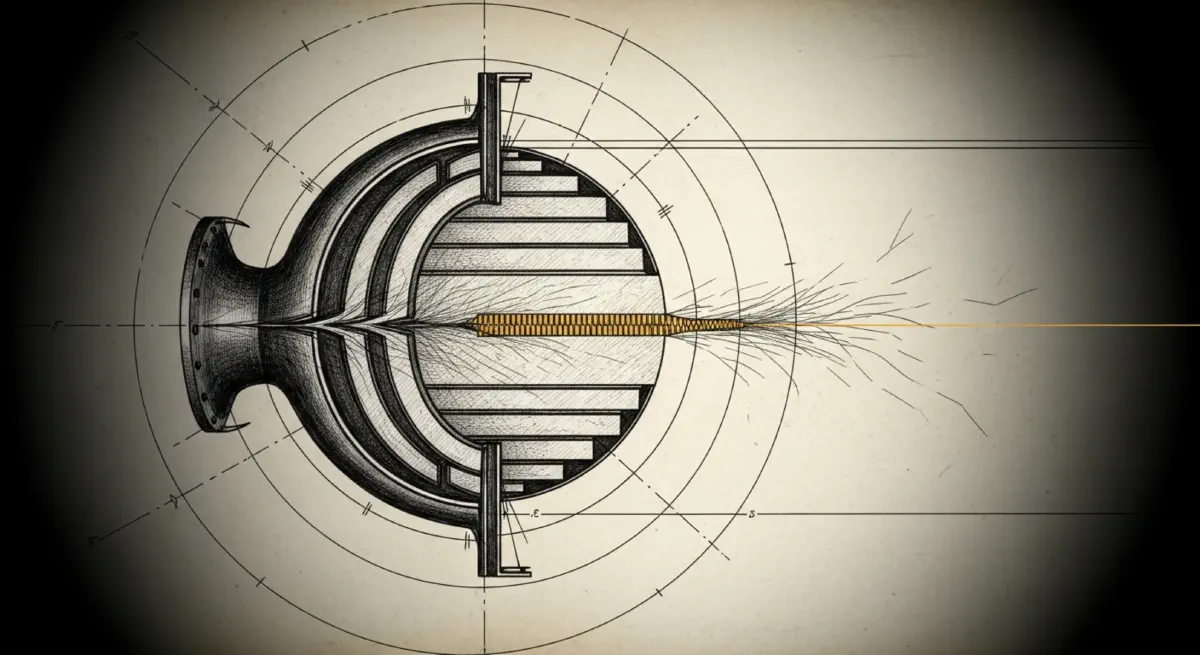
At 10:47 a.m. on June 18, 2023, the Titan submersible dropped 32 kilograms of ballast and its pilot radioed "all good here" to the surface vessel Polar Prince. Six seconds later, communication was lost. The sub was at approximately 3,500 metres depth, 277 metres above the seafloor.
The actual destruction — hull fracturing, air collapse, secondary explosion — was over in well under a second. What it left behind was a debris field 450 metres long and 200 metres wide on the North Atlantic floor: an elliptical plume whose shape encodes the ocean current running northwestward at the moment of the accident. Five people were killed. The speed of their deaths was the only mercy the physics permitted.
The Story the Physics Actually Tells#
The popular account of the Titan's end treats hull fracture as the cause of the implosion. In physical reality, it is a consequence. The cause is a breach: the creation of any fluid pathway, however small, between the external ocean and the vessel's interior air volume.
Understanding this distinction is essential to understanding why the failure was unrecoverable the instant it began, and why the structural degradation recorded by the hull health monitoring system represented not a risk to be managed incrementally but an irreversible approach toward a binary threshold.
The Thermodynamics of a Millisecond#
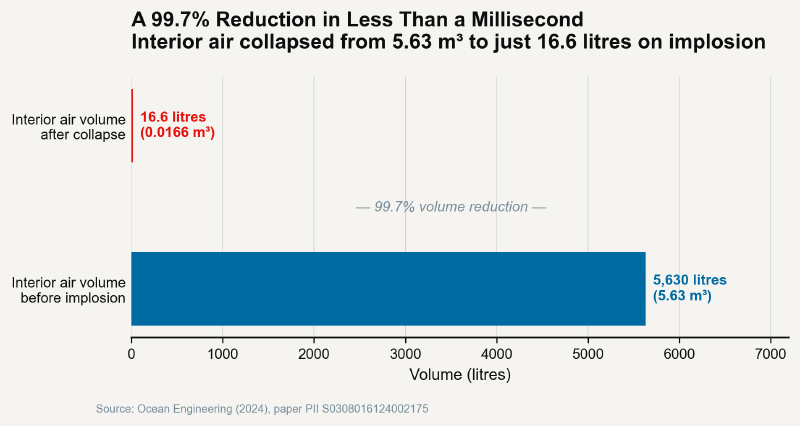
At 3,500 metres depth, ambient pressure is approximately 350 bar — 350 times atmospheric pressure at sea level. The Titan's pressure chamber held 5.63 cubic metres of air at near-surface pressure, a mass of roughly 6.9 kilograms.
If any pathway, however microscopic, connects that air volume to the surrounding water, the pressure differential drives instantaneous equalization. The final compressed volume of that air, calculated from the ambient pressure and temperature conditions at depth, is 0.0166 cubic metres — a 99.7 percent reduction occurring in a fraction of a millisecond.
This is not a slow process interrupted by structural resistance. The collapse of the air volume is the event. Hull fracturing is its mechanical expression.
The governing equation for this process is the adiabatic compression relation:
$$T_2 = T_1 \times \left(\frac{P_2}{P_1}\right)^{\frac{\gamma-1}{\gamma}}$$For air with a heat capacity ratio $\gamma = 1.4$, compressed from 1 atmosphere to 350 atmospheres beginning at a cabin temperature of approximately 293 K (20°C), the resulting temperature $T_2$ is approximately 1,600 Kelvin — comparable to jet turbine combustion temperatures, close to the melting point of structural steel, and well above the flash-boiling threshold of seawater at depth.
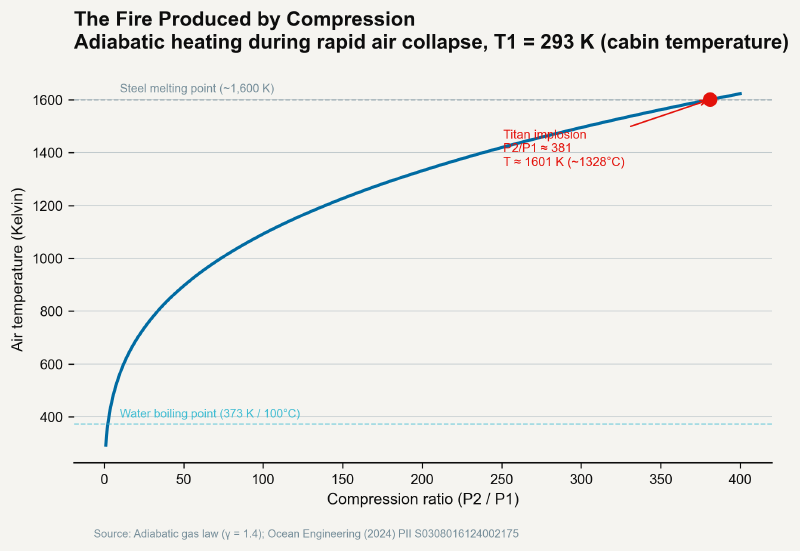
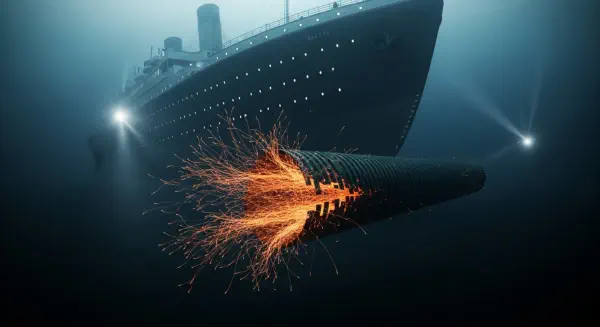
The compression is adiabatic — occurring so rapidly that no heat is exchanged with the surroundings. All the work done by the collapsing water column is converted directly into thermal energy in the gas. Adjacent seawater exposed to that heat flash-evaporates. The expanding steam drives a secondary explosion, propelling fragments of the hull, titanium fittings, and internal components outward into the water column before they fall to the floor at 3,777 metres. The debris field's 450-metre extent is a direct physical record of this two-phase event: primary air implosion, followed immediately by secondary steam ejection.
The distinction between deep-sea implosion and shallow-water flooding is not a matter of severity but of category. When a surface vessel is breached, flooding is gradual and response is possible. At 3,500 metres, the breach itself is invisible. The observable event is instantaneous and total. The physics permits no intermediate state between structural integrity and complete annihilation.
Carbon, Titanium, and the Interface Where Failure Concentrated#
Carbon fiber composites are not well-suited to sustained compressive loading. Their tensile strength is exceptional; their resistance to being crushed is not. For a pressure hull subject to enormous external hydrostatic force, this creates a fundamental constraint: manufacturing quality is not a margin consideration. It is the entire safety case.
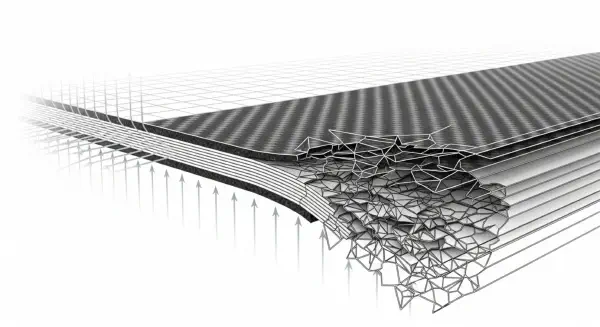
Hull V2 — remanufactured between 2020 and 2021 from five co-bonded laminate layers — did not meet that standard. NTSB investigators found wrinkles, porosity, and voids in the carbon fiber. Post-incident analysis of recovered hull fragments revealed degraded adhesive between layers, regions where adhesive had fully debonded from at least one laminate surface, and void zones where bonding had simply failed. The five nominal layers of the hull were, in the structurally critical sense, not five layers. They were a collection of partially bonded slabs, separated by voids that micro-pores filled with seawater under repeated pressure cycling.
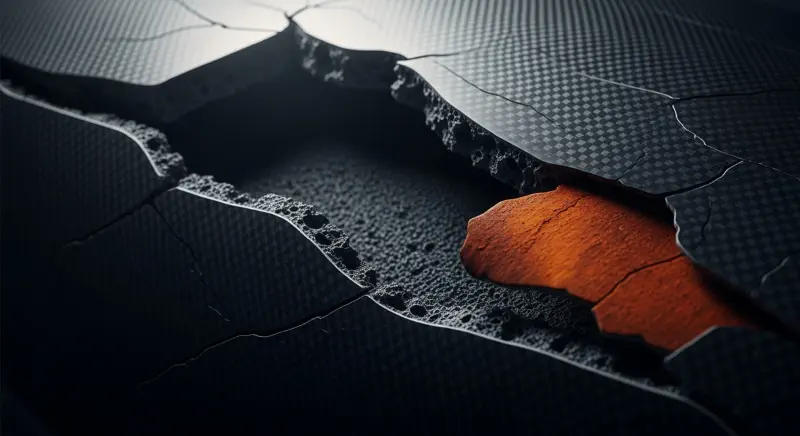
Each dive to Titanic depths imposed compressive loading at 350–380 bar, followed by depressurization on ascent. Cyclic loading of a material with pre-existing delamination is progressive fracture: each cycle extends existing defects and advances the delamination front. The hull fragments recovered from the crash site confirmed this. Many were large, nearly rectangular slabs — the morphology produced when a delaminated, thin-skinned cylinder fails by inward buckling along longitudinal fractures. A fully bonded hull of the same nominal dimensions would fail in shear mode, requiring higher stress and offering greater distributed resistance. The delamination did not merely weaken the hull. It changed its failure mode to a lower-energy, less predictable one.
Hull V1, built in 2017, had displayed identical pathology after just 50 dives, three of which reached 4,000 metres. It was retired in 2019. Pressure tests on scaled V1 segments showed implosion below 2,800 metres — 977 metres short of the Titanic wreck site. That data existed before Hull V2 was fabricated.
The Joint Failure Pattern Across Engineering History#
The Titan's failure geometry — crack propagation concentrating at the interface between dissimilar materials under cyclic stress — is a recurring structural signature across engineering history. Tracing it isolates the specific systemic mechanism that makes these failures predictable in retrospect and preventable in principle.
Challenger, January 1986. The Space Shuttle's solid rocket boosters used O-rings to seal joints between booster segments. In cold weather, the rubber lost elasticity and failed to seat under ignition gas pressure. Engineers at Morton Thiokol raised this concern in writing the night before the launch. The launch proceeded. The joint failed 73 seconds into flight. The primary structural members — the booster casings — performed within design parameters. The interface did not.
Ronan Point, May 1968. A residential tower in east London partially collapsed when a gas explosion transmitted lateral loads through precast concrete joints that had not been tested for that load path. The structural panels met their individual specifications. The connections between them failed. Five people were killed.
In each case — and in the Titan's — the forensic diagnosis is identical: the primary load-bearing elements were adequate. The interface between components with different material behaviours, different elastic moduli, or different fabrication tolerances was where degradation concentrated, propagated, and produced collapse.
The Titan's strain gauges had located this interface precisely. The bond region at the forward titanium flange showed the highest differential strain in the vessel, and recorded a permanent increase after Dive 80 that did not resolve. The instruments identified the failure origin eleven months before the failure. That is not a retrospective observation. It was available data.
What the Debris Field Encodes#
The wreckage tells the same story the strain gauges told, in the language of force vectors and scatter rather than millivolts and acoustic amplitude.
The heavy elements — titanium end capsules and the metal ring — settled closest to the sub's last known position. The forward titanium end cap, complete with its acrylic viewport, was found separated from the carbon fiber cylinder — establishing that the failure sequence passed through the carbon-titanium interface, precisely where the monitoring system had recorded its most significant anomalies. The lighter rectangular carbon fiber slabs are distributed across the long axis of the elliptical field. That distribution is not random: it is the spatial record of the two-phase energy release — primary air implosion followed immediately by the secondary steam flash that ejected hull fragments before they fell to the floor at 3,777 metres.
Post-recovery analysis of some carbon fiber fragments showed heat-induced porosity and thermal degradation consistent with extreme rapid heating rather than purely mechanical fracture. The secondary thermal event was real and physically recorded in the material.
What the Failure Establishes as a Systems Principle#
The Titan's loss establishes a narrow but important principle about real-time structural monitoring.
Monitoring is only as useful as the decision protocol that acts on its output. An instrument that detects cumulative damage provides no safety benefit unless the operating organisation has defined, in advance, what level of detected anomaly mandates operational suspension — and unless that definition is reviewed and enforced by an authority with both the technical standing and the independence to do so. That threshold can be set incorrectly; it can be overridden by commercial or schedule pressure; or it can simply not exist as a formal criterion. Each of those three failure modes produces the same physical outcome when the load cycle closes.
The deep-sea environment is not uniquely dangerous because it is remote. It is uniquely dangerous because it eliminates all intermediate failure states. A surface vessel with a compromised hull can be pumped, patched, and sailed to port. A deep-sea submersible with a compromised hull has one available state transition: from integrity to instantaneous annihilation. That binary is a design constraint, not a natural hazard. It defines precisely what standard of structural quality, manufacturing control, and monitoring protocol is necessary to operate there.
The Titan's hull health monitoring system was engineered with care. The decision system that used its data was not. That asymmetry is where the five deaths were, in the end, located.
References#
Weijermars, R. (2025). Comprehensive assessment of deep-water vessel implosion mechanisms: OceanGate's Titan submersible failure sequence explained. International Journal of Pressure Vessels and Piping, 213, Article 105340. https://doi.org/10.1016/j.ijpvp.2024.105340
National Transportation Safety Board. (2025). Hull failure and implosion of submersible Titan (Marine Investigation Report No. MIR-25-36). U.S. Government Publishing Office.
United States Coast Guard. (2024). Marine Board of Investigation: Loss of OceanGate Titan submersible — public hearings testimony. U.S. Department of Homeland Security. (September 2024 sessions.)
Davies, P., Riou, L., Mazeas, F., & Warnier, P. (2005). Thermoplastic composite cylinders for underwater applications. Journal of Thermoplastic Composite Materials, 18, 417–443.
Farhat, C., Wang, K. G., Main, A., Kyriakides, S., Lee, L. H., Ravi-Chandar, K., & Belytschko, T. (2013). Dynamic implosion of underwater cylindrical shells: Experiments and computations. International Journal of Solids and Structures, 50(19), 2943–2961. https://doi.org/10.1016/j.ijsolstr.2013.05.006
Li, Y., Yu, C., Wang, W., Li, H., & Jiang, X. (2022). A review on structural failure of composite pressure hulls in deep sea. Journal of Marine Science and Engineering, 10, 1456. https://doi.org/10.3390/jmse10101456
Graham, R. A. (1993). Solids under high-pressure shock compression: Mechanics, physics, and chemistry. Springer.
Stettler, J. W., & Thomas, B. (2013). Flooding and structural forensic analysis of the sinking of the RMS Titanic. Ships and Offshore Structures, 8, 346–366.
This is Part 3 of the Pressure & Protocol series. ← Part 2 examined the monitoring data and the timeline of unheeded warnings. Return to the series index for key insights and combined references.