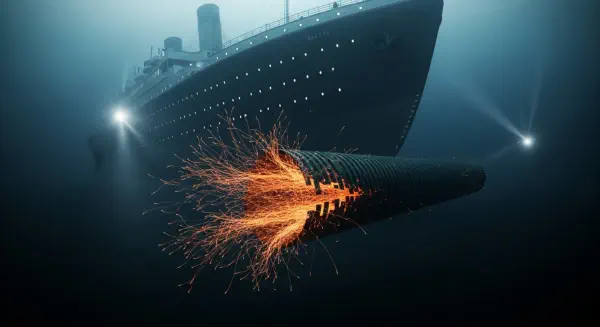
The ocean did not surprise the Titan. The Titan had been telling anyone who was listening what was coming.
On June 18, 2023, a submersible named Titan descended into the North Atlantic carrying five people and a commercial premise: that the deep ocean had become accessible to paying tourists. Ninety-six minutes after losing contact with its surface ship, the vessel was gone. What the subsequent investigation recovered was not just debris — it was a detailed mechanical record of a failure that had been accumulating silently across multiple dives, written in the language of acoustic emissions, strain gauge shifts, and separating composite layers.
At Depth, the Ocean Has No Patience#
The physics of deep-sea pressure are simple and absolute. For every ten metres of descent, ambient pressure increases by one atmosphere — the same pressure that the full weight of Earth's atmosphere exerts at sea level. At 100 metres, the pressure is 11 atmospheres. At 1,000 metres, it is 101. At the Titanic wreck site, 3,784 metres below the surface, it reaches 379 atmospheres.
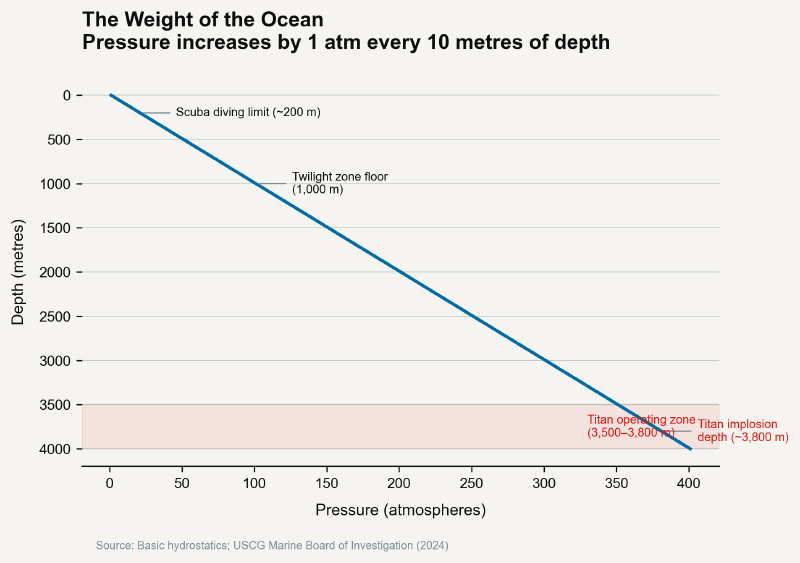
Steel and titanium have carried humans to these depths for decades. Their failure modes are well characterised: they yield visibly before they break, providing observable warning before catastrophic collapse. The engineering institutions that certify crewed submarines for deep operations built their specifications around these properties.
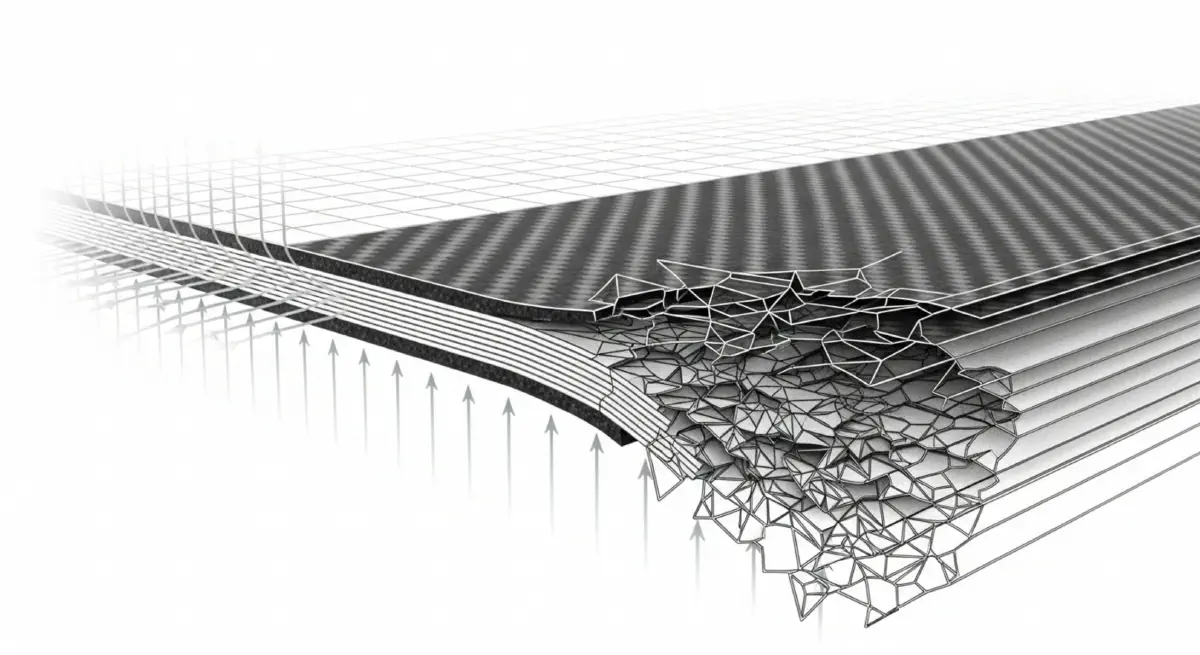
Carbon fiber does not behave this way. It does not yield. It delaminates — invisibly, progressively, without external sign — until, at some point determined by the cumulative extent of internal damage, it stops providing any structural contribution at all. The transition from integrity to failure is not a gradient. It is a threshold.
A System Designed to Listen#
The Titan was not operating without instrumentation. Its structural health monitoring system was, by the standards of operational submersibles, genuinely sophisticated. It comprised:
- Seven acoustic emission sensors distributed along the carbon fiber cylinder
- One acoustic emission sensor on the rear titanium flange
- Five strain gauges on the hull cylinder
- Two strain gauges on the forward dome
- One strain gauge on the rear flange
The acoustic sensors detected the ultrasonic signals produced when carbon fiber strands fracture within the composite matrix — the high-frequency sound of structural tissue tearing at the microscopic level. The strain gauges measured the actual deformation of the hull under load, tracking whether the vessel was responding elastically (recovering its original geometry between dives) or accumulating permanent deformation.
This system was presented publicly as a revolutionary safety feature. In the context of what the data showed — and of what the data produced in response — that framing warrants close examination.
The Record That Was Not Acted On#
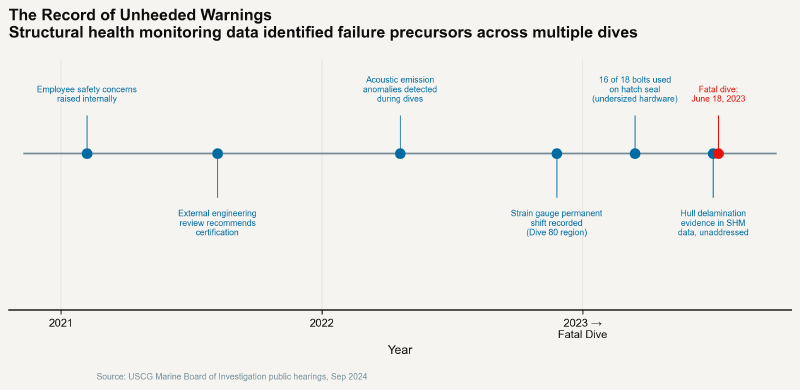
The timeline of documented signals is reconstructed from testimony presented at the United States Coast Guard Marine Board of Investigation public hearings in September 2024, from the NTSB's 2025 Marine Investigation Report, and from the acoustic and strain data recovered in post-incident analysis.
Employee safety concerns raised internally
Early 2021
Internal dissent begins
Multiple employees report safety shortcomings and design flaws. Dissent is treated as disloyalty to the CEO's vision. Director of Marine Operations David Lochridge submits a formal report identifying visible hull delamination and recommending non-destructive ultrasonic or X-ray testing. He is terminated and subsequently sued.External engineering review recommends certification
Mid 2021
Independent advice rejected
A third-party review urges OceanGate to seek class certification from a recognised marine classification society. The recommendation is declined. Rush characterises certification standards as incompatible with OceanGate's innovation cycle.Acoustic emission anomalies detected during dives
March 2022
The system starts recording
The structural health monitoring system records unusual acoustic events during operational dives. The signals indicate microcracking within the composite matrix. They are not investigated as structural warnings.Loud acoustic event and permanent strain shift — Dive 80
July 2022
Irreversible structural change
During Dive 80 on July 15, 2022, occupants hear a loud bang during ascent. Both acoustic sensors and strain gauges register the event. Strain gauge pair Ch4/Gr4, positioned at the interface between the carbon fiber cylinder and the forward titanium flange, records a permanent shift in both hoop and longitudinal strain. The shift does not resolve between dives. Rush attributes the event to the hull settling in its metal cradle and orders continued diving to observe what develops.Anomalous strain values appear at shallower depths — Dives 81–83
Late 2022
Progressive damage signature
During the three dives following Dive 80, the anomalous strain values recorded by Ch4/Gr4 appear at progressively shallower depths than in prior dive profiles. This is the measurable signature of cumulative structural damage: a hull that is no longer recovering elastically between load cycles.Improper hardware used on hatch seal
February 2023
Specification deviation
The forward titanium hatch ring is specified for eighteen bolts. On multiple dives, including the fatal mission, seventeen are used. The bolts themselves — 8 millimetres in diameter — have been assessed by multiple independent engineers as undersized for the shear stresses imposed at operating depth.SHM data indicates delamination — no operational response
May 2023
Critical warning unaddressed
Structural health monitoring data contains clear indicators of active delamination in the hull composite. The 2023 dive season begins. The vessel has been stored outdoors uncovered in St. John's through the winter, exposing the damaged composite to freeze-thaw cycling. It has been towed approximately 4,800 kilometres to the expedition site on its launch barge, subjecting a compromised hull to sustained vibration loads. Neither the winter storage conditions nor the towing stresses have been studied for their effect on a delaminated composite.Fatal dive — June 18, 2023
June 2023
Catastrophic implosion
At approximately 3,363 metres depth, during Dive 88, the pressure hull fails in less than one millisecond. All five occupants — Stockton Rush, Paul-Henri Nargeolet, Hamish Harding, Shahzada Dawood, and Suleiman Dawood — are killed instantly. The debris field is later located 1,600 feet from the bow of the Titanic.
What a Permanent Strain Shift Means#
The single most significant data point in the pre-failure record is the permanent strain shift recorded during Dive 80.
A strain gauge measures the deformation of the structure it is bonded to. Under normal elastic loading, the hull compresses under pressure at depth and returns to its original geometry upon ascent — the strain reading returns to its baseline. A permanent strain shift is a reading that does not return to baseline after the load is removed.
This is not a measurement artefact. A permanent strain shift in a pressure hull means the structure has been loaded beyond its elastic limit and has experienced irreversible deformation. In a metallic structure, this indicates plastic yielding — damage, but damage that an experienced eye can assess. In a carbon fiber composite, irreversible deformation means delamination has advanced. The geometry of the vessel has changed. The bonded layers have separated to a degree that prevents the structure from returning to its original configuration.
The shift recorded in strain gauge pair Ch4/Gr4 was located precisely at the forward titanium-to-carbon fiber interface — the highest-stress interface in the entire hull geometry. The subsequent pattern, in which the same anomalous values appeared at progressively shallower depths during Dives 81 through 83, has a precise structural interpretation: each dive was extending the delamination front further into the composite, and each successive dive encountered the same level of structural degradation at a shallower depth because the effective load-bearing area had been reduced. The hull's margin at depth was shrinking with every mission.
Eighty-eight dives were completed after the monitoring system began operating. The sensors worked exactly as designed.
The Hardware That Did Not Meet Specification#
The forward titanium hatch ring's bolt configuration is a secondary but clarifying data point in the failure record.
The design specification called for eighteen bolts of 8-millimetre diameter securing the forward hatch ring to the titanium transition ring bonded to the carbon fiber cylinder. On multiple dives, including the fatal one, seventeen were used. Multiple independent engineers who reviewed the design found the bolts to be undersized for the shear stresses imposed at operating depth even when all eighteen were present.
In the debris field recovered from the seabed, the forward titanium end cap — intact, with its acrylic viewport — was found separated from the carbon fiber cylinder. The failure sequence passed through the joint between the titanium ring and the composite hull: the same interface the strain gauges had been monitoring, the same interface where the permanent shift was first recorded in July 2022.
The hardware non-conformance and the structural monitoring data pointed to the same location.
Why the Monitoring Produced No Response#
The monitoring system's outputs required human interpretation and a defined decision protocol to translate them into operational constraints. Neither existed in a functional form.
The acoustic hit count system did not accumulate between dives — it was recalibrated at the start of each mission. This meant the progressive damage history encoded in cumulative acoustic emission events was not being tracked. The system recorded events in real time but carried no memory of prior damage across dive cycles.
The baseline from which anomalous readings were assessed had been calibrated against Hull V1 — the vessel's first-generation predecessor, retired after displaying identical delamination pathology at only 50 dives — and against smaller test articles with different manufacturing characteristics. A sensor calibrated against a different structure produces readings whose deviation from baseline reflects the difference between those structures, not the current structural state of the vessel being monitored.
Most fundamentally: there was no defined threshold. No criterion established, in advance, by an independent authority, specifying what level of permanent strain shift, what acoustic emission rate, what deviation from prior dive profiles would require the mission to be suspended pending engineering review. The data was generated. The data was available. The decision framework that would have made it a safety feature was absent.
Three failure modes in monitoring-based safety systems produce the same physical outcome: the threshold is set incorrectly; the threshold is overridden by schedule or commercial pressure; or the threshold does not exist. In the Titan's case, the record is most consistent with the third.
This is Part 2 of the Pressure & Protocol series. ← Part 1 examined the foundational material and organisational decisions. Part 3 → examines the physics of what happened in the final millisecond — and what the debris field encodes about the failure mechanism.