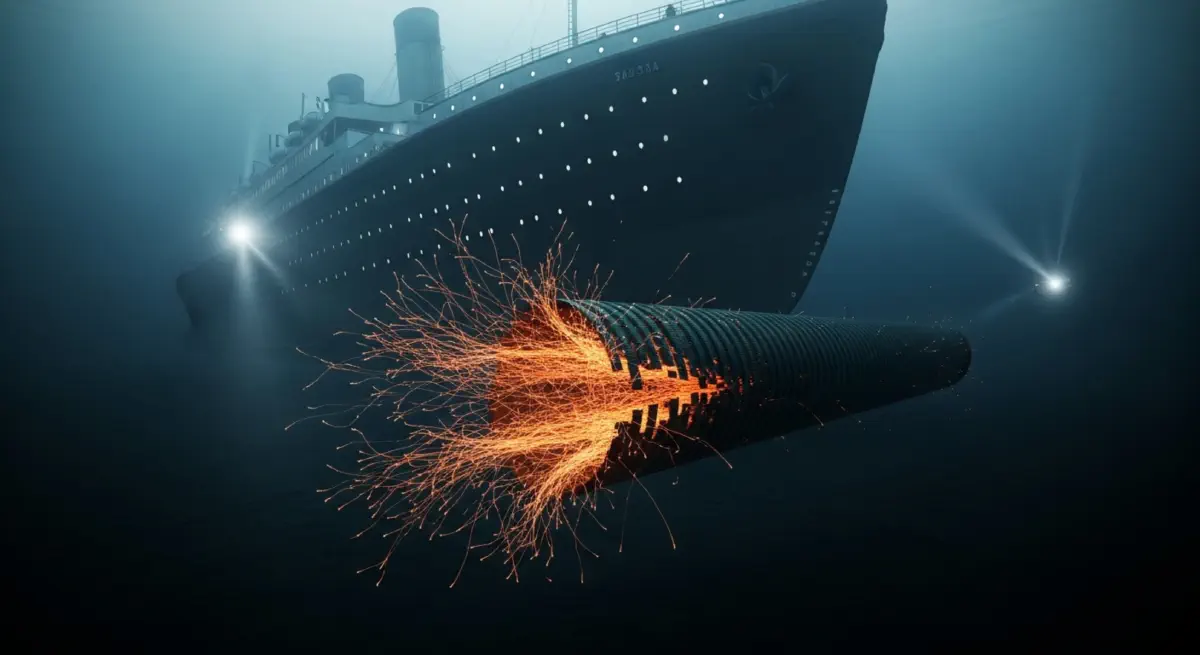
A technician at Spencer Composites watched carbon fiber filament wind around a massive steel mandrel, layer after layer, until the wall of the cylinder reached exactly five inches of thickness.
It was 2017. The air carried the faint, sterile scent of epoxy resin. To the uninitiated, the 480 layers of pre-preg unidirectional cloth looked like a testament to modern aerospace efficiency. To anyone who understood the physics of deep-sea compression, it looked like a gamble with no winning hand.
Each pass of the machine appended a fresh layer of structural ambiguity — microscopic voids and air gaps permanently baked into a pressure vessel designed to descend 3,800 metres into the North Atlantic. On June 18, 2023, that gamble ran out of time.
The Geometry of a Bad Decision#
In deep-sea engineering, the sphere is the canonical solution. A sphere distributes crushing ocean pressure equally across its entire surface — every point bears the same load. It is elegant, proven, and, for OceanGate's commercial purposes, inconvenient.
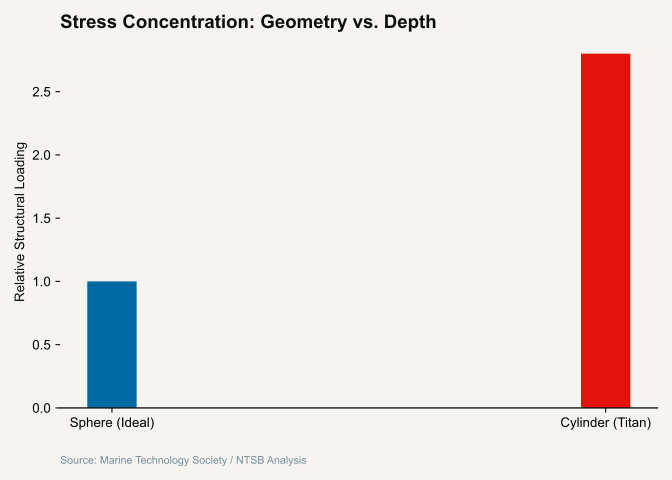
A sphere large enough to hold five people would be too heavy and too expensive to launch from a modified platform ship without heavy infrastructure. Stockton Rush, OceanGate's CEO, wanted more "Mission Specialists" — paying customers at $250,000 per seat — so he elongated the cabin into a cylinder.
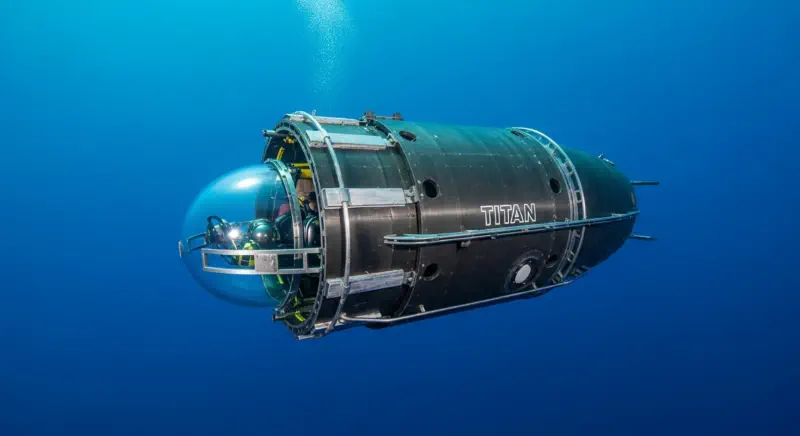
This decision redistributed ocean pressure at depth, focusing it on the vessel's midsection like a vise tightening with every metre of descent. The structural penalty was severe. No amount of composite layering could fully overcome it.
A Material That Lies About Its Limits#
Carbon fiber is extraordinary under tension — which is why it wings modern aircraft. The deep ocean is not a tensile environment. At 380 atmospheres of pressure, the physics demand compression resistance, and carbon fiber's compressive strength is only 30 to 50 percent of its tensile strength.
This limitation is not obscure. It appears in every foundational composites text and is well documented in the engineering literature on underwater pressure vessels. The mechanism is microstructural: graphitic crystallites buckle at unsupported regions under compressive load. High-modulus fibers — the kind Rush preferred for weight savings — are more susceptible to this mode, because their larger crystallites lack lateral support from the matrix.
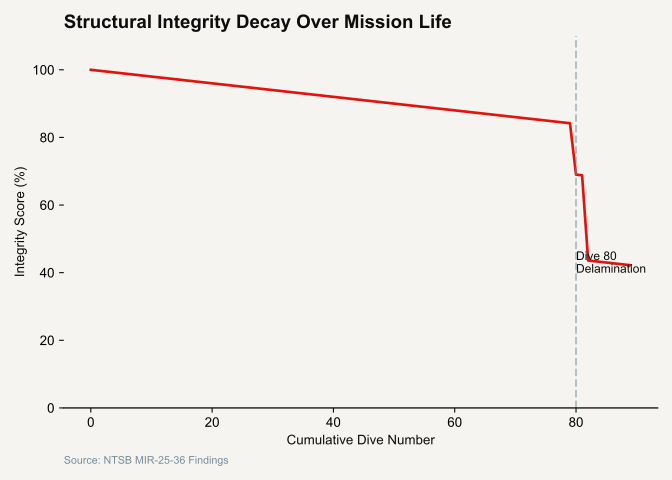
Under sustained cyclic compressive loading — the repeated compression and decompression that occurs every time a submersible dives and surfaces — the resin matrix between fiber layers experiences progressive microcracking. These cracks propagate across cycles. Over time, the layers begin to separate. This is delamination. It does not look like anything from the outside. There is no bulge, no crack visible at the surface, no obvious warning. The hull appears intact while its effective load-bearing thickness is being reduced, layer by layer.
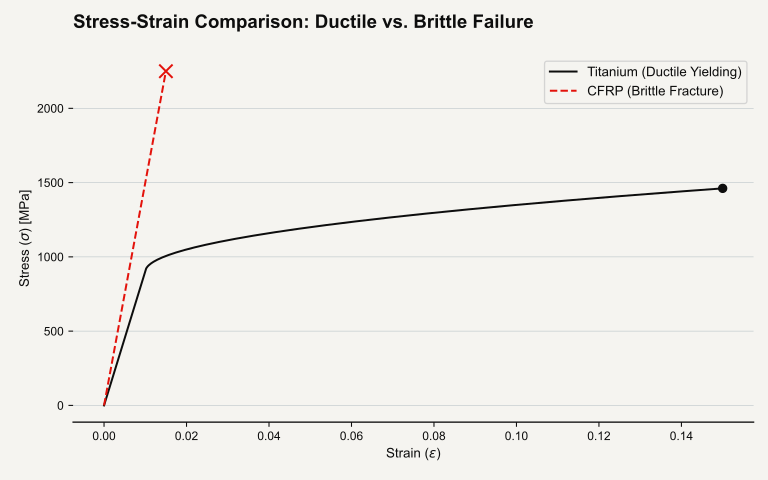
Rush believed carbon fiber was compression-superior. He said so publicly and held the position after engineers contradicted him directly. This was not a reading of the literature. It was a preference stated as an engineering fact.
Manufacturing a Catastrophe#
The second Titan hull was built using a co-bonding process: five nominally one-inch-thick composite sections joined with epoxy film adhesive. The theory was sound. The execution was not.
When investigators later recovered the wreckage, they found wrinkles, waviness, and significant porosity between plies. Voids in the adhesive reached lengths of 0.6 inches (~15 mm) in structurally critical zones — precisely the geometry that initiates and accelerates delamination under cyclic compression. Don Kramer of the U.S. National Transportation Safety Board testified that the hull contained manufacturing defects present from its initial fabrication, before it ever entered the water.
The story worsened. OceanGate personnel reportedly sanded the hull's exterior surface flush to present a smooth appearance to paying passengers. In the process, they severed the very fiber layers responsible for the structure's integrity. James Cameron — who has designed and piloted more deep-sea vehicles than almost anyone living — described this practice as a definitive structural intervention that compromised the hull before its first operational dive. It was not engineering. It was set dressing for a high-stakes tourism venture.
The first Titan hull, Hull V1, had displayed identical pathology after just 50 dives, three of which reached 4,000 metres. It was retired in 2019. Pressure tests on scaled V1 segments demonstrated implosion below 2,800 metres — 977 metres short of the Titanic wreck site. That data existed before Hull V2 was fabricated.
The Monitoring System's Hidden Flaw#
OceanGate marketed a "Real-Time Hull Structural Health Monitoring" system as an advanced safety feature. Acoustic sensors and strain gauges would detect carbon fibers fracturing within the composite. If the hull began to "scream," the system would catch it.
The premise concealed a fatal misunderstanding.
At 5,500 psi (approximately 380 bar), the time between the first detectable acoustic emission and total structural failure in a brittle composite is measured in milliseconds. The human nervous system does not operate on that timescale. The monitoring system's output could not be acted on by the crew in the interval between detectable signal and catastrophic loss of hull integrity. Whatever safety function the system appeared to serve, interrupting a failure in progress was not it.
There was a deeper problem. The system's baseline data came from Hull V1 — the condemned first hull — and from smaller test models with different manufacturing anomalies. Acoustic hit counts did not accumulate between dives. Once a carbon fiber layer fractures under compression, it is structurally gone. The monitoring system was not designed to track that cumulative damage across missions. It was recalibrated at the start of each dive, effectively resetting the record of what had already been lost.
The Culture That Suppressed the Safety Function#
By 2018, the internal record of dissent was substantial.
David Lochridge, Director of Marine Operations and an experienced submersible pilot, submitted a formal report identifying visible hull delamination and recommending non-destructive testing — X-ray or ultrasonic scanning — to map the internal condition of the composite. Rush terminated him. OceanGate then sued him for breach of contract.
Tony Nissen, the company's first Director of Engineering, refused to pilot the Titan himself and was eventually forced out after raising concerns about operational practices: incorrect O-rings, improper fuses, critical components left unlubricated, and a lightning strike that destroyed $40,000 in electronics because the vessel was not properly grounded.
The pattern these cases establish is consistent. Safety concerns were not evaluated as technical inputs to a risk management process. They were treated as expressions of disloyalty to the CEO's vision. Rush would not employ engineers who disagreed with his material assumptions. Senior staff who remained described staying because they were afraid of what would happen if they left — a sentiment that speaks less to a safety culture than to its complete absence.
When an organization fires the safety function and sues its director, what remains is not a slightly impaired safety system. What remains is a commercial operation with sophisticated instrumentation and no functional safety governance.
The Legal Void That Was Built on Purpose#
The question — how was any of this permitted? — has a precise answer.
Jurisdictional elimination. The Titanic wreck lies in international waters, approximately 370 miles off Newfoundland. No single national authority has enforcement jurisdiction over a vessel operating there.
Passenger reclassification. Paying customers signed contracts designating them "Mission Specialists" — members of a research crew. This reclassification converted a commercial tourism operation into an experimental endeavour and removed it from the scope of U.S. Coast Guard Subchapter T passenger vessel regulations.
Certification rejection. Rush explicitly declined to certify the Titan with the American Bureau of Shipping, DNV, or Lloyd's Register. He characterized certification standards as "obscene" and called the multi-year approval timelines incompatible with his innovation cycle. The Marine Board of Investigation record includes a contemporaneous account of Rush stating that, if the Coast Guard became a problem, "he would buy a congressman and make it go away."
Each element of this arrangement was deliberate. The Titan operated in a regulatory void that OceanGate had constructed with care. There was no external structural review, no mandatory inspection, no third-party validation of the hull's fatigue life, and no authority with the standing to require any of those things. The collective wisdom of a century of maritime safety development had no operational grip on the vessel.
The Cost of Disruption#
The "move fast and break things" operating philosophy assumes that failure is a recoverable, instructive event. In software, a bug produces a crash; you patch it, deploy, and learn. In a pressure vessel at 3,800 metres, a structural failure produces instantaneous, total, and fatal collapse. There is no patch. There is no second dive.
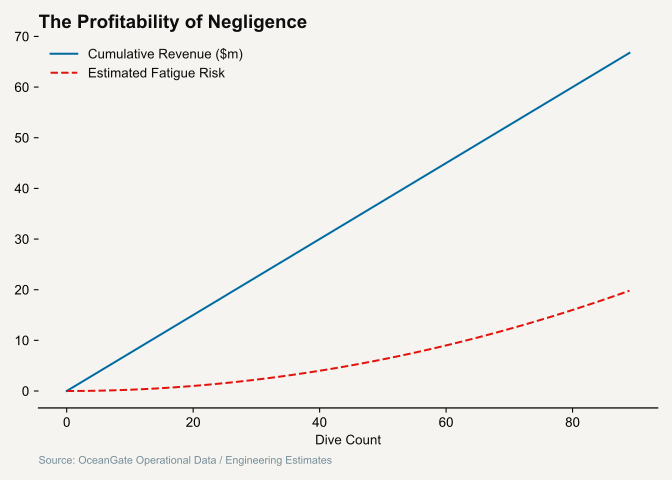
Rush believed that engineering rigor was a constraint to be bypassed rather than a standard to be met. He sourced material from expired Boeing stock to reduce costs. He marketed a $4.2 million experimental craft as "proven." He declined to have it certified and declined to have its hull life tested. He charged the price of a luxury home for a seat inside a structure that had already begun to delaminate by the time paying passengers first boarded.
The search and rescue operation that followed the Titan's loss cost millions of dollars and drew assets from multiple nations. OceanGate had no standing emergency response plan. No rescue assets were pre-positioned. The support vessel Polar Prince spent hours transmitting to the Titan before initiating a surface search. The company had externalized its risk entirely onto the public sector — a final accounting that matched the logic of everything that preceded it.
What Remains#
The NTSB concluded the Titan's engineering process was "inadequate" and its monitoring data "flawed." These are the clinical terms for a tragedy that was entirely preventable.
Regulations only work when operators accept that they apply. The Titan's story is not primarily a cautionary tale about carbon fiber or about bold entrepreneurship. It is a study in what happens when the belief that one's own judgment supersedes accumulated institutional knowledge is held by someone with sufficient resources to act on it.
The North Atlantic does not negotiate with operating philosophies. At 3,800 metres, the margin between a sound engineering decision and a fatal one is not bridged by conviction.
This is Part 1 of the Pressure & Protocol series. Part 2 → examines how the Titan's own monitoring system documented its progressive structural failure in real time — and why that data produced no response.