On June 18, 2023, a carbon fiber cylinder carrying five people descended into the North Atlantic for the eighty-eighth time. It did not return. What the subsequent investigation revealed was not a story of a single catastrophic mistake but a detailed, layered record of accumulated decisions — about materials, monitoring, culture, and accountability — each of which advanced the Titan submersible toward an outcome the physics had been preparing for months.
This series examines that record across three interconnected angles: the engineering compromises built into the vessel from the start, the real-time data that documented its progressive deterioration, and the physical mechanism by which it finally failed. Taken together, they constitute a case study in what happens when the assumption that failure is a learning opportunity meets an environment where failure is instantaneous and total.
The Series
#| Part | Title | Focus |
|---|
| Part 1 | The Five-Inch Compromise | Material selection, manufacturing defects, organizational culture, and the regulatory void that allowed the Titan to operate |
| Part 2 | The Warnings Were Written | How the structural health monitoring system documented the hull's progressive failure — and why none of it triggered a halt |
| Part 3 | In Less Than a Millisecond | The thermodynamics and mechanics of deep-sea implosion, the debris field as physical evidence, and what the failure means for how we design monitoring systems |
Key Insights Across the Series
#1. The Design Compromise Was Foundational
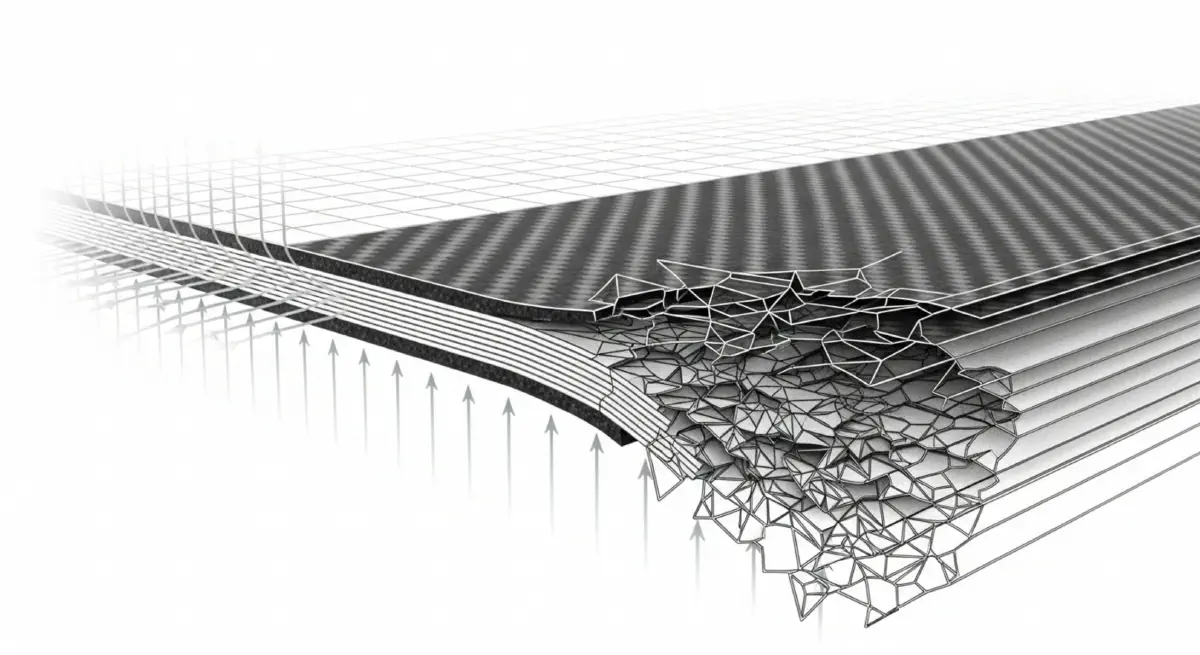
#Every other failure in this story flows from an original choice: to use carbon fiber for a manned pressure hull at 3,800 metres depth. Carbon fiber composites are exceptional in tension — they carry aircraft wings efficiently. Under sustained compressive cyclic loading, their failure mode is delamination: invisible internal separation of bonded layers that reduces effective structural thickness without any external sign of deterioration. This property is not obscure. It is documented in the engineering literature and well understood in the composites community. The decision to use it anyway, at full ocean depth, without the full-lifecycle fatigue testing that would characterise its behaviour in this specific application, was not an oversight. It was a calculated preference for weight reduction and commercial viability over structural predictability.
2. The Hull Was Already Failing Eleven Months Before the Final Dive
#On July 15, 2022, during Dive 80, passengers heard a loud acoustic event. Strain gauges near the critical interface between the carbon fiber cylinder and the forward titanium flange recorded a permanent shift — a change that did not resolve between dives. During subsequent dives 81 through 83, the anomalous strain values appeared at progressively shallower depths than in prior profiles. This is the measurable signature of cumulative structural damage: a hull that is no longer recovering elastically between load cycles. Eighty-eight dives were completed. The sensors worked. The decision framework did not.
3. The Interface Between Dissimilar Materials Was the Locus of Failure
#The Titan's structural geometry — a carbon fiber cylinder bonded at each end to titanium transition rings — created a specific vulnerability: the interface between materials with different elastic moduli, different thermal expansion coefficients, and different fatigue behaviour under cyclic loading. This is a recurring structural failure signature across engineering history. The O-ring joints in the Challenger space shuttle's solid rocket boosters failed at the interface between rubber and metal under thermal conditions the materials handled differently. The precast connections at Ronan Point failed at the interface between structural panels and joints not tested for lateral load transfer. In each case, the primary structural members performed within specification. The interface did not. The Titan's strain gauges had located precisely this interface and were recording its progressive failure for months.
4. The Physics Eliminated All Intermediate Failure States
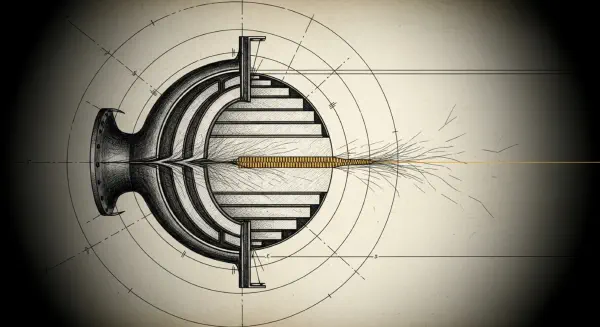
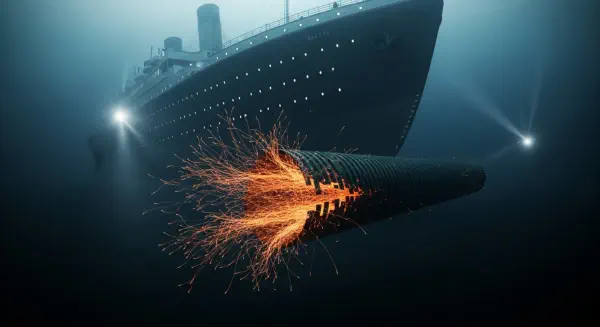
#At 3,500–3,800 metres depth, ambient pressure is 350–380 times atmospheric. The Titan's pressure chamber held 5.63 cubic metres of air at near-surface pressure. Any pathway — however microscopic — connecting that volume to the surrounding ocean would trigger instantaneous pressure equalization. The final compressed volume of that air at ambient conditions is 16.6 litres: a 99.7 percent reduction occurring in a fraction of a millisecond. This compression is adiabatic — no heat exchange occurs with surroundings — and the governing thermodynamics yield an estimated air temperature of approximately 1,600 Kelvin at peak compression, sufficient to flash-boil adjacent seawater and produce a secondary thermal explosion. The debris field's 450-metre extent is the physical record of that two-phase event. There is no intermediate state between structural integrity and instantaneous annihilation at this depth. This binary is not a natural hazard. It is a design constraint that defines precisely what standard of structural quality, manufacturing control, and monitoring protocol is required to operate there.
5. Real-Time Monitoring Without Decision Protocol Provides No Safety Benefit
#The Titan's structural health monitoring system was thoughtfully engineered. Seven acoustic sensors, one rear-flange sensor, five hull strain gauges, two dome gauges, one rear-flange gauge. The system detected the acoustic event during Dive 80. It registered the permanent strain shift. It continued operating on every subsequent dive. What did not exist was a defined threshold: a formal criterion specifying what level of detected anomaly mandated operational suspension, reviewed by an independent authority with the standing to enforce it. The monitoring system was real. The decision protocol that would have made it a safety feature was not. That asymmetry is where the five deaths were, in the end, located.
6. Organizational Culture Suppressed the Safety Function
#David Lochridge, Director of Marine Operations, submitted a report identifying visible delamination and recommending non-destructive testing. He was terminated and sued. Tony Nissen, the first Director of Engineering, refused to pilot the vessel himself and was forced out after raising concerns about operational practices. The pattern these cases describe is consistent: safety concerns were treated as expressions of disloyalty to the CEO's vision rather than inputs to be evaluated on their technical merits. Rush's documented belief that carbon fiber was superior under compression — a belief contradicted by the engineering literature he had been presented with — was not corrected through any internal process, because the internal process had been dismantled. What remained was a commercial operation with sophisticated instrumentation and no functional safety governance.
7. The Regulatory Framework Was Deliberately Circumvented
#The Titan operated in a jurisdictional void constructed with precision. The Titanic wreck lies in international waters, removing U.S. Coast Guard enforcement jurisdiction. Paying customers were designated "Mission Specialists" on a research vessel, converting a commercial tourism operation into an experimental endeavour and bypassing Subchapter T passenger vessel regulations. OceanGate explicitly declined certification from the American Bureau of Shipping, DNV, and Lloyd's Register. Every element of the regulatory environment that might have imposed an external structural review was either non-applicable by geography or declined by the operator. The collective wisdom of a century of maritime safety standards had no operational grip on the Titan.
References
#Weijermars, R. (2025). Comprehensive assessment of deep-water vessel implosion mechanisms: OceanGate's Titan submersible failure sequence explained. International Journal of Pressure Vessels and Piping, 213, Article 105340. https://doi.org/10.1016/j.ijpvp.2024.105340
National Transportation Safety Board. (2025). Hull failure and implosion of submersible Titan (Marine Investigation Report No. MIR-25-36). U.S. Government Publishing Office.
United States Coast Guard. (2024). Marine Board of Investigation: Loss of OceanGate Titan submersible — public hearings testimony. U.S. Department of Homeland Security. (September 2024 sessions.)
Daniel, I. M., & Ishai, O. (2006). Engineering mechanics of composite materials (2nd ed.). Oxford University Press.
Davies, P., Riou, L., Mazeas, F., & Warnier, P. (2005). Thermoplastic composite cylinders for underwater applications. Journal of Thermoplastic Composite Materials, 18, 417–443.
Farhat, C., Wang, K. G., Main, A., Kyriakides, S., Lee, L. H., Ravi-Chandar, K., & Belytschko, T. (2013). Dynamic implosion of underwater cylindrical shells: Experiments and computations. International Journal of Solids and Structures, 50(19), 2943–2961. https://doi.org/10.1016/j.ijsolstr.2013.05.006
Li, Y., Yu, C., Wang, W., Li, H., & Jiang, X. (2022). A review on structural failure of composite pressure hulls in deep sea. Journal of Marine Science and Engineering, 10, 1456. https://doi.org/10.3390/jmse10101456
Soden, P. D., Hinton, M. J., & Kaddour, A. S. (1998). A comparison of the predictive capabilities of current failure theories for composite laminates. Composites Science and Technology, 58(7), 1225–1254. https://doi.org/10.1016/S0266-3538(98)00077-1
Hutchinson, J. W., & Jensen, H. M. (1990). Models of fiber debonding and pullout in brittle composites with friction. Mechanics of Materials, 9(2), 139–163.
Flewitt, P. E. J., & Wild, R. K. (2001). Physical methods for materials characterisation (2nd ed.). Institute of Physics Publishing.
Graham, R. A. (1993). Solids under high-pressure shock compression: Mechanics, physics, and chemistry. Springer.
Stettler, J. W., & Thomas, B. (2013). Flooding and structural forensic analysis of the sinking of the RMS Titanic. Ships and Offshore Structures, 8, 346–366.
Buddhacosa, N., Orifici, A. C., Kandare, E., Gresil, M., Trinh, K. S., & Grigoriou, K. (2026). Effect of ageing temperature and fibre orientation on hygrothermal degradation of aerospace-grade carbon fibre epoxy laminates. Composites Part A: Applied Science and Manufacturing.
GCaptain. (2025, October 2). NTSB finds OceanGate's poor design and missed damage led to Titan disaster. https://gcaptain.com/ntsb-finds-oceangate-ignored-critical-damage-before-titans-final-dive/
The Independent. (2025, August 5). OceanGate CEO 'completely ignored' flawed Titan sub before deadly Titanic trip, Coast Guard report finds. https://www.independent.co.uk/news/world/americas/titan-submersible-report-oceangate-coast-guard-b2802208.html