On September 13, 1882, at the Battle of Tel el-Kebir, a British expeditionary force crushed the army of Colonel Ahmed ‘Urabi Pasha. ‘Urabi’s nationalist revolt had threatened to eject European influence from Egypt and, crucially, from the Suez Canal-Britain’s indispensable artery to India. Conventional history records this as a military victory. In reality, it was the culminating kinetic act in a financial siege that had begun years earlier. Britain did not merely defeat ‘Urabi; it administered the second, surgical sting of a geopolitical predation that perfectly mirrored the emerald wasp’s protocol. First, it had used sovereign debt to paralyze Egypt’s economic sovereignty. Then, it inserted Lord Cromer as the de facto ruler into the brainstem of the Egyptian state.
On September 13, 1882, at the Battle of Tel el-Kebir, a British expeditionary force crushed the army of Colonel Ahmed ‘Urabi Pasha. ‘Urabi’s nationalist revolt had threatened to eject European influence from Egypt and, crucially, from the Suez Canal-Britain’s indispensable artery to India. Conventional history records this as a military victory. In reality, it was the culminating kinetic act in a financial siege that had begun years earlier. Britain did not merely defeat ‘Urabi; it administered the second, surgical sting of a geopolitical predation that perfectly mirrored the emerald wasp’s protocol. First, it had used sovereign debt to paralyze Egypt’s economic sovereignty. Then, it inserted Lord Cromer as the de facto ruler into the brainstem of the Egyptian state.
For the following four decades, the Khedive remained on his throne in Cairo. The body of the Egyptian state lived on. But its will—its capacity for independent strategic action—was extinguished. Egypt walked, worked, and its economy grew, but every significant step served a British imperial purpose. It was the 19th century’s most sophisticated experiment in conquest: the preservation of the host to exploit its functions. This was the Wasp Doctrine, perfected by history’s greatest empire.
From Sovereign to Zombie: The Anatomy of a Financial Hijack#
The British management of Egypt from the 1870s to the 1910s stands as the definitive historical case study of neurological conquest applied to a modern nation-state. It was a deliberate, calculated policy of subjugation through administrative and fiscal hijacking, leaving the formal structures of the host intact while seizing control of its decision-making core. This was not blundering imperialism; it was precision engineering.
The First Sting: The Debt Trap and the Caisse de la Dette#
The initial, paralyzing sting was purely financial. In the 1860s and 70s, Egypt’s ruler, Khedive Ismail, embarked on a frantic modernization spree—the Suez Canal, railways, palaces—financed by enormous loans from European banks at ruinous rates. By 1876, Egypt was bankrupt, unable to service a debt of nearly £100 million. The European powers, led by Britain and France, pounced.
They forced the creation of the Caisse de la Dette Publique (Public Debt Commission), an autonomous body of European officials that seized direct control of Egypt’s most lucrative revenue streams: railways, customs, the port of Alexandria, and provincial tax collection. The Caisse’s mandate was singular: ensure bondholders were paid before any other state expenditure.
The paralysis was immediate and total. The Egyptian government could not pay its soldiers, bureaucrats, or suppliers without the Caisse’s approval. The state retained its territory, its people, and its legal form, but the economic motor functions were no longer under its own control. Like the cockroach with its front legs numbed, it was hobbled and vulnerable. The nationalist resentment that fueled ‘Urabi’s revolt was the inevitable, thrashing response of a body feeling the venom take hold.
The Second Sting: The Protectorate and Cromer’s Insertion#
‘Urabi’s rebellion provided the pretext for the surgical, neurological strike. Invoking the need to “protect financial stability” and “restore order,” Britain bombarded Alexandria and invaded. After its military victory, it faced a choice. Formal annexation was politically messy. Withdrawal would abandon the financial prize.
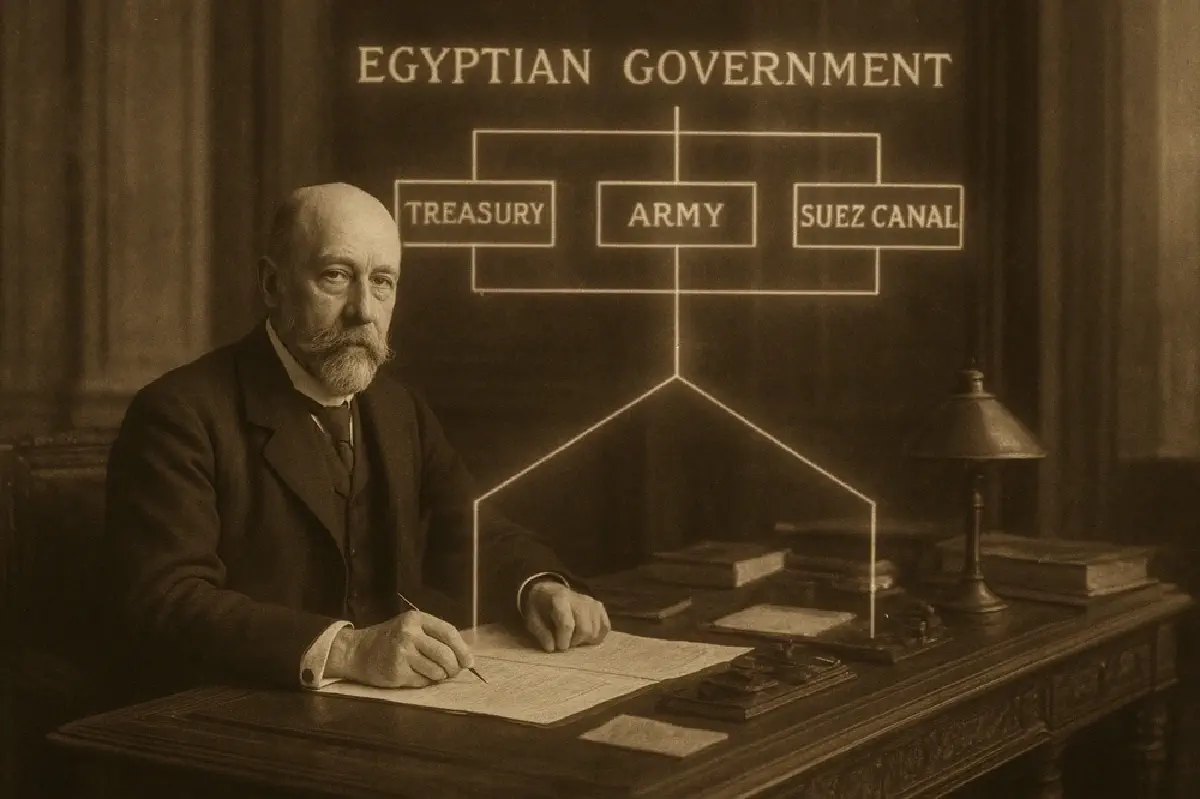
Britain chose the wasp’s burrow. In 1883, it installed Evelyn Baring, later Lord Cromer, as British Consul-General. Cromer, a former Indian finance official, was the human equivalent of the wasp’s second-sting venom. For the next 24 years, he ruled Egypt from behind the throne of a puppet Khedive. A British “advisor” was placed in every Egyptian ministry—Finance, War, Public Works, Justice. These advisors did not advise; they commanded. The Egyptian cabinet debated; Cromer decided.
Lord Dufferin’s report, which formalized this arrangement, revealingly described Britain’s role as providing “leading-strings”—the literal strings by which one leads a toddler, or a wasp leads a zombie cockroach. The Egyptian state’s “escape instinct,” its drive for independent policy, had been chemically deleted. Its brainstem now pulsed with British imperial directives.
The Preserved Host in Service to Empire#
With executive control secured, Britain exploited the functional host with breathtaking efficiency. Egyptian policy was systematically rewired.
- Economic Re-purposing: Egypt’s agriculture was forcibly reoriented from food crops to a single export: long-staple cotton for the mills of Lancashire. This created wealth for a landed elite and British industry but made the population hostage to global cotton prices and vulnerable to famine.
- Strategic Compliance: The Egyptian army was reduced to a ceremonial force. The country became a vast, secure barracks and coaling station for the British Royal Navy, guaranteeing free passage through the Suez Canal. During World War I, Egypt’s resources and manpower were deployed for the British war effort without its consent—it was simply declared a British Protectorate.
- The Illusion of Life: Infrastructure was built—railways, irrigation canals, schools—but primarily to facilitate control and cotton export. The body was maintained and even improved, but only to better serve the parasite. Egypt functioned, but its function was to be a compliant component of the British imperial organism.
The Ottoman Empire suffered a similar, if more diffuse, fate through the Ottoman Public Debt Administration (OPDA), established in 1881. The “Sick Man of Europe” was kept alive for decades by European financiers who directly administered his revenue, ensuring his strategic choices never threatened their interests until his physical dismemberment after World War I.
The British in Egypt proved that the most potent empire is not the one that destroys a rival state, but the one that quietly unplugs its sovereignty and plugs in its own command module. The legacy of this Victorian wasp is the modern blueprint of structural adjustment, debt diplomacy, and the consultant-led coups that continue to rewire nations. In our next post, we will see how this doctrine has evolved, trading pith helmets for algorithms and gunboats for balance sheets.