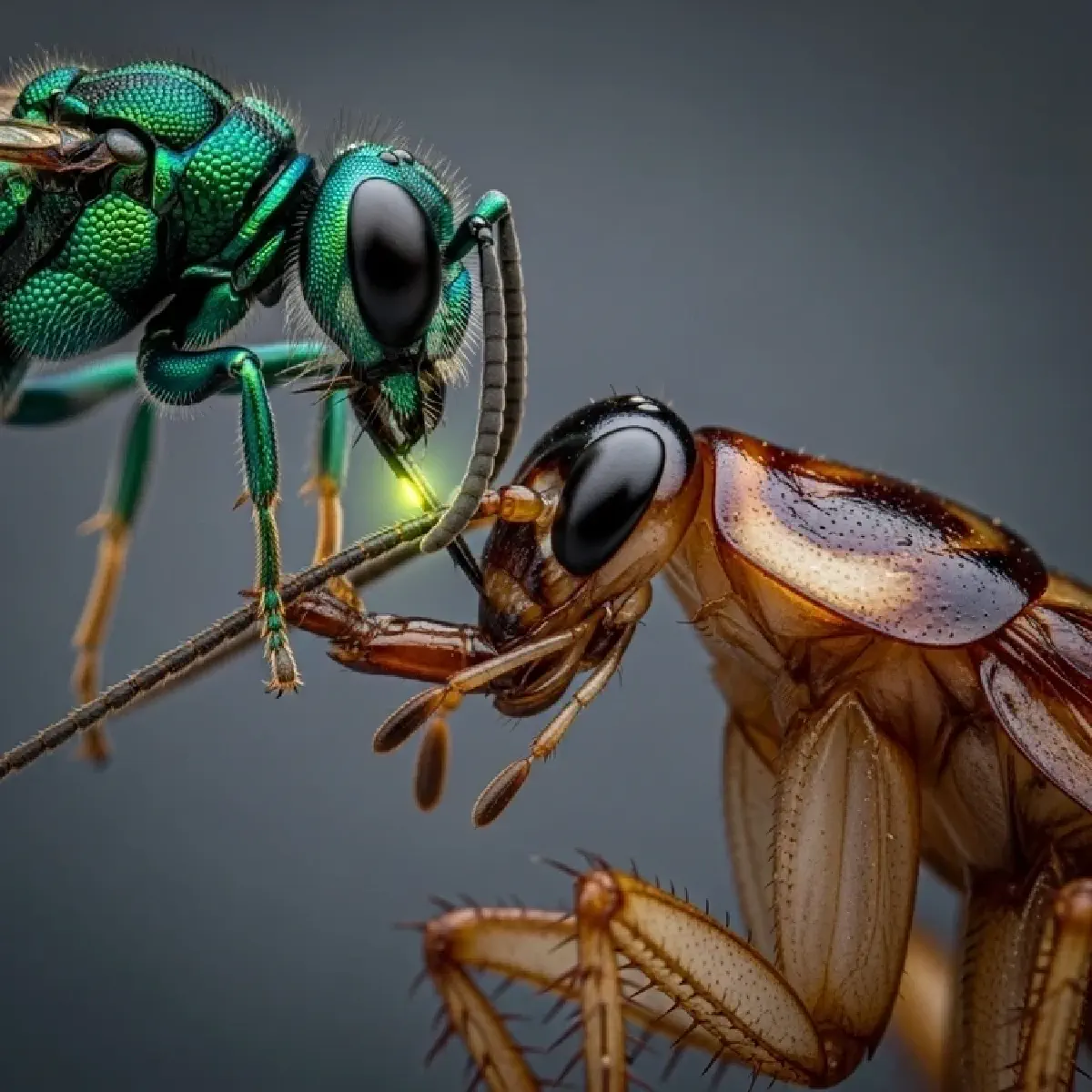
In the dappled undergrowth of a tropical forest, a solitary Ampulex compressa—the emerald cockroach wasp—completes a hunt that redefines predation. Her target is an American cockroach, an insect three times her size, armored, and capable of explosive escape. She does not engage in a battle of strength. She executes a neurological protocol. With a surgeon’s precision, she delivers two stings. The first, to the thorax, induces a brief, local paralysis of the front legs. The second is her masterpiece: her needle-like stinger finds a tiny articular membrane in the cockroach’s neck and penetrates directly into the cerebral ganglia and subesophageal ganglion—the insect equivalent of the brain stem.
The venom she injects does not kill. It does not cause generalized paralysis. It performs a targeted, functional edit of the host’s core operating system. Within minutes, the cockroach is fully mobile. It can walk, but it will not flee. Its grooming reflex remains intact, but its will to escape has been deleted. The wasp then leads the docile insect—like a gardener leading a wheelbarrow—to a prepared burrow, lays a single egg on its abdomen, and seals the tomb. The cockroach will remain alive, its metabolism preserved, to serve as a fresh, passive food source for the developing larva. The predator has not destroyed its prey; it has converted a self-directed agent into a compliant, self-propelled larder.
This is not mere hunting. It is the purest form of strategic conquest: the seizure of executive control. The wasp bypasses the hard shell, ignores the thrashing limbs, and delivers a chemical update directly to the central processor. Her method is a chillingly elegant, three-phase algorithm for domination that has been discovered, adapted, and perfected by the most powerful empires in human history. To understand the logic of modern power, we must first understand the wasp.
The Biological Blueprint for Neurological Hijack#
The emerald wasp’s strategy represents a quantum leap in predatory efficiency. It expends minimal energy to subdue a far larger resource by targeting not strength, but sovereignty. Its success depends on a sequence of specific, non-negotiable actions: first, induce a precise, tactical paralysis; second, assume command of the central nervous system; third, exploit the host’s preserved capabilities for exclusive benefit. This biological algorithm is not a metaphor for power; it is the foundational operating system for a form of power that leaves the conquered entity functional, but forever altered.
Phase 1: The Paralysis Sting – Disabling the Defense Subroutine#
The initial sting is a tactical masterstroke. By temporarily paralyzing the front legs, the wasp neutralizes the prey’s most powerful weapons—the limbs used for fighting, scratching, and the initial push-off for flight. Research indicates the venom contains a cocktail that blocks the neurotransmitter octopamine in the thoracic ganglia, which in insects regulates the initiation of voluntary movement.
The effect is not total shutdown. The cockroach’s metabolic engine, sensory systems, and rear legs remain fully operational. It is not dead, nor is it helpless. It is strategically hobbled—its most immediate and effective response to threat has been decommissioned. The predator has created a window of vulnerability without destroying the asset’s underlying utility.
Phase 2: The Brain Sting – The Hostile Takeover#
The second sting is the coup. The venom delivered to the head targets specific clusters of neurons. Studies show it dramatically alters the processing of dopamine, a key neurotransmitter for motivation and motor activation, particularly in circuits governing the escape response. The animal’s internal command “flee” is chemically replaced with “wait.”
The wasp has not installed a remote-control unit; she has edited the host’s core firmware. The cockroach becomes a passenger in its own body, its autonomy replaced by a void. This neurological hijack is remarkably specific: grooming and walking reflexes remain, proving the wasp’s venom is a precision tool, not a blunt instrument. She seeks a compliant tool, not a corpse.
Phase 3: The Preserved Host – Exploitation of the Functional Asset#
With executive control secured, the wasp shifts to exploitation. She leads the docile cockroach to a burrow. The cockroach walks, utilizing its own locomotive power, directed by the wasp’s gentle tugs on its antennae. This is the ultimate efficiency: the predator uses the host’s own energy and systems to complete the predation cycle. Inside the burrow, the egg is laid. The host remains alive, its metabolic functions preserved to keep the future larval food fresh. It will not struggle as it is consumed.
This three-phase sequence—Defense Suppression, Neurological Hijack, Preservation-based Exploitation—is the Wasp Doctrine in its primal form. It proves that complex, adaptive control is not a property of individual intelligence, but a potential of correctly configured systems. The environment is not merely a container for action; it is the canvas, the tool, and the rulebook. The empires that shaped our modern world did not stumble upon this logic. They studied it in the ruthless calculus of survival and applied it to nations. In the next post, we will witness its historical perfection: how the Victorian British Empire used sovereign debt as its paralyzing venom and installed a consul-general as its larval agent in the brainstem of Egypt.
In the dappled undergrowth of a tropical forest, a solitary Ampulex compressa—the emerald cockroach wasp—completes a hunt that redefines predation. Her target is an American cockroach, an insect three times her size, armored, and capable of explosive escape. She does not engage in a battle of strength. She executes a neurological protocol. With a surgeon’s precision, she delivers two stings. The first, to the thorax, induces a brief, local paralysis of the front legs. The second is her masterpiece: her needle-like stinger finds a tiny articular membrane in the cockroach’s neck and penetrates directly into the cerebral ganglia and subesophageal ganglion—the insect equivalent of the brain stem.
The venom she injects does not kill. It does not cause generalized paralysis. It performs a targeted, functional edit of the host’s core operating system. Within minutes, the cockroach is fully mobile. It can walk, but it will not flee. Its grooming reflex remains intact, but its will to escape has been deleted. The wasp then leads the docile insect—like a gardener leading a wheelbarrow—to a prepared burrow, lays a single egg on its abdomen, and seals the tomb. The cockroach will remain alive, its metabolism preserved, to serve as a fresh, passive food source for the developing larva. The predator has not destroyed its prey; it has converted a self-directed agent into a compliant, self-propelled larder.
This is not mere hunting. It is the purest form of strategic conquest: the seizure of executive control. The wasp bypasses the hard shell, ignores the thrashing limbs, and delivers a chemical update directly to the central processor. Her method is a chillingly elegant, three-phase algorithm for domination that has been discovered, adapted, and perfected by the most powerful empires in human history. To understand the logic of modern power, we must first understand the wasp.
The Biological Blueprint for Neurological Hijack#
The emerald wasp’s strategy represents a quantum leap in predatory efficiency. It expends minimal energy to subdue a far larger resource by targeting not strength, but sovereignty. Its success depends on a sequence of specific, non-negotiable actions: first, induce a precise, tactical paralysis; second, assume command of the central nervous system; third, exploit the host’s preserved capabilities for exclusive benefit. This biological algorithm is not a metaphor for power; it is the foundational operating system for a form of power that leaves the conquered entity functional, but forever altered.
Phase 1: The Paralysis Sting – Disabling the Defense Subroutine#
The initial sting is a tactical masterstroke. By temporarily paralyzing the front legs, the wasp neutralizes the prey’s most powerful weapons—the limbs used for fighting, scratching, and the initial push-off for flight. Research indicates the venom contains a cocktail that blocks the neurotransmitter octopamine in the thoracic ganglia, which in insects regulates the initiation of voluntary movement.
The effect is not total shutdown. The cockroach’s metabolic engine, sensory systems, and rear legs remain fully operational. It is not dead, nor is it helpless. It is strategically hobbled—its most immediate and effective response to threat has been decommissioned. The predator has created a window of vulnerability without destroying the asset’s underlying utility.
Phase 2: The Brain Sting – The Hostile Takeover#
The second sting is the coup. The venom delivered to the head targets specific clusters of neurons. Studies show it dramatically alters the processing of dopamine, a key neurotransmitter for motivation and motor activation, particularly in circuits governing the escape response. The animal’s internal command “flee” is chemically replaced with “wait.”
The wasp has not installed a remote-control unit; she has edited the host’s core firmware. The cockroach becomes a passenger in its own body, its autonomy replaced by a void. This neurological hijack is remarkably specific: grooming and walking reflexes remain, proving the wasp’s venom is a precision tool, not a blunt instrument. She seeks a compliant tool, not a corpse.
Phase 3: The Preserved Host – Exploitation of the Functional Asset#
With executive control secured, the wasp shifts to exploitation. She leads the docile cockroach to a burrow. The cockroach walks, utilizing its own locomotive power, directed by the wasp’s gentle tugs on its antennae. This is the ultimate efficiency: the predator uses the host’s own energy and systems to complete the predation cycle. Inside the burrow, the egg is laid. The host remains alive, its metabolic functions preserved to keep the future larval food fresh. It will not struggle as it is consumed.
This three-phase sequence—Defense Suppression, Neurological Hijack, Preservation-based Exploitation—is the Wasp Doctrine in its primal form. It proves that complex, adaptive control is not a property of individual intelligence, but a potential of correctly configured systems. The environment is not merely a container for action; it is the canvas, the tool, and the rulebook. The empires that shaped our modern world did not stumble upon this logic. They studied it in the ruthless calculus of survival and applied it to nations. In the next post, we will witness its historical perfection: how the Victorian British Empire used sovereign debt as its paralyzing venom and installed a consul-general as its larval agent in the brainstem of Egypt.