The Detection of Vibrational Resistance#
On June 8, 2007, the Space Shuttle Atlantis delivered the S3/S4 truss segment to the International Space Station (ISS). This hardware contained the starboard Solar Alpha Rotary Joint (SARJ), a mechanical interface 10.5 ft (3.2 m) in diameter weighing over 2,500 lbs (1134 kg). The primary function of this assembly is the continuous positioning of solar array wings to maintain alignment with the sun during orbit. Approximately 90 days after installation, flight controllers at the Johnson Space Center identified a discrepancy between the commanded velocity and the actual velocity of the joint. Telemetry indicated that the electric current required to drive the motor controllers had doubled and then quadrupled over nominal levels. This increase in current correlated directly with escalating mechanical torque, suggesting a progression toward a complete mechanical seizure.
The Failure of Solid Lubrication#
The SARJ anomaly illustrates the difficulty of managing high-load mechanical interfaces in vacuum environments where traditional liquid lubricants are insufficient. The root cause of this failure involves the interaction between specialized stainless steels and metallic plating under extreme contact stress.
The Mechanics of the Rotating Interface#
The SARJ utilizes two race rings composed of nitrided 15-5 precipitation hardened (PH) stainless steel forgings. Twelve independent Trundle Bearing Assemblies (TBAs) support the interface, featuring rollers made of 440C stainless steel. To manage friction, these rollers were coated with gold plating to act as a solid lubricant between the roller surface and the nitrided race ring. This mechanical connection allows for a full 360° rotation every 90 minutes in synchronization with the station’s orbit. The system relies on the metallurgical integrity of the nitrided surface to resist wear while the gold plating provides the necessary slip.
The Disintegration of the Gold Barrier#
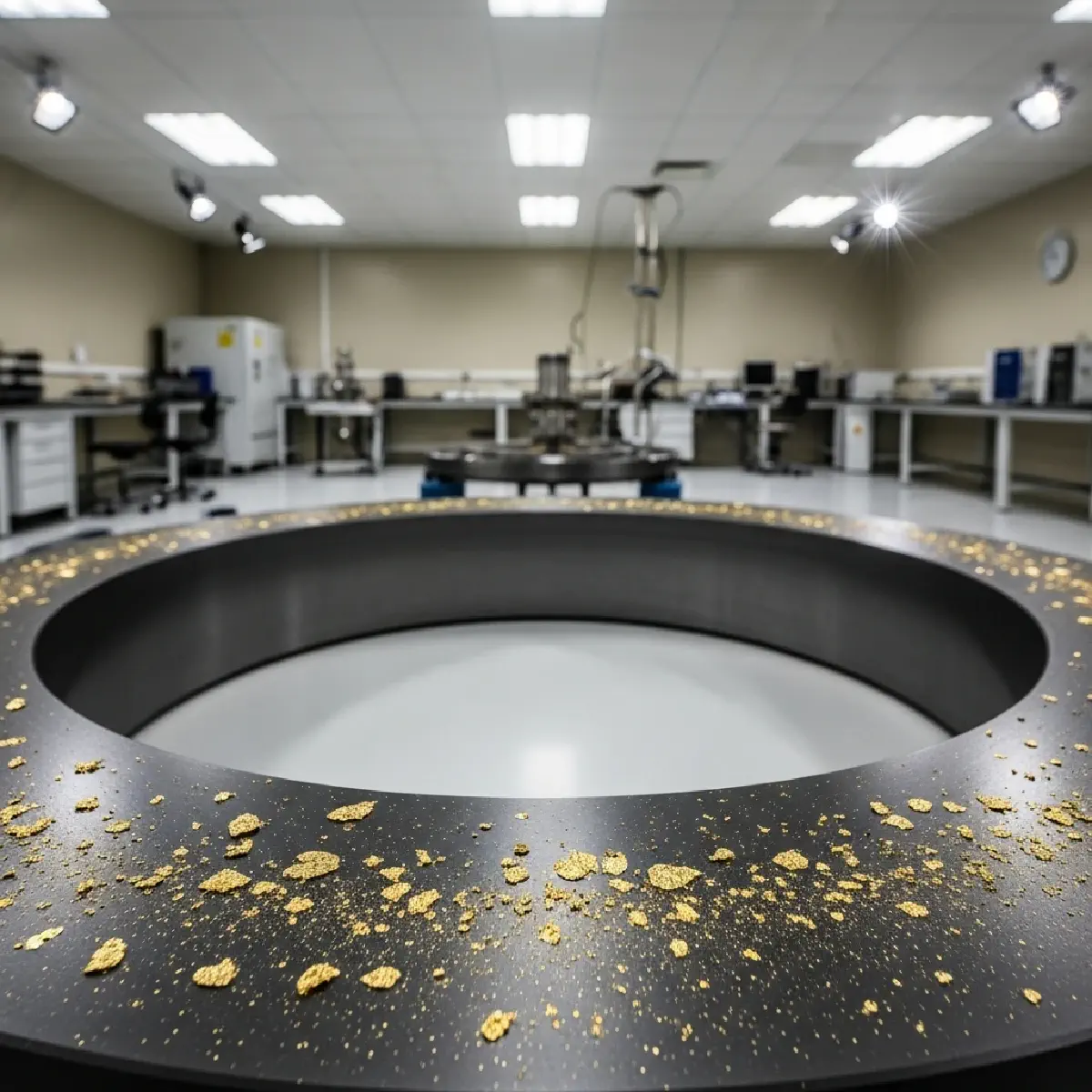
Extravehicular activity (EVA) performed during mission STS-120 allowed for the physical collection of metallic debris using polyimide tape. Subsequent analysis at the Kennedy Space Center Failure Analysis Laboratory utilized scanning electron microscopy (SEM) and energy dispersive spectroscopy (EDS) to characterize these fragments. The debris consisted of nitrided 15-5 PH stainless steel shards ranging from 50 μm (0.0019 in) to 1 mm (0.039 in). Investigators determined that the gold plating on the TBAs had failed to maintain adhesion to the 440C substrate. Artificial aging of flight spares demonstrated that corrosion occurred at the interface between the plating and the substrate, allowing the plating to detach in ribbons. Without this lubricant, the frictional forces between the rollers and the race ring increased substantially.
The Cascade of Subsurface Spalling#
The absence of gold lubrication transferred excessive loads directly to the race ring surface. These shards displayed evidence of Hertzian contact stress failure, which is characterized by fracture paths that run parallel to the outer surface. The fracture features were brittle and initiated at subsurface locations where Niobium-rich precipitates acted as stress concentrators. Laser confocal microscopy revealed that the resulting spalling was restricted to the nitrided case, which had a specified depth of less than 170 μm (0.0067 in). The debris remained within the joint due to magnetic forces, where it was pulverized by the rollers and formed extruded agglomerates that further increased the drive torque.
The Resolution Through Viscous Substitution#
The resolution of the SARJ crisis required a fundamental shift in the station’s lubrication strategy. In November 2008, mission STS-126 implemented a repair protocol involving the physical cleaning of the race surfaces with terry cloth wipes and metal scrapers. Astronauts replaced the damaged TBAs and applied Braycote grease, a vacuum-stable lubricant, to the race rings using a specially designed grease gun. This procedure successfully lowered the coefficient of friction and allowed the joint to return to continuous autotrack operations by 2010. The transition from solid gold plating to a viscous lubricant mitigated the contact stress issues that led to the spalling. Monitoring continues via telemetry of the motor current loads to ensure that the port and starboard joints maintain their structural integrity.