
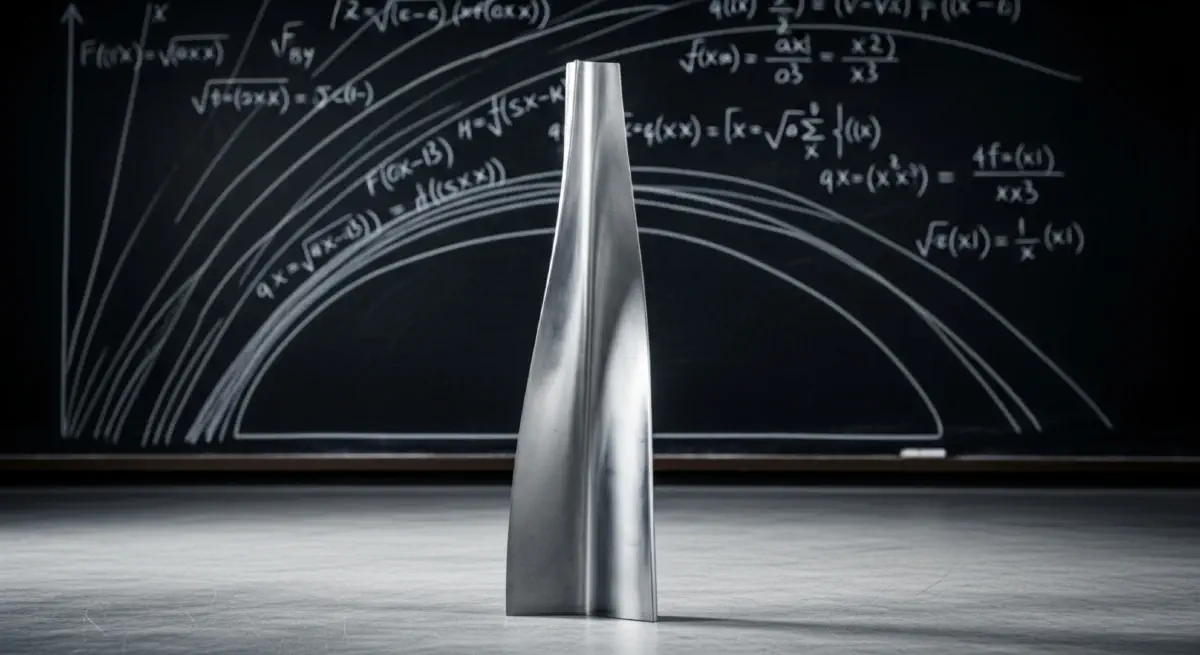
A man stands in a shed in Dayton, Ohio, holding a piece of spruce wood. He is trying to decide how much to shave off the trailing edge of a propeller. If he takes too much, the wood will snap under the strain of the engine. If he takes too little, the propeller will not catch enough air to pull his machine off the ground. He has no computer. He has no sensors. He has only a wind tunnel he built himself and the memory of every propeller that has already failed him. He is performing the act of optimization. He does not call it that. He calls it trying to make the thing work.
Every object we build is a collection of compromises. You want a car that is fast, but you also want a car that does not burn a gallon of petrol every five miles. You want a bridge that can hold a thousand lorries, but you do not want to spend the entire national budget on steel to build it. In the language of the office, people call this “striking a balance.” In the language of the engineer, we call it the design space. It is a map of every possible version of a machine that could exist. Most of these versions are useless. Some will break. A few will work. Only one is the best.
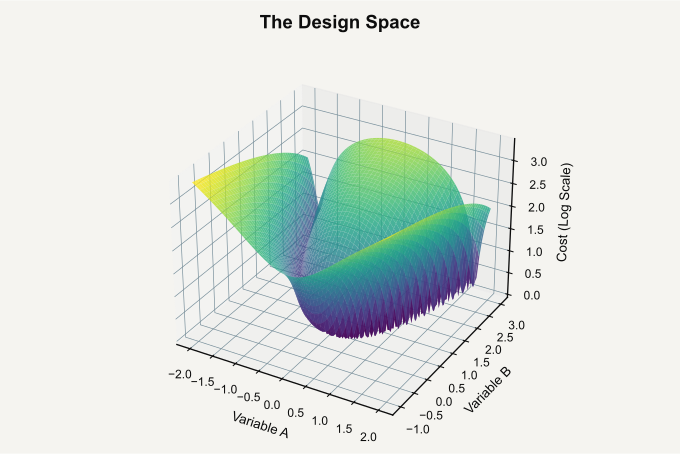
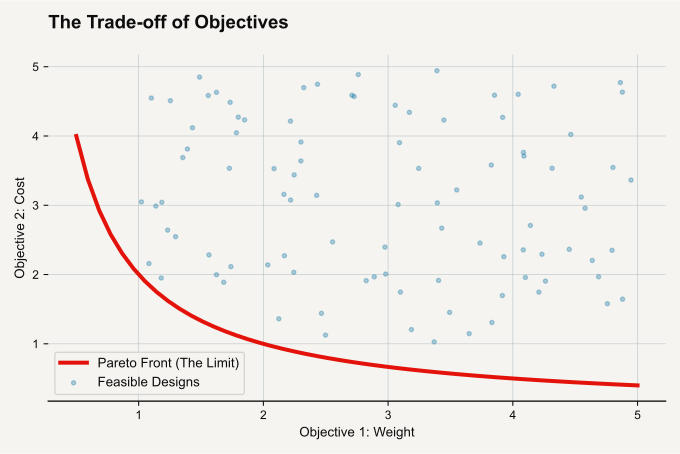
To find that one version, the engineer must first decide what he values. We call this the objective. It is the one number that tells you if you are winning or losing. If you are building a racing car, the number is the time it takes to circle a track. If you are building a cargo plane, the number is the cost to carry a ton of freight a thousand miles. You cannot value everything at once. If you try to make a plane that is the fastest, the lightest, and the cheapest all at the same time, you will end up with a drawing that never leaves the paper. You must pick a master.
Once you have a goal, you face the limits. We call these constraints. The laws of physics do not care about your mission statement. The steel will melt at a certain heat. The wing will buckle at a certain load. The fuel tank only holds so many gallons. These are the walls of the room. You can move around inside the room, but if you try to walk through the wall, the machine fails. The act of design is the act of walking as close to the wall as you can without touching it. The most efficient machines are almost always the ones that are nearly broken.
For most of history, we found these limits by breaking things. You built a bridge, and if it fell down, you built the next one with thicker pillars. This was slow and it was expensive. It also meant we never knew how much extra stone we were using. We built “safety factors” into everything. A safety factor is a polite way of saying “I do not know exactly when this will break, so I will make it three times heavier than I think it needs to be.” It is a mask for ignorance. It is the weight of what we do not understand.
Then came the math. In the seventeenth century, men like Newton and Leibniz began to describe the world not as a set of fixed things, but as a set of changes. They gave us the derivative. A derivative is a way of feeling the slope of a hill while you are standing in the dark. If you take a step to the left and the ground rises, you know the peak is that way. If you take a step to the right and the ground falls, you know you are moving into a valley. This is how a computer “thinks” about a wing. It does not see a wing. It sees a list of numbers—the thickness at the front, the curve at the back, the length of the spar. It changes one number by a tiny amount and checks if the objective—the drag or the weight—goes up or down.
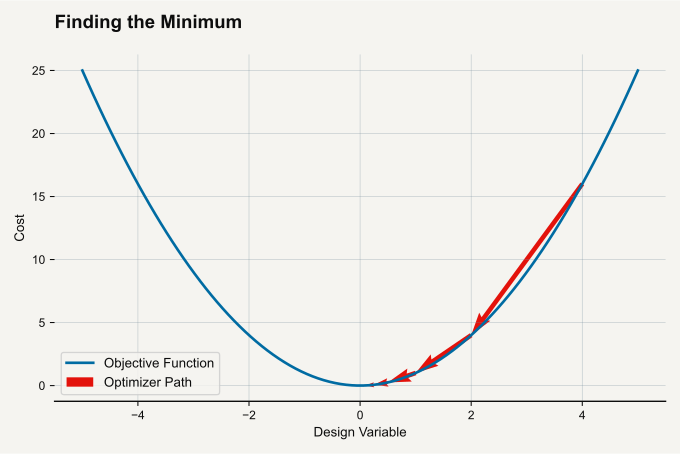
But there is a trap. We call it the local optimum. Imagine you are walking in a thick fog, trying to find the lowest point in a mountain range. You walk downhill until every direction you step leads back up. You stop. You think you have found the bottom. But you are only in a small crater on the side of a peak. Five miles away, there is a vast, deep valley that is much lower than where you are standing. But because you only looked at the ground beneath your feet, you never saw it. This happens in engineering every day. A company builds a jet engine that is five percent better than the last one. They think they have reached the limit. In reality, they are just at the bottom of a very small hole. To find the real valley, they would have to climb back up and look elsewhere. They rarely do. It is too expensive to be wrong.
The modern world does not build propellers in sheds anymore. We build systems. A modern jet engine is not one thing; it is a thousand things fighting each other. The person who designs the fan blades wants them to be thin so they slice the air. The person who designs the cooling system wants the blades to be hollow so he can pump cold air through them. The person who pays the bills wants them to be made of cheap steel. If the fan designer wins, the engine melts. If the cooling designer wins, the engine is too heavy to fly. If the accountant wins, the engine lasts for a week.
We call the solution to this “Multidisciplinary Design Optimization.” It is a long name for a simple problem: how do you get three people in different rooms to stop ruining each other’s work? In the old days, they sent memos. The fan designer would finish his drawing and hand it to the cooling designer. The cooling designer would look at it, realize it was impossible, and hand it back. This loop could go on for years. It was a machine for wasting time.
Now, we use a single equation to link them. We call it the Unified Derivatives Equation. It is a mathematical ledger. It tracks how a change in the thickness of a bolt in the engine affects the fuel consumption of the entire airplane ten hours later. It strips away the bureaucracy. It does not matter what the head of the engine department thinks or what the head of the wing department says. The equation shows the physical truth: if you change this, that happens. It forces the system to be honest.
But even with the best math, we are still guessing. A computer model is a simplified map of reality. It assumes the air is smooth. It assumes the metal has no flaws. It assumes the pilot will always do what he is told. None of these things are true. The gap between the computer and the sky is where the danger lives. We try to account for this by “optimizing under uncertainty.” We no longer look for the single “best” design. We look for the “robust” design.
A robust design is a machine that works well even when things go wrong. Imagine two bridges. Bridge A is perfect. If the wind blows at exactly fifty miles per hour, it is the most efficient structure ever built. But if the wind blows at fifty-one miles per hour, it collapses. Bridge B is not perfect. It uses more steel than it needs. It is “sub-optimal” on paper. But it stays standing whether the wind blows at ten miles per hour or a hundred. In a world of machines, the person who builds Bridge A is a genius on Monday and a criminal on Tuesday. The person who builds Bridge B is an engineer.
We are entering an era where we can “grow” shapes that no human would ever think to draw. We use “Genetic Algorithms.” We tell the computer the rules of the room—the constraints—and we tell it the goal. Then we let it “breed” thousands of designs. It keeps the ones that work and throws away the ones that don’t. After ten thousand generations, it produces a bracket for a satellite or a bone for a prosthetic leg. These shapes do not look like engineering. They look like driftwood or dried muscle. They have no straight lines. They have no right angles. They are the result of a blind process that only cares about the limit.
There is a temptation to think that because the computer found the shape, the shape must be right. This is a mistake. The computer only knows what you told it. If you forgot to tell it that the metal will rust, it will give you a shape that is beautiful for a month and a pile of orange flakes by the year’s end. If you forgot to tell it that a human must be able to reach the bolt with a wrench, you will build a machine that can never be fixed. The computer is a fast clerk, not a wise judge.
In the end, optimization is not about math. It is about the refusal to accept “good enough” when “better” is possible. It is the realization that every gram of weight we save on a rocket is a gram more of fuel we can carry to another planet. It is the understanding that the shape of a turbine blade is not a matter of taste, but a matter of how much coal we must burn to keep the lights on in a city. We are surrounded by these invisible decisions. Every car, every phone, every window frame is a physical record of a thousand small battles between what we want and what the world allows.
The designer in the shed in Ohio did not have the Unified Derivatives Equation. He had a piece of wood and a sense of the wind. But he was looking for the same thing we are looking for today. He was looking for the edge of the possible. He knew that if he could find the exact shape that was just strong enough and just light enough, he could do something no one had ever done. He could leave the ground.
The perfect machine is the one where every part fails at exactly the same moment.