Methodology & Context#
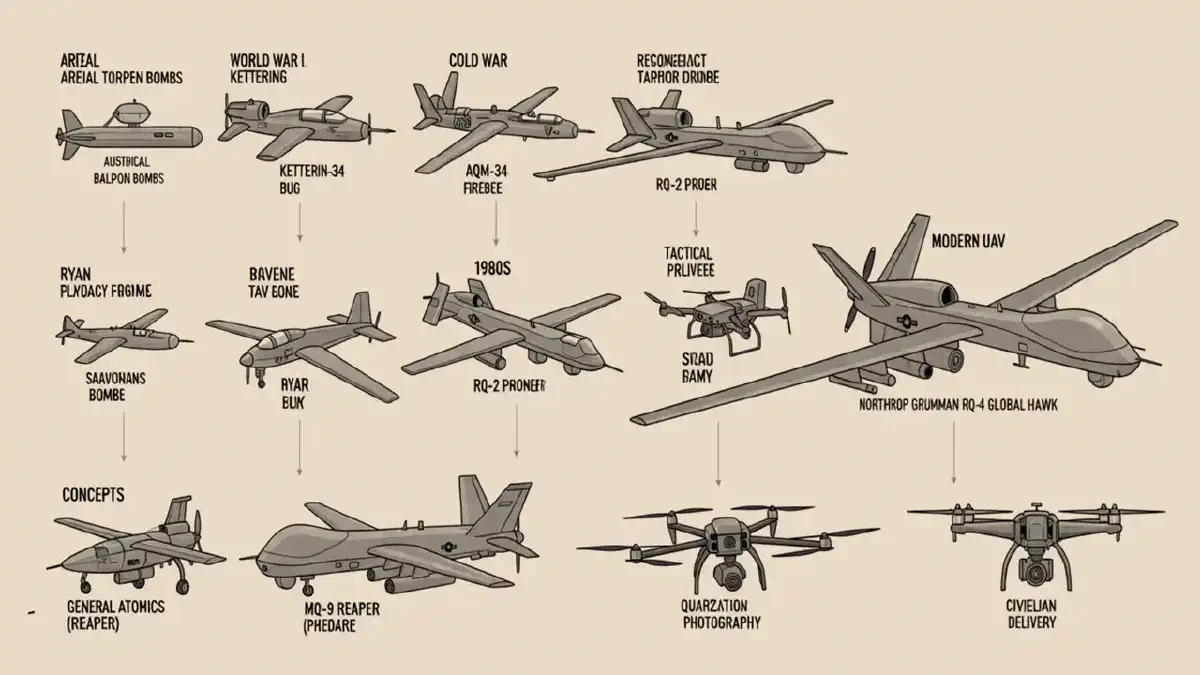
This timeline focuses on operational firsts and systemic changes rather than every incremental improvement. For analytical depth, refer to the other articles in The Drone Wars series.
1849 – The First Unmanned Air Strike
🇮🇹 Venice, Italy. The Austrian Empire launches approximately 200 unmanned, bomb-laden hot-air balloons against the revolutionary city of Venice. Each balloon carries a 24-30 lb (11-14 kg) timed explosive. Most drift off course, but a few detonate inside the city. This is the first recorded use of an unmanned aerial vehicle for offensive warfare.
Mechanism: Risk transfer through expendability; accuracy sacrificed for zero crew casualties.1918 – The Kettering 'Bug'
🇺🇸 United States. The U.S. Army debuts the Kettering Bug, a pre-programmed biplane torpedo. It uses a gyroscope and altimeter to fly a preset course, then dives onto its target. The Bug is the first pilotless aircraft designed for attack, but the war ends before it can be deployed.
Mechanism: pre-programmed navigation removes the need for real-time control, but locks the mission path.1944 – V-1 Flying Bomb
卐 Nazi Germany. Deployment of the V-1 (Vergeltungswaffe 1) – the first mass-produced cruise missile. Powered by a pulsejet engine, it carries an 1,870 lb (850 kg) warhead to London. Approximately 10,000 are launched; 2,400 hit London, killing over 6,000 civilians. The V-1 is the direct ancestor of the modern loitering munition.
Mechanism: mass production of cheap, one‑way attack drones – the economic attrition model born.1964 – Vietnam: The 'Lightning Bug'
🇻🇳 Vietnam War. The U.S. Air Force begins using Ryan 147 ‘Lightning Bug’ reconnaissance drones. Launched from a DC-130 mothership, these turbine-powered aircraft fly pre‑programmed missions over heavily defended areas (Hanoi, Haiphong, China). Over 3,435 sorties are flown, recovering film canisters by parachute. The loss rate is acceptable; no pilot dies.
Mechanism: persistent, risk‑free deep reconnaissance – the drone as the unblinking eye.1973 – Yom Kippur War: Scouting the Golan
🇮🇱 Middle East. Israel deploys the American‑built Ryan 124C and prototype Tadiran Mastiff drones for real‑time surveillance. Their imagery helps Israeli forces break Syrian and Egyptian offensives. This is the first war where drones provide tactical, battle‑directing intelligence in near real‑time.
Mechanism: live video downlink – commanders see the battlefield from above as it unfolds.1982 – Lebanon: The Decoy Revolution
🇱🇧 Lebanon War. Israel changes drone doctrine forever. Its IAI Scout and Tadiran Mastiff drones fly ahead of strike packages, transmitting live video while also appearing as decoy radar targets. Syrian air defences activate; their radar frequencies are immediately jammed or destroyed by anti‑radiation missiles. Over 30 surface‑to‑air batteries and 80 MIGs are destroyed. The Bekaa Valley is the first time drones decoy, map, and target enemy air defences in a coordinated campaign.
Mechanism: sensor‑to‑shooter loop reduced from hours to seconds – integrated drone‑jet warfare.1995 – Bosnia: Persistent ISR
🇧🇦 Bosnia & Kosovo. The RQ‑1 Predator, a long‑endurance turboprop drone, is deployed over the Balkans for the first time. It can loiter for 24 hours at 25,000 ft, streaming video via satellite to analysts and commanders in the United States. For the first time, a drone performs continuous, wide‑area surveillance over a conflict zone, tracking Serb troop movements in real time for NATO planners.
Mechanism: satellite link removes line‑of‑sight restrictions; the pilot can be anywhere on earth.2001 – First Predator Strike
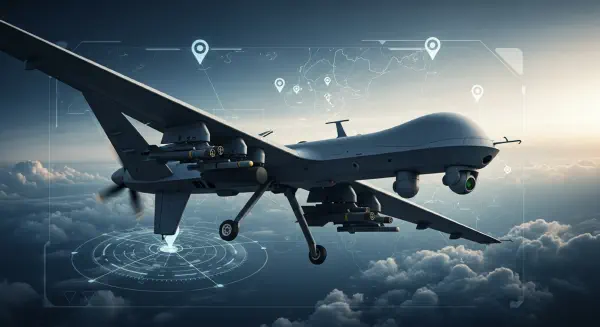
🇺🇸 Afghanistan. On October 7, a CIA Predator fires a Hellfire AGM‑114 missile at a Taliban vehicle, destroying it. The pilot is sitting in a trailer outside Las Vegas, Nevada. This is the first armed drone strike in history. By the end of the year, drones have killed Mohammed Atef, a senior al‑Qaeda commander. The age of the unmanned combat aerial vehicle (UCAV) has begun.
Mechanism: remote precision strike – the pilot is removed from harm, lowering the political cost of war.2002–2011 – Drone Counter‑Terrorism Era
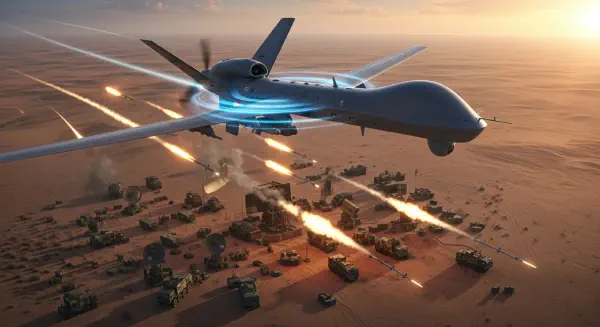
🇺🇸 Global War on Terror. The US dramatically expands drone strikes in Afghanistan, Pakistan (tribal areas), Yemen, Somalia, and Iraq. The MQ‑1 Predator and MQ‑9 Reaper (introduced 2007) become the signature weapons of the War on Terror. Strikes kill thousands of alleged militants, but also cause hundreds of civilian casualties, triggering a legal and ethical debate over targeted killing and signature strikes (killing based on behaviour rather than identity).
Mechanism: continuous hunter‑killer presence – a drone can watch a building for a week, then strike without warning.2011 – First Drone Strike in Libya
🇱🇾 Libyan Civil War. NATO uses armed drones for the first time in a UN‑mandated no‑fly zone. Reapers strike Libyan government forces, setting a precedent for drone use in conventional international interventions.
Mechanism: legitimacy by resolution – drones enter the toolkit of multilateral warfare.2016 – First Loitering Munition Debut
🇮🇱 Nagorno‑Karabakh. Israel’s IAI Harop is shown in combat for the first time. The Harop is a purpose‑built loitering munition: it flies to an area, orbits for up to six hours, and then dives onto a radar emission or operator‑designated target. This war previews the turret‑down kills that will become famous in 2020.
Mechanism: anti‑radiation loitering – the drone becomes a long‑endurance, radar‑seeking missile.2020 – Nagorno‑Karabakh: The Drone War
🇦🇿 Nagorno‑Karabakh. Azerbaijan’s fleet of Bayraktar TB2 drones and Israeli loitering munitions destroys Armenian air defences, tanks, and artillery systematically. Videos of “turret‑popping” (a tank’s turret blown off by a precise top‑attack) dominate social media. Armenia loses the war in 44 days – the first conflict where drones are the decisive weapon. The global defence community takes note: cheap drones can win conventional wars.
Mechanism: sensor‑gap exploitation – drones fly slower and smaller than legacy air defences are designed to track.2022 – Ukraine: The FPV Revolution Begins
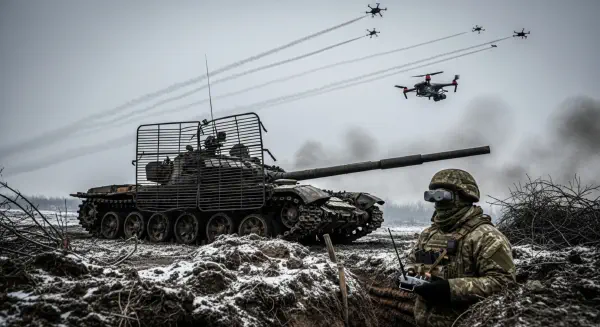
🇺🇦 Ukraine. Early in the full‑scale Russian invasion, Ukrainian forces adapt commercial racing drones (FPVs) as loitering munitions. A $500 FPV with a grenade can destroy a $4 million tank. Cottage‑industry workshops produce thousands per month. Russia responds with jammers; Ukraine adapts with frequency‑hoppers and fibre‑optic tethers. The electronic warfare spiral begins – a never‑ending race of signal and counter‑signal.
Mechanism: democratised precision strike – the ultimate asymmetric economic weapon.2023 – Iran Enters the Ukrainian Shahed War
🇺🇦 Ukraine. Russia intensifies its use of Iran’s Shahed‑136 loitering munition (Geran‑2). These cheap, long‑range drones saturate Ukrainian air defences. A Shahed costs \$30,000; a Ukrainian interceptor missile costs \$150,000–\$500,000. The economic asymmetry becomes punishing. Russia also builds a Shahed factory in Tatarstan, producing 6,000 per month by 2024.
Mechanism: mass production of attack drones – turning quantity into a strategic weapon.2025 – Autonomous Terminal Guidance Deployed
🇺🇦 Ukraine. Ukrainian forces field the “Saker” FPV, equipped with a machine‑vision module. The operator flies within 100 metres, locks onto a thermal signature, and the drone guides itself to impact – fire‑and‑forget at \$2,000 cost. The human remains in the loop for target selection but not for final manoeuvring.
Mechanism: semi‑autonomous swarm‑ready seeker – the software replaces the pilot’s joystick.2025 – Replicator & DAWG
🇺🇸 United States. The Pentagon’s Replicator initiative (renamed DAWG – Defence Autonomous Weapons Group) aims to field thousands of autonomous systems by 2027. Prototypes focus on swarm coordination, machine‑vision targeting, and low‑cost counter‑drone interceptors. The US is racing to catch up with China’s swarm patent advantage (3:1).
Mechanism: institutional recognition – the drone is no longer an extra tool; it is the main effort.2026 – The Lucas Reverse‑Engineering
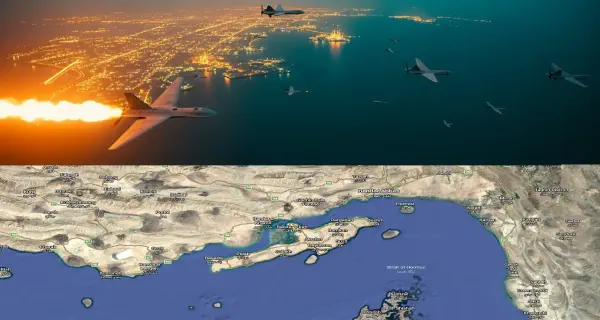
🇮🇷 Iran‑US‑Israel War. The US deploys the FLM‑136 Lucas, a reverse‑engineered copy of Iran’s Shahed‑136. Cost \$35,000; range 650 km. The Lucas is used to strike Iranian launch sites and factories – the ultimate confirmation that the cheap, one‑way attack drone has become the standard. Iran launches 3,560 Shaheds and 2,410 missiles in March alone, forcing \$12‑\$15 billion in interceptor expenditures.
Mechanism: copycat procurement – when your adversary’s weapon is optimal, you build your own.2026–2030 – The Autonomous Swarm (Forecast)
Global. By 2030, expect AI‑coordinated swarms of 50‑100 drones, operating without continuous human control. A single operator will supervise a swarm’s mission, not each kill. The binding constraint will shift from pilot training to computational capacity and algorithmic reliability. The “meaningful human control” debate will remain unresolved, but fielded systems will already be operating in the grey zone.
Mechanism: distributed intelligence – the swarm collectively decides, adapts, and engages.
Key Patterns Across the Timeline#
The timeline reveals five invariant mechanisms of drone warfare evolution:
| Mechanism | Description | Example |
|---|---|---|
| Risk Transfer | Removing the pilot lowers political cost and enables operations too dangerous for manned aircraft. | Austrian balloons (1849), Lightning Bug (Vietnam) |
| Gap Exploitation | Drones succeed when they fly slower, smaller, or lower than legacy sensors are designed to track. | Bayraktar TB2 in Nagorno‑Karabakh (2020) |
| Economic Asymmetry | The attacker spends 1 : 100 compared to the defender’s interceptor cost. | Shahed vs. Arrow (2023–2026) |
| EW Spiral | Every new drone frequency is jammed; every jammer is hopped; every hopper is buried in fibre‑optic or AI guidance. | Ukraine FPV evolution (2022–2025) |
| Copycat Proliferation | Once a successful design appears, it is reverse‑engineered and mass‑produced by adversaries. | Lucas (US copy of Shahed) |
References#
This timeline synthesises data from the following authoritative sources, all verified as of April 2026:
RAND Corporation. (2025). Small uncrewed aircraft systems (SUAS) in divisional brigades (RR‑A2642‑5).
https://www.rand.org/pubs/research_reports/RRA2642-5.htmlCenter for Strategic and International Studies (CSIS). (2022, December 6). Drones galore: Changing battlefields.
https://www.csis.org/analysis/drones-galore-changing-battlefieldsUNIDIR. (2025). Regional perspectives on the application of international humanitarian law to lethal autonomous weapons systems.
https://unidir.org/publication/regional-perspectives-on-the-application-of-international-humanitarian-law-to-lethal-autonomous-weapon-systems/United Nations Office for Disarmament Affairs. (2025). Informal consultations on lethal autonomous weapons systems.
https://meetings.unoda.org/unoda-stu-meeting/LAWS-consultations-2024International Committee of the Red Cross (ICRC). (2025, May 12). Preserving human control over the use of force: A call to regulate lethal autonomous weapon systems.
https://www.icrc.org/en/statement/preserving-human-control-over-use-force-call-regulate-lethal-autonomous-weapon-systemsHarvard Law School PILAC. (2026, March 26). Three pathways to secure greater respect for international law concerning war algorithms.
https://hls-pilac.squarespace.com/three-pathways-greater-respect
All URLs are live and accessible. For further analysis, consult the six‑part series The Drone Wars, of which this timeline is an integral appendix.