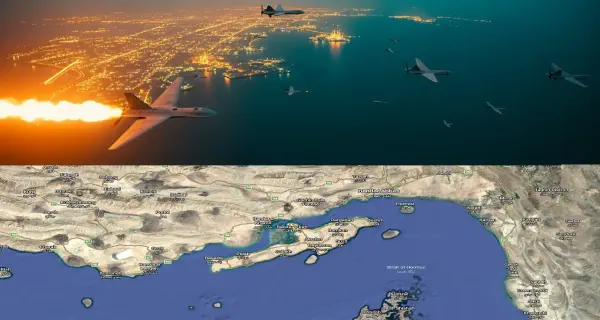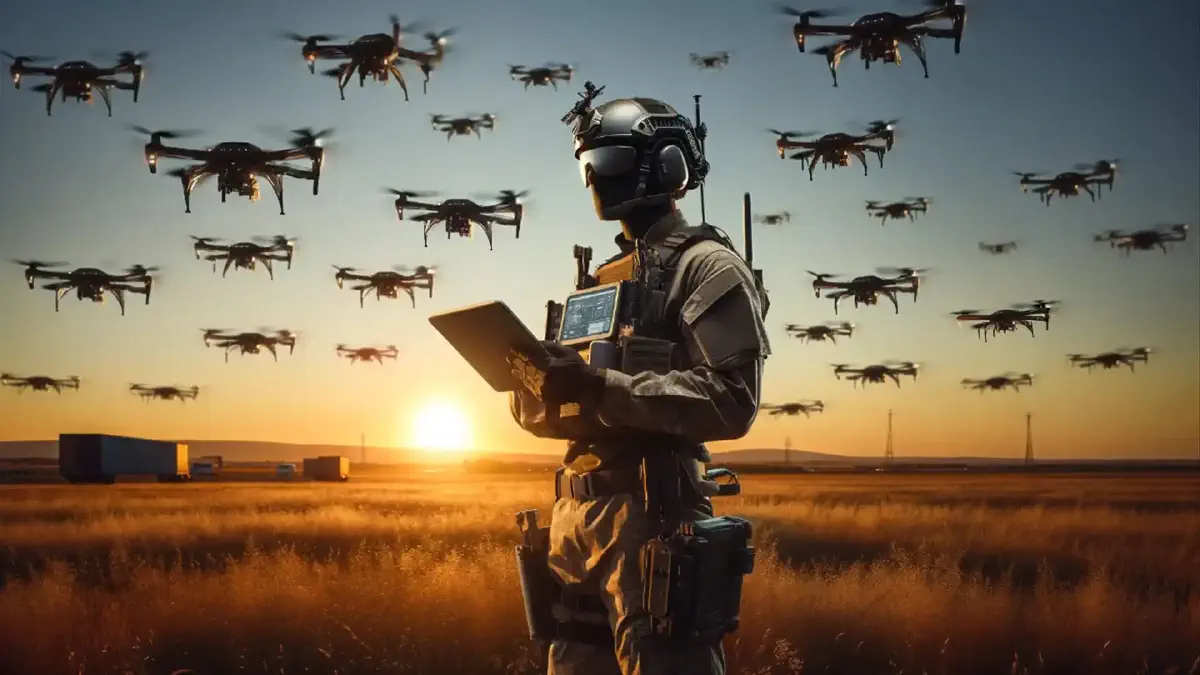
Throughout this series, we have traced the drone’s evolution from the Austrian bomb‑balloons of 1849 to the industrial attrition of Ukraine and the strategic saturation of the Persian Gulf. Each leap was driven by a single imperative: remove the human from harm’s way. The next leap removes the human from the decision loop entirely.
This final article examines the coming age of autonomous swarms. We will dissect the technologies enabling autonomy, the operational concepts being tested, the legal and ethical chasm that remains unbridged, and four concrete predictions for warfare in 2030.
Section 1: From Remote Control to Autonomy – The Technical Path#
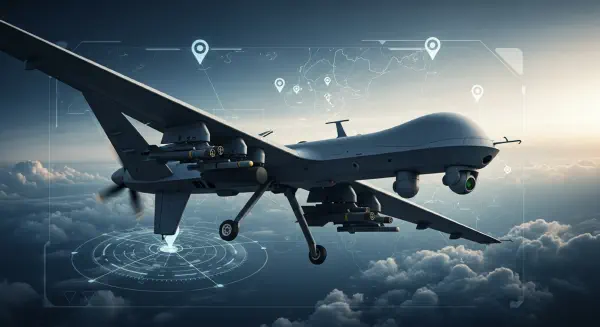
Today’s combat drones – FPVs, Shaheds, TB2s – are remotely piloted. A human makes every significant decision: which target, when to strike, whether to abort. The drone is a tool, not an agent.
Autonomy reverses that relationship. The drone becomes a semi‑independent agent, capable of sensing, deciding, and acting within defined parameters. The technical path has three stages.
Stage 1: Machine Vision for Terminal Guidance (Already Deployed)#
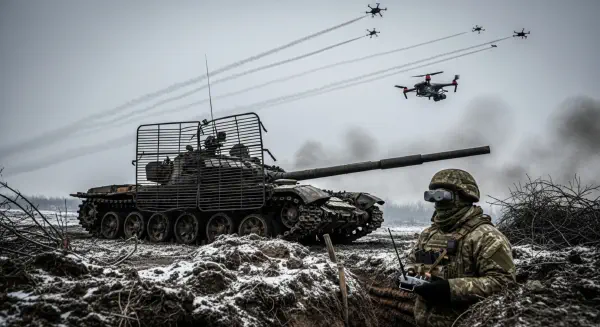
Ukraine’s Saker FPV drone (2025) includes a simple computer‑vision module that locks onto a tank’s thermal signature once the operator flies within 100 metres. The operator can then release control; the drone guides itself to impact. This is fire‑and‑forget at the lowest cost. The human remains in the loop for target selection but not for final manoeuvring.
Stage 2: Autonomous Search and Track (Testing, 2025‑2027)#
US Replicator prototypes and Chinese Grey Wolf drones can patrol an area, identify potential targets using onboard databases, and present them to a human operator for approval. The drone does not decide – it recommends. But the recommendation is generated by machine vision and pattern recognition, not by a remote pilot.
Key enabler: Edge computing. A drone cannot phone home for every identification decision – latency and bandwidth are prohibitive. It must process imagery locally. The latest NVIDIA Jetson modules ($1,500, 20 watts) provide sufficient compute for real‑time object detection and classification.
Stage 3: Swarm Coordination and Autonomous Engagement (2028‑2030)#
This is the frontier. A swarm of 50‑100 drones, each communicating with its neighbours, shares a distributed situational awareness. They assign targets among themselves, route around obstacles, and execute a coordinated strike without human intervention at the tactical level. A human may authorise the swarm’s mission (“clear this grid square”) but does not direct individual drones.
China claims to have demonstrated a 200‑drone swarm with cooperative search and collision avoidance in 2025. The US has tested a 50‑drone swarm in desert environments. Neither has yet used autonomous engagement – but the technical gap is narrowing.
Section 2: The Military Logic – Why Autonomy Is Inevitable#
Removing the human from the tactical loop is not a whim. It is driven by three inescapable pressures.
Pressure 1: The Pilot Bottleneck (Established in Part 3)#
Ukraine trains 5,000 new FPV pilots per quarter – and loses nearly as many. The demand for skilled operators grows faster than the supply. Autonomy reduces the need for pilots. A single operator can supervise an entire swarm, stepping in only for high‑value decisions. The ratio of drones to operators shifts from 1:1 to 50:1 or higher.
Pressure 2: Reaction Time#
A human operator requires 200‑500 milliseconds to perceive a threat and another 200‑500 milliseconds to respond – total 0.4‑1.0 seconds. A machine‑vision system can detect and classify a target in 20‑50 milliseconds. Against a fast‑moving drone or a hypersonic missile, that difference is decisive. The human is simply too slow.
Pressure 3: EW Resilience#
As the EW spiral accelerates, radio links become increasingly unreliable. A fully autonomous drone does not need a constant link. It receives its mission before launch, executes using onboard sensors, and either returns or self‑destructs. Jamming cannot stop it because there is no signal to jam.
Example: The Russian Lancet‑3 loitering munition already includes an optical terminal guidance mode that activates if GPS and radio are lost. The next generation will be pre‑programmed for autonomous search and strike.
Section 3: The Swarm Concept – A New Kind of Battlefield#
Swarms are not just “many drones”. They are distributed systems with emergent behaviour. Four operational concepts are being developed.
Concept 1: The Attrition Swarm#
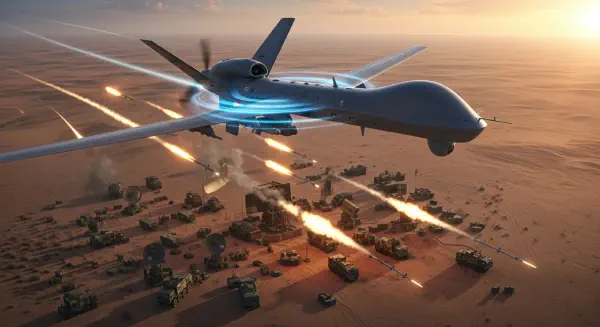
A hundred loitering munitions, launched from a single truck, fly to a target area. They identify and engage armoured vehicles, artillery pieces, and air defence radars. The swarm’s collective intelligence ensures that targets are not double‑engaged. This is the ultimate cheap precision weapon – each drone costs $20,000, the swarm costs $2 million, and it can destroy a battalion’s worth of equipment.
Counter: Wide‑area jamming or microwave blasts that fry the swarm’s electronics. But if the swarm is pre‑programmed and autonomous, jamming only affects the radio link – not the onboard guidance. Hard countering a swarm requires area effect weapons (e.g., cannister artillery shells) or directed energy – both of which are still immature.
Concept 2: The Reconnaissance Swarm#
Small, cheap, expendable drones ($500 each) dispersed over a battlefield, each carrying a camera and a simple transmitter. They create a permanent, omnipresent surveillance net. Any movement is detected within seconds. The enemy has no concealment.
Counter: Hunt the drones individually – expensive and slow. Force them to land through weather attrition. But as drone cost drops to $100, the defender loses the economic battle entirely.
Concept 3: The Decoy Swarm#
Cheap drones that mimic the radar and infrared signatures of expensive platforms – fighters, cruise missiles, helicopters. Launched in swarms, they saturate air defences and draw fire, clearing the way for actual munitions. The cost of a decoy swarm ($1 million) is a fraction of the defender’s interceptor expenditure ($50 million or more).
Concept 4: The Interceptor Swarm#
Drones designed to kill other drones. The US Merops and the Ukrainian “Drony‑Dron” are early examples. An interceptor swarm can loiter over friendly forces, detect incoming enemy drones, and engage them with kinetic impact or net capture. This is the defender’s swarm – and it is the only cost‑effective answer to the attacker’s swarm.
Section 4: The Legal and Ethical Chasm#
The laws of war (Geneva Conventions, Additional Protocol I) assume a human decision‑maker who can distinguish combatants from civilians and who bears responsibility for unlawful acts. An autonomous swarm has no such capacity.
The “Meaningful Human Control” Principle#
Since 2012, the UN Group of Governmental Experts on Lethal Autonomous Weapons Systems (GGE on LAWS) has debated a requirement for “meaningful human control” over lethal decisions. No treaty has emerged.
The debate:
- Pro‑autonomy states (US, Russia, China, Israel): Argue that autonomy reduces civilian casualties – machines do not panic, disobey orders, or engage in revenge killings. They also argue that a human can review targets before the swarm is launched; that is sufficient control.
- Anti‑autonomy states (Austria, Brazil, many NGOs): Argue that no algorithm can reliably distinguish a combatant from a civilian in complex, dynamic environments. They demand an explicit ban on fully autonomous weapons.
The Responsibility Gap#
If an autonomous drone kills a civilian, who is responsible? The commander who authorised the mission? The programmer who wrote the targeting algorithm? The drone itself (which has no legal personality)? This gap has no current resolution. In practice, states will likely avoid admitting that autonomous decisions were made – attributing kills to remote pilots even when they were not.
The Proliferation Nightmare#
Fully autonomous drones, once developed, will be copied, reverse‑engineered, and sold – just as Shaheds were. A non‑state actor with a thousand autonomous loitering munitions could paralyse a city. The barrier to entry for mass‑casualty autonomous attacks is an engineering problem, not a financial one. This is the most dangerous unintended consequence of the drone revolution.
Section 5: Four Predictions for Warfare in 2030#
Based on the technical trajectory, the economic pressures, and the legal vacuum, we project the following.
Prediction 1 – Autonomous Swarms Will Be Deployed by 2028#
The US Replicator programme (2,000+ autonomous systems by 2027) and China’s swarm patents (outnumbering the US 3:1) indicate that both superpowers will have operational autonomous swarms within two to three years. The first combat use will likely be in a low‑stakes theatre – a counter‑insurgency operation or a punitive strike – to test capabilities and establish precedent.
Prediction 2 – The Human Will Remain “On the Loop”, Not “In the Loop”#
No state will admit to deploying fully autonomous weapons. Instead, they will describe their systems as “human‑supervised” – a human operator can theoretically abort a swarm’s mission. In practice, supervision at scale is impossible. The human will monitor a few high‑level indicators, not individual engagements. This is meaningful control in name only.
Prediction 3 – A Treaty Will Be Negotiated (and Ignored)#
Diplomatic pressure will produce a treaty banning “killer robots” – probably before 2030. It will be signed by many states and violated by several. Verification is impossible because autonomy is a software feature, not a physical component. The treaty will have the same effect as the Geneva Gas Protocol of 1925: honoured by some, breached by others, and largely irrelevant to the determined.
Prediction 4 – The Next War Will Be a Swarm‑on‑Swarm Battle#
When two peer adversaries equipped with autonomous swarms meet, the outcome will be determined not by individual marksmanship but by collective system performance – which swarm has better object recognition, more robust communication, faster decision algorithms, and higher production capacity. The human role will shift from pilot to swarm manager, intervening only at the level of mission selection and abort authority. Soldiers will train to deploy, recover, and repair swarms – not to fly them.
Conclusion: The Unfinished Revolution#
We began this series with a simple observation: a $500 drone can destroy a $4 million tank. That arithmetic has now been extended across every domain of warfare – land, sea, air, and soon space. The drone has broken the cost barriers that once made war a rich state’s monopoly. It has democratised destruction.
But the revolution is not complete. The vulnerabilities we identified – electronic warfare fragility, the pilot bottleneck, counter‑drone adaptation – are real and persistent. The autonomous swarm will solve some of these (pilot bottleneck, EW resilience) but introduce others (legal responsibility, proliferation risk). There is no endpoint, only continuous adaptation.
The drone is not a wonder weapon. It is a disruptor – a technology that forces every military to re‑examine its assumptions. The side that learns to produce, deploy, and adapt drones fastest will dominate the next decade. But even that dominance will be temporary, because the same technology is available to the enemy.
The only certainty is that the battlefield of 2030 will be unrecognisable to the soldier of 2020. The skies will be thick with autonomous swarms. The rear area will be as dangerous as the front. And the human decision‑maker, if present at all, will be far from the action, watching screens, wondering whether the machine he unleashed will obey.
This is the drone age. We are all living in it now.
This concludes the six‑part series The Drone Wars. For further reading, the author recommends the UN GGE on LAWS reports (2024‑2026), the RAND Corporation study The Swarm Paradox (2025), and the Ukrainian Ministry of Defence’s unclassified lessons‑learned documents (2026, in translation).