The previous four parts of this series have traced the drone’s evolution from a curiosity to a decisive instrument of economic attrition. We have dissected the Ukrainian industrial laboratory and the Middle Eastern strategic siege. But no weapon is without its trade‑offs.
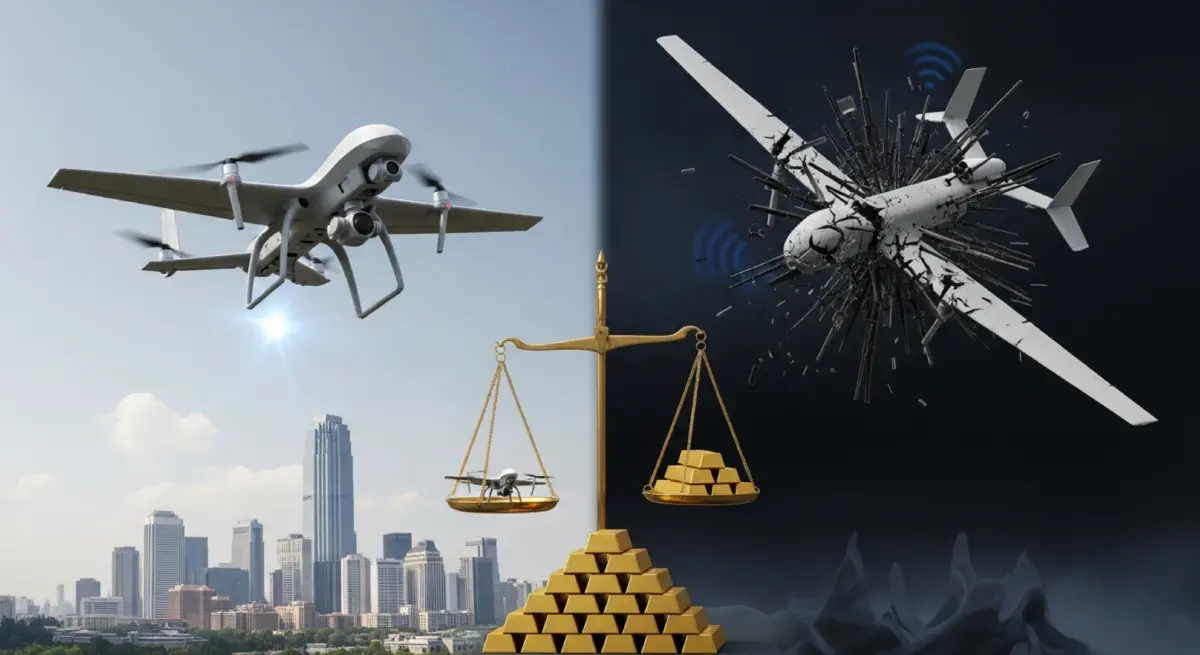
This article provides a dispassionate balance sheet. We examine the five core advantages that make drones attractive, the five critical vulnerabilities that constrain them, and the unintended consequences – strategic, legal, and psychological – that are already reshaping global security.
Section 1: The Five Strengths of Drone Warfare#
Strength 1 – Low Barrier to Entry#
Drones have democratised air power. A non‑state actor (Houthis, Hamas) can acquire loitering munitions for a few thousand dollars. A small state (Azerbaijan, Ukraine) can build a thousand‑strong drone fleet for the cost of a single fighter jet.
Mechanism: Modern drones rely on commercially available components: GPS modules, smartphone cameras, brushless motors, lithium batteries. No advanced supply chain required. The difference between a racing drone and an FPV weapon is a 3D‑printed grenade mount. This proliferation cascade is unstoppable.
Strength 2 – Asymmetric Economic Attrition#
As established in Part 1, the cost‑exchange ratio favours the attacker by one to two orders of magnitude. A \$30,000 Shahed forces a \$3.5 million Arrow‑3 intercept. A \$500 FPV can destroy a \$4 million tank. The defender bleeds money; the attacker bleeds cheap hardware.
Mechanism: The defender must build for reliability and performance (expensive). The attacker builds for minimum viable function (cheap). This structural gap cannot be closed by technology alone; it requires a shift in defence procurement philosophy – one that most Western militaries have resisted.
Strength 3 – Reduction of Political Risk#
A drone has no pilot to capture, torture, or parade on television. A drone strike does not produce a POW crisis. This lowers the political threshold for initiating conflict – a dangerous double‑edged sword, but an undeniable advantage for the attacker.
Mechanism: Casualty aversion is a dominant feature of post‑Vietnam Western democracies. Drones circumvent that aversion. The US conducted thousands of drone strikes in Pakistan, Yemen, and Somalia with minimal domestic political opposition precisely because no American lives were at risk.
Strength 4 – Persistence and the “Unblinking Eye”#
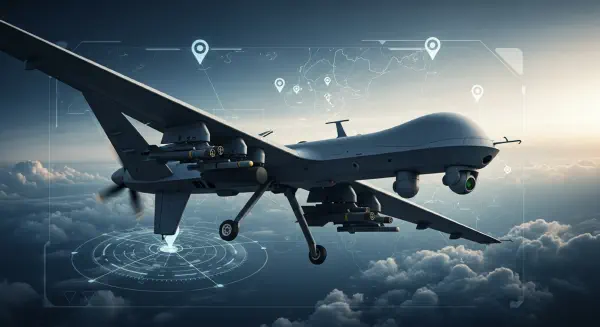
A manned fighter jet can loiter for 2‑3 hours before fuel exhaustion. A turboprop drone (Predator, TB2) can loiter for 24 hours. A solar‑electric drone (still experimental) could loiter for days. This persistence transforms intelligence and targeting.
Mechanism: The drone watches, waits, and strikes when the target is most vulnerable – not when the pilot’s fuel gauge demands a return. This “always on” surveillance is psychologically oppressive for the enemy.
Strength 5 – Force Multiplication#
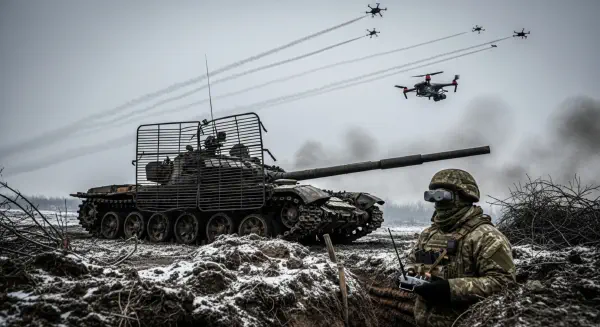
One skilled FPV operator, in a single sortie, can destroy a tank, a howitzer, and a supply truck – three separate missions that would previously have required an artillery battery or an airstrike. The ratio of operators to targets has inverted.
Mechanism: Precision guidance (human‑in‑the‑loop or machine vision) turns a cheap drone into a smart weapon. The operator’s skill substitutes for an entire fire‑direction centre.
Section 2: The Five Critical Vulnerabilities#
Vulnerability 1 – Electronic Warfare (EW) Fragility#
Most combat drones rely on radio links for command and video feedback. A cheap, man‑portable jammer (\$5,000) can cut that link within 1‑2 km, turning a lethal weapon into a falling brick. The EW spiral (described in Part 3) means no frequency is safe for long.
Example: Early 2022, Ukrainian TB2s dominated. By late 2022, Russian jammers had grounded most TB2 operations. The drone that cannot communicate is a glider.
Vulnerability 2 – The Skilled Pilot Bottleneck#
A drone is useless without a trained operator. Basic FPV proficiency requires 3‑6 months of full‑time training. Advanced missions (EW evasion, night operations, swarming) require 12‑18 months. Battlefield losses of pilots – through casualties, burnout, or capture – are harder to replace than drones.
Example: Ukraine trains approximately 5,000 new FPV pilots per quarter. It loses roughly 2,000 per quarter to attrition (killed, wounded, rotated out). The net gain is barely keeping pace with demand. Russia faces a similar squeeze.
Vulnerability 3 – Counter‑Drone Adaptation#
The defender is not passive. The same adaptation cycle that drives EW also drives kinetic countermeasures. Low‑cost interceptor drones (\$150,000 Merops), directed‑energy weapons (lasers, microwaves), and even trained eagles (in the Netherlands) have been fielded against drones. Each success forces the attacker to innovate again.
Example: Fibre‑optic FPVs (immune to jamming) emerged in 2024. By 2025, Russian troops had begun deploying net‑firing shotguns – drone‑hunting weapons that entangle fibre‑optic cables. The counter‑counter cycle continues.
Vulnerability 4 – Logistics and Weather#
Drones are fragile. Rain grounds small FPVs (electronics short). High winds (>40 km/h) degrade control. Extreme heat (Persian Gulf summer) overheats batteries, reducing endurance by 50%. Snow and ice foul rotors. Russia’s Shahed offensives drop sharply during winter months – not because of morale, but because the drones cannot fly reliably.
Example: In February 2025, a prolonged cold spell over Ukraine reduced FPV sorties by 70% for two weeks. Both sides used the pause to resupply and train.
Vulnerability 5 – Attribution and Escalation Risk#
Deniability cuts both ways. While Iran can plausibly deny proxy drone attacks, the attacked state must still respond. Over‑attribution can trigger escalation; under‑attribution invites more attacks. The ambiguity creates a dangerous guessing game.
Example: When a drone struck a Jordanian base in January 2026, killing three US soldiers, it took two weeks to determine whether Iran had launched it directly or whether a proxy had acted independently. The delay complicated the US response, which ultimately fell short of a full retaliatory strike.
Section 3: Unintended Consequences#
Beyond the immediate strengths and vulnerabilities, drone warfare has produced several second‑order effects that are reshaping conflict itself.
Consequence 1 – The End of Sanctuary#
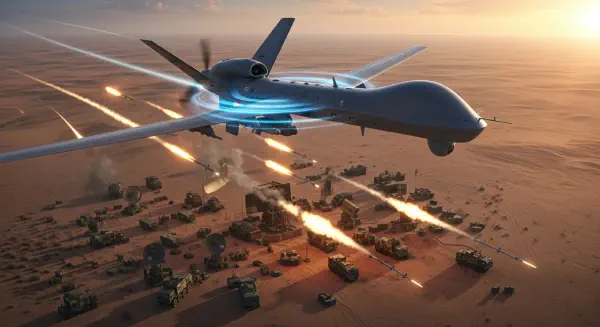
Traditionally, the rear area was safe. Artillery had range limits. Airstrikes required targeting intelligence. Drones erase that distinction. A Shahed can strike a refinery 1,000 km from the front. An FPV can hover over a general’s headquarters. Nowhere is safe.
Data point: In 2025, Ukraine struck Russian oil refineries as far east as Ufa (1,200 km from the border). Russia struck Ukrainian power substations in Lviv (30 km from the Polish border). Both sides have targeted command bunkers previously considered invulnerable.
Consequence 2 – The Social Media Spectacle#
Drone gun‑camera footage is easily released, easily edited, and easily weaponised as propaganda. The war is narrated through the attacker’s lens. This creates a distorted reality – the defender’s successes are invisible; the attacker’s kills are viral.
Effect: Public opinion becomes more volatile. A single dramatic strike can shift political support overnight. Governments lose control of the narrative because every drone operator with a GoPro is a potential propagandist.
Consequence 3 – Legal and Ethical Grey Zones#
International humanitarian law (IHL) assumes a human decision‑maker. When a drone operator is 500 km away, is that “direct participation in hostilities”? When a machine‑vision system selects a target, who is responsible? No treaty has caught up.
Example: In 2025, a Ukrainian FPV operator struck a Russian vehicle that, on post‑strike review, turned out to be an ambulance. The operator could not see the Red Cross symbol through the low‑resolution camera. Was this a war crime? The legal debate continues.
Consequence 4 – The Hollowing of Conventional Forces#
Drones are cheap; tanks, jets, and ships are expensive. The trend line suggests that states will invest less in traditional platforms and more in drone forces. But drones cannot hold ground, conduct close air support in contested EW environments, or perform strategic reconnaissance. Over‑investment in drones risks creating a hollow military – one that can harass but not conquer.
Data point: The US Army’s 2027 budget request reduces tank procurement by 40% while increasing drone spending by 300%. Some generals warn of “asymmetry addiction” – the belief that cheap drones can replace heavy forces, which has never been proven in a war of territorial conquest.
Section 4: The Balance – A Comparative Matrix#
The following table summarises the trade‑offs across four key dimensions. Use the arrows to interpret: ▲ indicates strength, ▼ indicates vulnerability, and (~) indicates ambiguous or contested effect.
| Dimension | Attacker Perspective | Defender Perspective |
|---|---|---|
| Economic | ▲ Low cost per platform | ▼ High cost per interception |
| Personnel | ▲ No pilot risk | ▼ Attrition of interceptor crews |
| Electronic Warfare | ▼ Radio‑link fragility | ▲ Jamming effectiveness (temporary) |
| Operational Tempo | ▲ Persistent loitering | ▼ Constant alert fatigue |
| Legal Risk | (~) Attribution ambiguity | (~) Difficulty of proportionate response |
| Public Perception | ▲ Viral propaganda | ▼ Defensive successes invisible |
| Strategic Depth | ▲ Rear area no longer safe | ▼ Sanctuary eliminated |
Conclusion: No Silver Bullet, No Free Lunch#
The drone has fundamentally altered the landscape of armed conflict. It has democratised air power, transformed economics into a weapon, and made every metre of territory vulnerable. But it has not abolished the need for soldiers, air defences, or strategy. It has merely added a new, unforgiving layer of complexity.
The five strengths – low cost, economic asymmetry, political risk reduction, persistence, and force multiplication – are real. So are the five vulnerabilities – EW fragility, pilot bottlenecks, counter‑drone adaptation, logistics, and attribution gaps. And the unintended consequences – the end of sanctuary, the social media spectacle, legal grey zones, and the hollowing of conventional forces – will take decades to resolve.
The drone is not a wonder weapon. It is a disruptor – a technology that breaks existing models and forces adaptation. The side that adapts fastest wins. But adaptation is never free. It requires money, time, and a willingness to accept new risks while shedding old assumptions.
Next: Part 6, the final article in this series, will peer into the future – autonomous swarms, AI‑driven kill chains, and the question of whether humans will remain in the loop at all. We conclude with four predictions for warfare in 2030 and beyond.