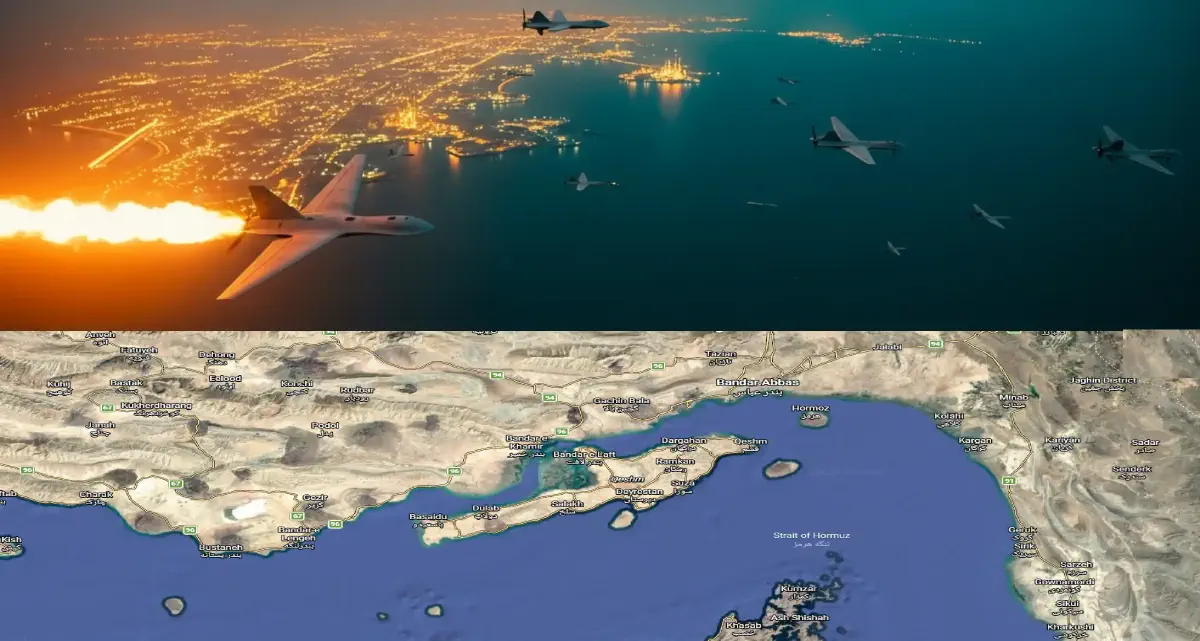
The previous three parts of this series established the core mechanism of drone warfare – asymmetric economic attrition – and traced its evolution from the Austrian balloons to the industrialised battlefields of Ukraine. But Ukraine is a war of frontlines, trenches, and artillery duels. The Persian Gulf is different.
Here, drones serve strategic siege. Iran cannot invade Israel or overthrow the Gulf monarchies with conventional forces. It can, however, launch waves of cheap, one‑way attack drones that force its enemies to expend extraordinarily expensive interceptors. The goal is not to destroy armies – it is to drain treasuries, exhaust missile inventories, and create political pressure for ceasefire on Iranian terms.
This article dissects the drone war of 2026 between Iran and the US‑Israeli coalition. It covers the Shahed flood, the reverse‑engineered US copy (LUCAS), the air‑defence crisis, the role of proxies, and the strategic logic that makes this conflict fundamentally different from Ukraine.
Section 1: The Iranian Doctrine – Saturation as Strategy#
Iran’s drone programme is not a recent development. It began in the 1980s, during the Iran‑Iraq war, with reverse‑engineered models of captured Iraqi drones. By the 2010s, Iran had developed the Shahed (Witness) family of loitering munitions, named for their supposed “witnessing” of targets before impact.
The Shahed‑136, introduced around 2020, is the workhorse. Specifications (open‑source estimates):
- Length: 3.5 m
- Wingspan: 2.5 m
- Weight: 200 kg (warhead 30‑50 kg)
- Engine: Four‑cylinder piston, 50 hp
- Range: 2,000 km (enough to reach Israel from western Iran)
- Cruising speed: 185 km/h
- Cost: \$20,000‑\$50,000 (depending on guidance package)
The Shahed is not stealthy. It is loud (lawnmower engine), slow, and detectable by radar. But it is small and low. Its radar cross‑section is roughly 0.1 m² – comparable to a large bird. Many conventional air‑defence radars filter out such small returns to avoid false alarms. Iran exploits that filter.
The Saturation Arithmetic#
In March 2026, during the peak of the Iran‑US‑Israel war, Iran launched 3,560 Shahed‑136 drones in coordinated waves, alongside 2,410 ballistic and cruise missiles. The attacks targeted Israeli military bases, US facilities in the Gulf, Saudi oil infrastructure, and UAE desalination plants.
The defender’s problem: each Shahed requires a hard kill (missile, gun, or interceptor drone) or soft kill (jamming, decoy). Israel’s air defence array includes:
| System | Interceptor Cost | Effective Against | Inventory (pre‑war est.) |
|---|---|---|---|
| Iron Dome | \$50,000 | Rockets, drones | 10,000+ interceptors |
| David’s Sling | \$1,000,000 | Cruise missiles, drones | 1,000+ |
| Arrow‑2/3 | \$3,500,000 | Ballistic missiles | 500+ |
| Patriot PAC‑3 | \$4,000,000 | Aircraft, missiles | Limited (US supplied) |
Even at the cheapest option (Iron Dome), intercepting 3,560 Shaheds would cost \$178 million – roughly ten times Iran’s production cost (\$3,560 × \$50,000 = \$178 M; Iran’s cost approx \$140 M). But Iron Dome is not effective against all Shaheds; many fly too high or too fast for its radar. The more capable systems (David’s Sling, Arrow) drive the cost per kill into the millions.
The result: A single month of Shahed attacks forced Israel and the US to expend an estimated \$12‑\$15 billion worth of interceptors and combat air patrols. Iran’s production cost was below \$150 million. That is a 100:1 cost‑exchange ratio – far beyond even the favourable ratios observed in Ukraine.
Section 2: The LUCAS – Reverse‑Engineering as Strategy#
The US response to the Shahed flood was not solely defensive. It also involved copying the Iranian drone.
The FLM 136 Lucas (also called LUCAS) is a reverse‑engineered Shahed, built by SpektreWorks under contract to the Pentagon. The story began in 2023, when the US captured intact Shahed‑136 wrecks in Ukraine and the Red Sea. Engineers disassembled them, studied the components, and replicated the design – but with American electronics, a more reliable engine, and modular payloads.
Specifications (Pentagon briefing, declassified February 2026)#
- Cost: \$35,000 per unit (production run of 10,000)
- Range: 650 km – less than the Shahed’s 2,000 km, but sufficient for Gulf theatre
- Warhead: 18‑20 kg (smaller than Shahed, but focused fragmentation)
- Guidance: GPS + inertial + optional IIR terminal seeker
- Launch: pneumatic rail (truck‑mounted)
The Lucas is not a defensive weapon. It is an offensive counter‑drone. The US uses it to strike Iranian launch sites, drone factories, and command centres. The logic is identical to Iran’s: cheap, expendable, and produced in volume. By late March 2026, US forces had deployed Lucas drones against Iranian Revolutionary Guard facilities in eastern Iran, destroying at least six Shahed assembly workshops.
Strategic Irony#
The Lucas represents the ultimate recognition of Iran’s strategic logic. The US military, which once dismissed the Shahed as a “poor man’s cruise missile”, now copies it. The Pentagon has accelerated the Replicator programme (autonomous swarm drones) but, until those arrive, the Lucas is the stop‑gap.
“We are fighting a mass‑production enemy with a mass‑production weapon,” a US Central Command officer told The Wall Street Journal. “It feels wrong. But it works.”
Section 3: The Air‑Defence Crisis – Why Lasers Are Not the Answer#
Conventional wisdom in the 2010s held that directed‑energy weapons (lasers, high‑powered microwaves) would solve the cheap drone problem. The US developed the HEL‑TVD (laser) and THOR (microwave) systems; Israel fielded the Iron Beam laser.
In theory, a laser costs cents per shot. In practice:
- Atmospheric attenuation: Dust, humidity, and thermal blooming reduce effective range. Over the Persian Gulf, summer haze cuts laser effectiveness by 40‑60%.
- Engagement time: A laser must dwell on a target for 2‑5 seconds to burn through a drone’s skin. Against a swarm of 50 drones, that is 100‑250 seconds – during which the other 49 continue flying.
- Power and cooling: Truck‑mounted lasers require megawatt‑scale generators and massive cooling systems. They are not mobile enough for the fast‑changing Gulf battlefields.
The most effective counter‑drone weapon in the 2026 conflict has been the low‑cost interceptor drone – essentially, a faster, guided missile with a drone airframe. The US Merops (a vertical‑launch interceptor drone, cost \$150,000) has achieved 85% success rates against Shaheds in testing. But at five times the cost of a Shahed, it does not solve the economic asymmetry; it merely reduces it.
The painful conclusion: there is no silver bullet. The defender will always pay a premium. The only way to win the economic war is to attack the drone production and launch infrastructure – which requires offensive drones like the Lucas.
Section 4: The Proxy Multiplier – Houthis, Hezbollah, and the Red Sea#
Iran’s drone strategy does not rely solely on direct launches. It also supplies its proxies with loitering munitions, creating a distributed, deniable network of fire.
The Houthis (Yemen)#
Since 2023, the Houthis have launched over 1,000 Shahed‑type drones (their own “Samad” and “Waheed” variants) at shipping in the Red Sea, at US Navy destroyers, and at Israel. The drones are crude – many fail – but the few that hit have damaged commercial vessels, forcing shipping companies to reroute around Africa at enormous cost. The Transit Economics are staggering: each successful Houthi drone strike costs the global economy an estimated \$500 million in diverted shipping and insurance premiums.
Hezbollah (Lebanon)#
Hezbollah possesses an estimated 500‑1,000 Iranian‑supplied loitering munitions (including the “Quds‑1” and “Ababil‑T”). In the March 2026 escalations, Hezbollah launched dozens of drones at Israeli Iron Dome batteries, attempting to saturate and exhaust the system before a missile barrage. The tactic succeeded in a few cases, allowing rocket fire to slip through.
The Deniability Advantage#
Iran can claim – implausibly but without direct proof – that it did not authorise specific proxy attacks. This attribution gap complicates retaliation. When a drone strikes a Saudi oil facility, the responsible party is ambiguous enough to avoid automatic escalation. Drones, unlike manned aircraft, leave no pilot to capture or interrogate.
Section 5: Economic Warfare – The Real Weapon#
The 2026 Iran‑US‑Israel conflict has made explicit what was implicit in Ukraine: drones are primarily economic weapons. Their goal is to impose costs that exceed the opponent’s willingness to pay.
For Iran, the costs are modest: \$150‑\$200 million per month for Shahed production. For the US and Israel, the costs are enormous: interceptor expenditure (\$12‑\$15 billion in March alone), economic disruption (insurance, shipping reroutes), and diplomatic pressure to end the war.
The Balance Sheet of the Drone War:
- Iran monthly expenditure: ~\$200 million (drones + missiles)
- US/Israel monthly defence cost: ~\$12‑15 billion (interceptors, air patrols, repairs)
- Cost ratio favouring Iran: 60:1 to 75:1
- Political effect: Growing US congressional resistance to funding unlimited interceptor resupply. Israel’s treasury warns of budget crisis within six months.
The war’s outcome may not be decided by territory captured or armies destroyed. It may be decided by which side runs out of money first. By that measure, Iran has engineered a weapon it can afford far longer than its enemies can afford to defend against it.
Conclusion: The Strategic Saturation Model#
The Middle Eastern drone war has revealed a new form of strategic coercion. It is not about winning battles – it is about imposing unsustainable defence costs. Iran does not need to defeat the US Navy; it needs to force the US to spend so much on interceptors that the political calculus shifts.
This model has five pillars:
- Cheap, mass‑produced loitering munitions (Shahed and copies).
- Saturation attacks that overwhelm point defences.
- Distributed launch (proxies, mobile ramps) that prevents counter‑battery destruction.
- Deniability through proxy attribution gaps.
- Economic asymmetry that favours the attacker by a factor of 50‑100x.
The US and Israel have responded with reverse‑engineering (LUCAS), investment in laser and microwave systems, and offensive strikes on production facilities. But none of these fully closes the cost gap. Directed energy is not yet battlefield‑ready. Interceptor drones remain expensive. And Iran’s factories are dispersed, hardened, and sometimes buried.
The result is a stalemate of exhaustion. Neither side can decisively win. Both can prolong the war until the other blinks. In that environment, the drone – cheap, numerous, and psychologically devastating – becomes the weapon of choice not for conquest, but for attrition.
Next: Part 5 will weigh the pros and cons of drone warfare – the advantages, the vulnerabilities, and the unintended consequences that are already reshaping global security.