Part 2 concluded with the Nagorno‑Karabakh inflection point: the first war where drones were decisive. But Karabakh was a sprint – 44 days, a few hundred drone sorties. Ukraine is a marathon. It is the first conflict where both sides mass‑produce, consume, and adapt drones by the million.
This article dissects the mechanised drone war of 2022–2026. We will examine the three phases of adaptation, the economic realities of production, the critical role of electronic warfare, and the human bottleneck that neither side has solved.
Phase 1: 2022 – The Age of the Bayraktar (and Its Demise)#
When Russia launched its full‑scale invasion on February 24, 2022, Ukraine possessed approximately 20 Bayraktar TB2 drones. They were seen as curiosities – useful for counter‑terrorism, not for stopping a 200,000‑man armoured column.
Then the videos started appearing. TB2s struck Russian supply trucks, surface‑to‑air missile systems, and even a landing craft near Snake Island. The Turkish‑made drone became the symbol of Ukrainian resistance. A crowdfunding campaign bought another 20. For a few months, the TB2 was the star of the war.
Why it worked initially: Russian air defences in early 2022 were poorly integrated. The TB2 flew at medium altitude (5,000‑6,000 m), above MANPADS range but below sophisticated radar coverage. Russian jamming was inconsistent. The drone exploited chaos.
Why it ended: By mid‑2022, Russia adapted. It deployed Krasukha‑4 and R‑330Zh Zhitel electronic warfare systems, which jammed the TB2’s satellite link. Without a signal, the drone was a glider. Russia also repositioned its Tor‑M2 and Pantsir‑S1 air defences to cover the rear areas where TB2s hunted. Losses mounted. By late 2022, the TB2 had become a rare sight on the front lines – too expensive (\$5 million) and too vulnerable to risk.
Phase 2: 2023–2024 – The FPV Revolution#
With the Bayraktar marginalised, Ukraine needed a new drone. The answer came from an unexpected place: racing drones.
FPV (First‑Person View) drones are small, agile quadcopters used for drone racing. An FPV drone costs \$400‑\$1,000, can carry a 1‑2 kg payload (a shaped charge or fragmentation grenade), and flies at speeds up to 150 km/h. The operator wears goggles and flies as if sitting in the cockpit. The experience is immersive and precise.
The Mechanism#
An FPV strike is a terminal dive with manual guidance. Unlike a loitering munition, the FPV is not autonomous. The operator flies it all the way into the target, watching through the camera. This allows real‑time course correction – the drone can chase a moving vehicle, enter a trench, or fly through an open hatch.
FPVs are produced in the thousands by small workshops. A Ukrainian volunteer organisation, “Wild Hornets”, produces over 1,000 FPVs per day. The components are bought from AliExpress and assembled in garages. This is cottage‑industry warfare – and it works.
The Impact#
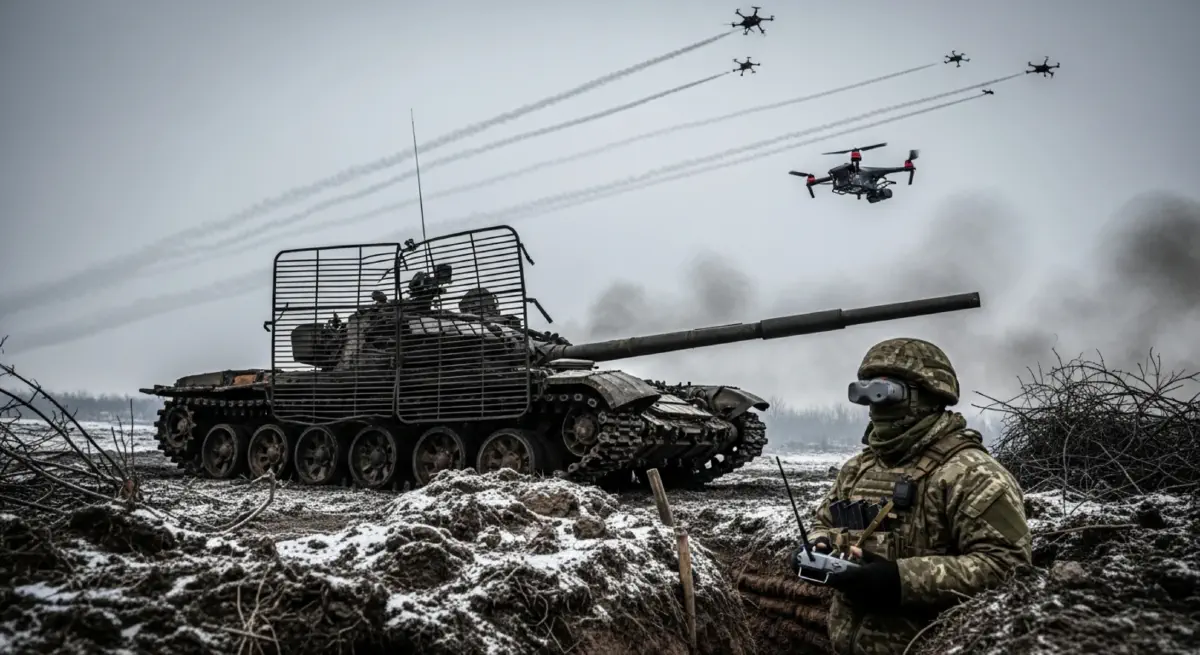
By 2024, FPV drones accounted for over 70% of all Ukrainian kills (tanks, artillery, infantry, armoured vehicles). The Russian military adapted – but slowly. Initially, they welded “cope cages” (metal grilles) over tank turrets to detonate FPVs prematurely. The Ukrainians responded by aiming for the engine deck or soft underbelly. Russians added electronic jammers; Ukrainians switched to frequency‑hopping transmitters. Then came fibre‑optic FPVs – drones that trail a 5‑10 km filament, immune to jamming because there is no radio signal to block.
The EW Adaptation Spiral (2023–2025)
1. **Russian jamming** (Zhitel, Shipovnik) disrupts standard 2.4/5.8 GHz FPV links. 2. **Ukrainian frequency hopping** – randomising channels faster than jammers can sweep. 3. **Russian wideband jamming** – brute‑force white noise overwhelms weak transmitters. 4. **Ukrainian fibre‑optic FPV** – a physical tether; jamming impossible. 5. **Russian drone hunting** – intercepting fibre‑optic drones with other drones before they reach the target. Each counter takes 3‑6 months to develop and field. The cycle continues.
Phase 3: 2025–2026 – Industrial Swarming and the Shahed Flood#
By 2025, both sides had moved beyond improvised FPVs to industrial‑scale loitering munitions.
Russia: The Shahed‑136 (Geran‑2)#
Iran transferred the Shahed‑136 design to Russia in 2023. Russia built a factory in Tatarstan (Alabuga Special Economic Zone) to produce its own version, the Geran‑2. By 2024, production reached 6,000 units per month. By 2025, it was 15,000 per month.
The Geran‑2 is not a precision weapon. It has an inertial navigation system with a commercial GPS backup. CEP (circular error probable) is 10‑20 metres – fine for a 50 kg warhead targeting a power substation, but not for a moving tank. Russia uses Shaheds primarily for strategic infrastructure attacks – power grids, refineries, ammunition depots. They are launched in waves of 30‑50, saturating air defences.
In November 2024, a single Shahed‑2 strike destroyed the Burshtyn thermal power plant in western Ukraine, knocking out 600 MW of capacity. The replacement cost was estimated at \$200 million; the drone cost \$30,000.
Ukraine: The Long‑Range Loitering Munition#
Ukraine lacked Iran’s manufacturing base. Instead, it developed home‑grown long‑range drones – the UJ‑22 Airborne and PD‑2. These are slower, smaller, and less reliable than Shaheds. But they can reach Moscow (600 km) and have struck Russian oil refineries, military airfields, and even the Kremlin district (symbolic, not destructive).
By 2025, Ukraine was producing approximately 1,000 long‑range strike drones per month – a tenth of Russia’s Shahed output, but enough to maintain pressure.
Swarm Tactics#
The real innovation of 2025‑2026 is coordinated swarms – not AI‑led, but human‑scripted. A typical Russian Shahed wave:
- Decoys: cheaper drones (UDAR) that mimic radar signatures.
- EW escorts: drones carrying jammers to suppress Ukrainian air‑defence radars.
- Attack drones: Geran‑2s with varied flight paths to avoid predictability.
Ukraine uses a similar approach with FPVs: a “mothership” drone carries four FPVs to the target area, then launches them simultaneously for a multi‑angle strike. This tactic has destroyed several Russian Tor‑M2 air‑defence vehicles, which can engage only one target at a time.
The Human Bottleneck: Pilots and Production#
Drones are cheap. Skilled pilots are not. In 2025, Ukraine trained over 20,000 drone operators – but lost an estimated 5,000 to casualties, burnout, or rotation. The training pipeline takes 3‑6 months for basic FPV proficiency, and 12 months for complex missions (long‑range, anti‑EW, swarming).
Russia faces a similar problem. Despite producing 15,000 Shaheds per month, it has a shortage of launch and recovery crews. Shaheds are launched from mobile ramps; each ramp requires a team of four. Russia has approximately 500 ramps, limiting simultaneous launch capacity to 2,000 drones per day – far below production capacity.
The implication: production capacity without pilot capacity is wasted. This is the overlooked constraint of industrial drone warfare.
Key Lessons from the Ukrainian Laboratory#
After four years of grinding adaptation, several systemic patterns have emerged:
1. The Electronic Warfare (EW) Spiral is Inexorable#
Every drone breakthrough creates its EW counter within months. The only durable advantage is frequency‑agile, machine‑learning‑driven transmitters that can hop faster than jammers can sweep. Ukraine’s “Dodochka” (Little Pipe) system, a 1,000‑hop‑per‑second protocol, has proven resilient.
2. Mass Defeats Precision#
A single Shahed is not a precision weapon. 50 Shaheds, launched simultaneously, are. The defender cannot intercept all, and the leakers cause damage. This is the inefficiency of layered defence – each interceptor is an expensive, scarce resource. The attacker’s drone is cheap and abundant.
3. Cost Asymmetry is the Primary Weapon#
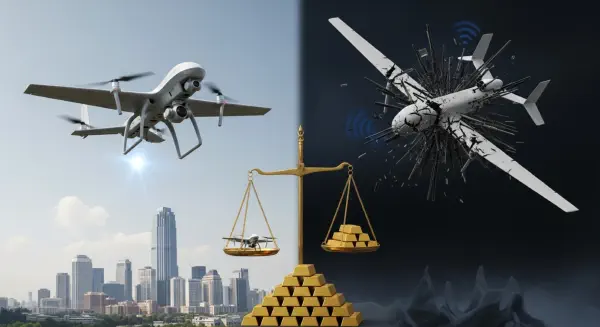
As shown in Part 1, the cost‑exchange ratio favours the attacker by one to two orders of magnitude. Russia spends about $450 million per month on Shahed production. Ukraine spends approximately $2 billion per month defending against them (interceptors, EW, repairs). That ratio – 1:4.5 – is unsustainable for the defender over the long term. Only foreign aid (US, EU) closes the gap.
4. The Return of the Manned Fighter (But Not as You Expect)#
Drones cannot maintain air superiority – they are too slow, too short‑ranged (except Shaheds, which are one‑way), and too vulnerable. The Russian Air Force, after a humiliating 2022, has learned to operate behind drone cover. Su‑35 and MiG‑31 fighters now launch stand‑off missiles (Kh‑59, Kh‑101) from beyond Ukrainian air‑defence range, while drones act as decoys and target spotters. The division of labour is drone sees, man shoots.
5. AI is Inevitable#
The biggest constraint is the pilot’s decision time. An FPV operator must fly, identify, and steer – up to 30 seconds for a dive. A machine‑vision system can do it in 0.1 seconds. Ukraine has already deployed semi‑autonomous terminal guidance on some FPVs: the operator flies to within 100 metres, then the drone locks onto the tank’s thermal signature and dives independently. This is fire‑and‑forget at very low cost. The step to full autonomy – search, identify, engage without human – is technical, not conceptual. It will happen by 2028.
Conclusion: The War as an Assembly Line#
The Russia‑Ukraine war has transformed drone warfare from a tactical curiosity into an industrial process. Drones are produced by the thousand, consumed by the hundred, and adapted by the week. The front line is now measured in FPV sorties per day, not kilometres advanced.
This is not a cleaner war – it is a more efficient one. The same economic logic that makes drones attractive for the attacker also makes them terrifying for the defender. Every cheap flying bomb is a bet that the other side will run out of interceptors first.
The Ukrainian laboratory has also revealed the limits: the human pilot, the EW spiral, and the financial dependency on foreign aid. None of these limits is permanent. Autonomy will replace the pilot. AI will break the EW spiral (by adapting faster than humans can program). And domestic production can replace foreign aid – slowly.
The next phase, already visible, is the fully autonomous swarm. When that arrives, the calculus of Part 1 – the cost of a drone versus the cost of its interceptor – will be joined by a new variable: the speed of decision. A machine that reacts in milliseconds will defeat a human who reacts in seconds. That is the future.
Next: Part 4 will examine the second major theatre – the US‑Israel‑Iran conflict, where strategic saturation attacks and reverse‑engineering have created a different, but equally transformative, drone warfare model.