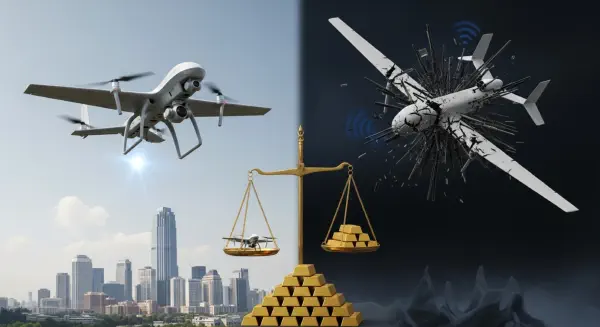
In Part 1, we established the core mechanism of the modern drone: asymmetric economic attrition, enabled by low cost and remote piloting. But that mechanism was not discovered overnight. It emerged through a series of operational crises—battles where traditional platforms failed and improvisation flourished.
This article traces the three great leaps of unmanned combat, from the crude balloons of 1849 to the decisive Turkish Bayraktar TB2 strikes of 2020. Understanding these inflection points reveals a pattern: drones do not replace existing weapons; they exploit weaknesses that manned systems leave behind.
First Leap: The Balloon Bombers of Venice (1849)#
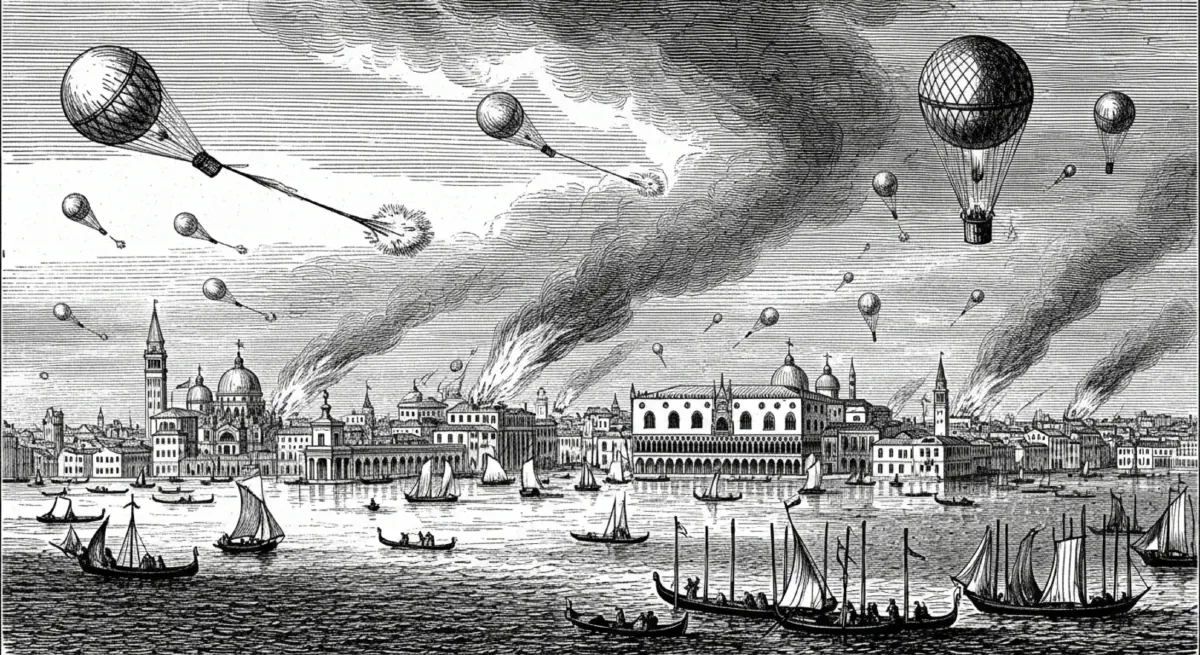
The earliest recorded use of an unmanned aerial weapon occurred during the First Italian War of Independence. The Austrian Empire, besieging the revolutionary city of Venice, launched approximately 200 unmanned hot‑air balloons. Each carried a 24‑to‑30‑pound explosive bomb, equipped with a simple time fuse.
Austria called them Luftballons mit Zeitzündern – balloons with time fuses. The idea was to let the prevailing north‑easterly wind carry them over the lagoon. In practice, accuracy was abysmal. Most balloons drifted off course or detonated harmlessly. Only a few reached the city, causing minimal damage.
Why this matters: The Austrian attack introduced the two defining features of all subsequent drone warfare:
- Separation of operator from weapon – No Austrian pilot was at risk.
- Expendability – Each balloon cost a fraction of a manned artillery battery.
The failure of accuracy, however, highlighted the fundamental limitation: without guidance, an unmanned weapon is just a drifting bomb. That problem would not be solved for another century.
Second Leap: The Vietnam Reconnaissance Bugs (1960s–1970s)#
The next major advance came from the US Air Force’s Ryan Model 147, nicknamed “Lightning Bug”. It was a jet‑powered, pre‑programmed drone, launched from a DC‑130 mothership. It flew pre‑set routes over North Vietnam, China, and the Soviet Union, capturing high‑resolution photographic film in a canister that was dropped and recovered by helicopter.
Between 1964 and 1975, Lightning Bugs flew over 3,400 missions – more than any manned reconnaissance aircraft in the theatre. The loss rate was approximately 15%, but that was acceptable because no pilot died. The drone provided persistent, risk‑free surveillance of the most heavily defended targets, including the Haiphong harbour and the Chinese border.
The mechanism here was risk transfer. Manned U‑2 and SR‑71 flights were politically sensitive and operationally scarce. Drones could be sent into “impossible” airspace and, when lost, simply replaced. North Vietnamese air defences (SA‑2 missiles, MiG fighters) had no effective counter – the drone was too small and too fast.
Why this matters: The Lightning Bug established the drone as a high‑endurance intelligence asset. It did not attack, but it enabled attacks by manned bombers. The division of labour – drone sees, man shoots – would persist for decades.
Third Leap: The Armed Predator Over Afghanistan (2001)#
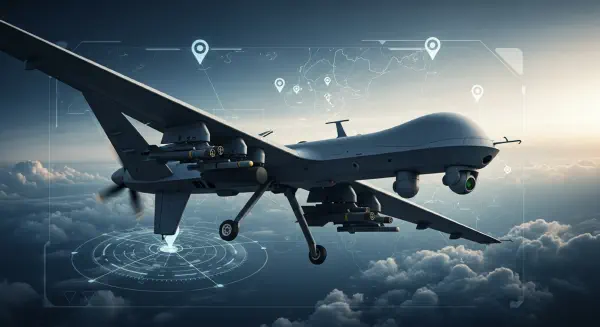
The leap from reconnaissance to combat took another thirty years. In the 1990s, the US developed the RQ‑1 Predator – a turboprop drone with a satellite link, capable of loitering for 24 hours. It was designed for “persistent stare” surveillance over Bosnia and Iraq.
On October 7, 2001, a CIA Predator fired a Hellfire AGM‑114 missile at a Taliban vehicle near Kandahar. That was the first armed drone strike in history. The pilot was sitting in a trailer outside Las Vegas, Nevada. The target was destroyed. No US aircraft was at risk.
The Predator was slow (130 km/h), unstealthy, and vulnerable to any fighter or anti‑aircraft gun. But in the skies over Afghanistan, where the Taliban had no air force, it was a god. Over the next two decades, the CIA and US military conducted thousands of armed Predator and Reaper strikes in Afghanistan, Pakistan, Yemen, and Somalia.
Why this matters: The Predator fused ISR and strike into a single persistent platform. The pilot could watch a target for hours, wait for a legal and tactical confirmation, and then strike – all while sipping coffee in Nevada. This “unblinking eye” became the counter‑terrorism weapon of choice. But it also introduced the ethical problem of signature strikes – killing unknown people based on behavioural patterns.
Inflection Point: Nagorno‑Karabakh 2020 – The War That Changed Everything#
By 2020, the Predator model – a single, expensive drone flown by a remote pilot – had dominated the imagination of Western militaries. Then came the Nagorno‑Karabakh war between Azerbaijan and Armenia. It shattered every assumption.
The Weapon: Bayraktar TB2#
Azerbaijan deployed the Turkish‑made Bayraktar TB2, a medium‑altitude drone costing about $5 million per airframe. That was cheap by Western standards (a Reaper costs $30 million). The TB2 carried four laser‑guided munitions (MAM‑L) with a 22‑kg warhead. It could loiter for 24 hours.
The Result: Systematic Annihilation#
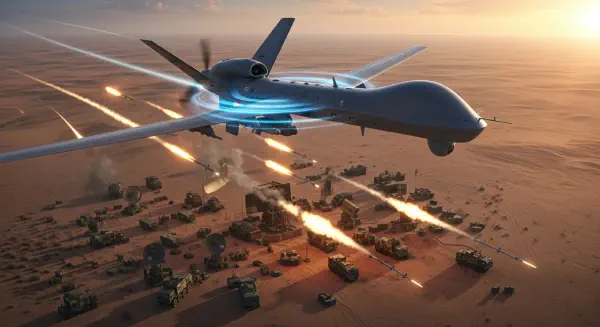
Azerbaijan used the TB2 to destroy over 150 Armenian tanks, 200 artillery pieces, 50 air‑defence systems, and dozens of armoured vehicles. The strikes were methodical: first, TB2s would loiter beyond the range of Armenian short‑range air defences (SA‑8, SA‑13). They would identify targets, then strike from high altitude. Armenian air defences were neutralised within days.
The most famous video shows a TB2 striking a moving Armenian truck – the drone operator leads the target with surgical precision. The footage, released by Azerbaijan’s Ministry of Defence, went viral. It was the first time a war was narrated entirely through drone gun‑camera footage.
Why It Was a Leap#
Nagorno‑Karabakh was not the first drone war. But it was the first where drones were the decisive weapon. Armenia’s military was not primitive; it had modern Russian systems (Tor‑M2, S‑300). But they were designed to detect fast jets, not slow, small drones. The TB2 exploited a sensor gap.
The TB2's Success Factors
- **Low radar cross‑section** (small, composite airframe) - **Slow speed** (130 km/h) – actually an advantage against Doppler radar - **High altitude** (6,000 m) – above MANPADS range - **Cheap attrition** – losing a $5 million TB2 was acceptable; losing a $120 million Su‑30 was not
The war lasted 44 days. Armenia lost. The peace agreement was dictated by Azerbaijan. The global defence community took notice. Drones had graduated from counter‑terrorism to conventional warfare.
The Pattern: How Each Leap Exploited a Weakness#
From the Austrian balloons to the Bayraktar, the same structural mechanism repeats:
| Leap | Weakness Exploited | Solution (Drone) |
|---|---|---|
| Venice 1849 | Vulnerability of manned artillery to counter‑battery fire | Unmanned balloon |
| Vietnam 1960s | Risk of losing pilots over defended airspace | Reconnaissance drone |
| Afghanistan 2001 | Need for persistent surveillance + immediate strike | Armed Predator |
| Karabakh 2020 | Inability of legacy air defences to detect small, slow targets | Loitering munition |
The pattern is asymmetric substitution: the drone does not outperform the manned system in speed, payload, or survivability. It outperforms in cost per mission and acceptable loss ratio. A general will risk a $5 million TB2 where he would never risk a $120 million Su‑30. That changed the operational calculus.
The Pre‑Ukraine Industrialisation: Turkey and Iran#
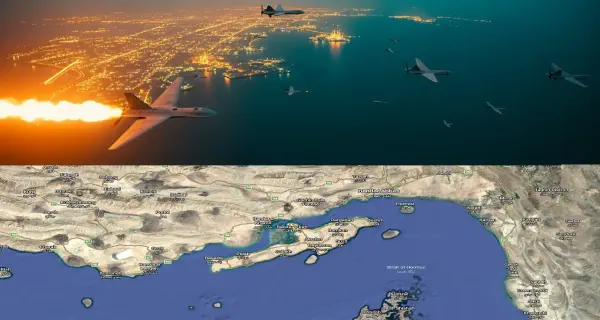
The Bayraktar TB2 was not an isolated phenomenon. Turkey, barred from Western fighter programmes, had invested heavily in drones. By 2020, it had the world’s most combat‑proven drone fleet. Iran, similarly sanctioned, had reverse‑engineered captured US drones (including a stealth RQ‑170 Sentinel) and developed the Shahed family of one‑way attack drones.
By 2022, on the eve of Russia’s full‑scale invasion of Ukraine, the drone landscape had shifted:
- Turkey produced tactical strike drones (TB2, Akıncı) used by Ukraine, Poland, and Libya.
- Iran produced loitering munitions (Shahed‑136, Mohajer‑6) sold to Russia and proxies.
- China produced reconnaissance and attack drones (CH‑4, Wing Loong) sold to Saudi Arabia, Egypt, and Myanmar.
- US and Israel produced high‑end systems (Reaper, Heron) but faced competition from cheaper alternatives.
The stage was set for the industrial war – where drones would be consumed in the thousands, not dozens. That war began on February 24, 2022.
Conclusion: Lessons from the Inflection Points#
History teaches us five invariants:
- Drones emerge when manned platforms become too expensive or too risky to lose. The cost asymmetry is the mother of invention.
- Every drone advance is initially underestimated. In 2001, few predicted the Predator would become the signature weapon of the War on Terror. In 2019, few predicted the TB2 would decide a conventional war.
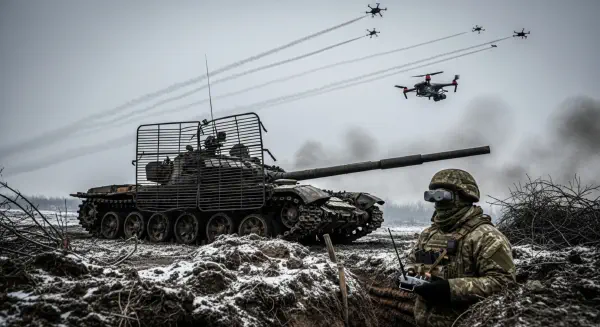
- The adaptation cycle is accelerating. It took 120 years from balloons to Vietnam, 40 years to the Predator, 20 years to the TB2, and only 2 years for Ukraine to mass‑produce FPV drones.
- Electronic warfare will eventually catch up. Each leap works because the defender has a gap. That gap closes – but the attacker then finds a new gap.
- The human operator remains the bottleneck. No drone works without a skilled pilot. The next leap will be autonomy – not because machines are better, but because humans cannot be trained fast enough.
Next: Part 3 will examine the Ukraine war as a laboratory of industrial‑scale drone combat – the first conflict where both sides mass‑produced and consumed drones by the million, and the lessons learned from that brutal efficiency.