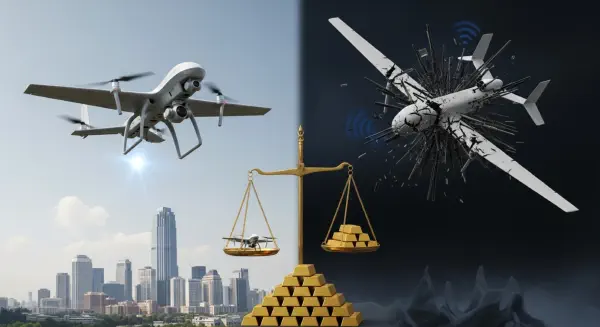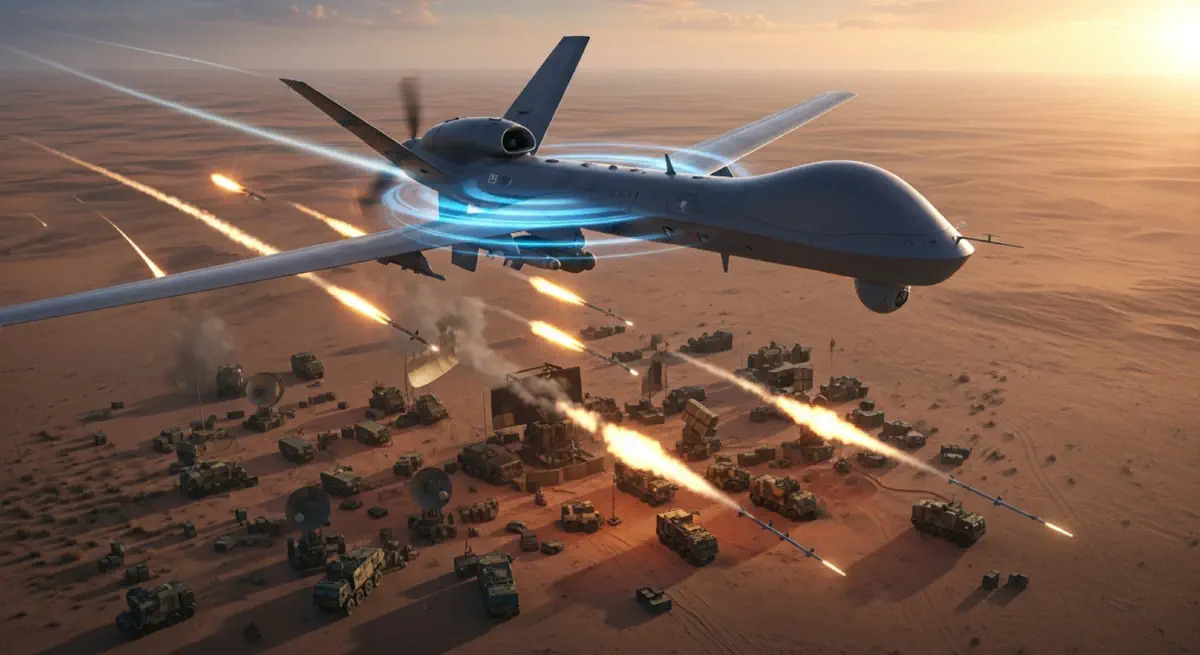
For the first three-quarters of the twentieth century, military power was measured in tons of steel, calibre of guns, and the unit cost of a fighter jet. The F-16, first flown in 1974, cost about $15 million in its day. A modern F-35 exceeds $80 million. These are exquisite, rare, and politically irreplaceable machines. Their very expense made war a privilege of wealthy states.
Then came the drone. Not the Predator or Reaper—those were simply cheaper, slower, less capable aircraft. The real revolution arrived when a commercial quadcopter, bought for $2,000 from a Chinese e‑commerce site, was strapped with a grenade and flown into a tank. That moment—which occurred in eastern Ukraine in 2015, then exploded globally in 2020 and 2022—recalibrated the entire physics of combat.
This is the first of a six‑part series examining the drone as a system disruptor. We will not merely narrate; we will dissect the mechanisms: cost‑exchange ratios, adaptation cycles, economic attrition, and the fragile human element. Welcome to the age of democratic destruction.
Section 1: Defining the Beast – What a "Drone" Actually Is#
The word "drone" is overused. To analysts, it is as vague as "vehicle". For a rigorous discussion, we must establish a taxonomy based on function, autonomy, and cost.
1.1 Categories of Combat Drones#
Class I: Reconnaissance & Surveillance (ISR)
**Examples:** DJI Mavic, Orlan-10, RQ-11 Raven. **Cost:** $2,000 – \$150,000. **Role:** Persistent observation, artillery spotting, battle damage assessment. The "eye in the sky" that never sleeps. These have no strike capability but enable every other weapon.Class II: Loitering Munition (One‑Way Attack)
**Examples:** Shahed-136, Lancet, Switchblade 600. **Cost:** $20,000 – \$100,000. **Role:** A cheap cruise missile. Loiters for hours, then dives onto a target. The main tool for **economic attrition** against high‑value assets. Iran has mastered this class; Russia now produces its own version (Geran‑2).Class III: FPV (First‑Person View) ‚Kamikaze‘
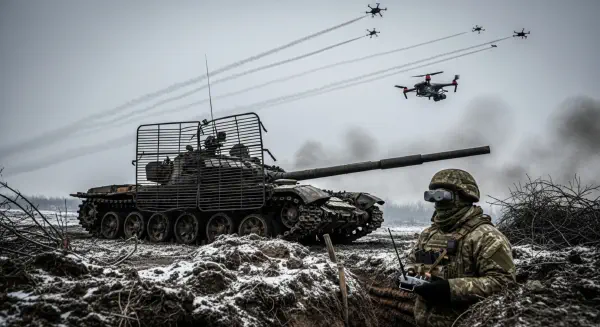
**Examples:** Ukrainian home‑built FPVs, Russian “Vandal”. **Cost:** $400 – \$2,000. **Role:** The ultimate improvised weapon. Racing drone frame + analogue video + RPG warhead. Produced in sheds, flown by gamers. Responsible for the majority of daily kills in Ukraine. **The great equaliser.**Class IV: Autonomous & Swarm Drones
**Examples:** US Replicator prototypes, Chinese “Grey Wolf”. **Cost:** Highly variable (research stage). **Role:** AI‑coordinated, machine‑vision guided. Can attack without a pilot’s joystick. The next frontier, already in field tests.
1.2 The Autonomy Spectrum#
The most critical variable is not size or payload—it is autonomy. The Blowfish timeline below illustrates the gradient from man‑to‑machine to (almost) no human.
Level 1: Human‑in‑the‑Loop
Operator sees video, makes final decision. This is 90% of today’s combat drones. The pilot is still responsible for the kill. Legally safest.Level 2: Human‑on‑the‑Loop
Drone performs autonomous search and tracking; human approves the engagement. Common in loitering munitions like Switchblade.Level 3: Fire‑and‑Forget
Operator designates a target, drone guides itself to impact using computer vision (e.g., on a tank). Jamming‑resistant because no signal needed after launch. Already in use.Level 4: Fully Autonomous
Drone searches, identifies, decides, and attacks without any human approval. Not yet legally sanctioned, but the technology exists. The “killer robot” of ethical debates.
Section 2: The Core Mechanism – Asymmetric Economic Attrition#
The drone is not revolutionary because it flies. It is revolutionary because of its cost structure. This section reveals the mathematical engine driving modern conflict.
2.1 The Cost‑Exchange Ratio#
Define R = (cost of defender’s countermeasure) / (cost of attacker’s drone). A ratio >1 means the defender spends more to kill than the attacker spends to launch. Drones systematically produce R >> 1.
| Drone Type | Attacker Cost | Typical Defender Interceptor | Defender Cost | Exchange Ratio |
|---|---|---|---|---|
| Shahed-136 | $30,000 | Patriot PAC‑3 MSE | $4,000,000 | 133 : 1 |
| FPV racing drone | $500 | Gepard anti‑air cannon (per shot) | $5,000 | 10 : 1 |
| Lancet | $35,000 | Stinger MANPADS | $120,000 | 3.4 : 1 |
The Shahed case is extraordinary. For every one million dollars Iran spends on drones, it forces the US or Israel to spend 133 million dollars on interceptors. This is not warfare; it is fiscal strangulation.
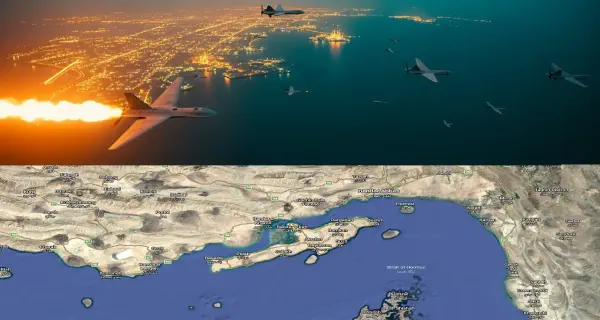
The Israeli military has explicitly warned that the current air‑defence doctrine—using Arrow‑3 and David’s Sling against cheap drones—is financially unsustainable. In the March 2026 barrages, Iran launched 3,560 drones. Even assuming a 100% interception rate, the defender’s ammunition cost exceeded $12 billion in a single month. Iran’s production cost for those drones was below $150 million.
2.2 The Swarm Multiplier#
A swarm of 50 Shaheds costs the attacker about $1.5 million. To defeat it with 50 interceptors at $3 million each costs the defender $150 million. The ratio holds. Worse, no air‑defence system is designed to engage 50 simultaneous targets with 100% success. Leakers will get through. That small percentage of leakers could destroy a power plant, a refinery, or an airbase. The expected loss multiplies the asymmetry further.
This mechanism explains why drones are the preferred weapon of non‑state actors and regional powers. They do not win wars by destroying armies—they win by making the war too expensive to continue.
Section 3: A Brief Operational History – Three Leaps#
To understand the present, we need the lineage. The drone has undergone three distinct evolutionary leaps.
3.1 First Leap: Loitering Over Vietnam (1960s–70s)#
The US Ryan Model 147 “Lightning Bug” was a jet‑powered, pre‑programmed reconnaissance drone. It flew over North Vietnam and China, capturing imagery. It did not attack, but it introduced persistent, risk‑free surveillance. Over 3,400 missions were flown. The principle was born: drones collect intelligence without sacrificing a pilot’s life.
3.2 Second Leap: The Predator and Hellfire (2001)#
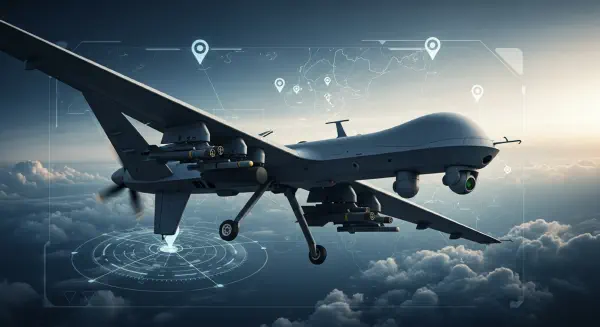
On October 7, 2001, a CIA Predator drone fired a Hellfire missile at a Taliban vehicle near Kandahar. That was the first armed drone strike in history. The Predator was slow, vulnerable, and expensive by today’s standards (approx $4 million per airframe). But it demonstrated the fusion of ISR and strike in a single remotely piloted vehicle. The era of UCAVs had begun.
3.3 Third Leap: Mass and Swarm (2020–2026)#
Two wars define this leap.
Nagorno‑Karabakh (2020): Azerbaijan used Turkish Bayraktar TB2 drones to systematically destroy Armenian air defences, artillery, and tanks. The TB2 cost about $5 million—not cheap, but far less than a fighter jet. However, the real lesson was precision at scale. Ukraine watched closely.
Ukraine (2022–2026): This is the industrial laboratory. Over 53,000 drone attacks were recorded in 2025 alone. The FPV class exploded from a hobbyist gadget to a weapon of mass (individual) destruction. The war also introduced the electronic warfare (EW) spiral: each jamming countermeasure spawns a frequency‑hopping adaptation, then fibre‑optic control (immune to jamming), then AI terminal guidance (no control link to jam). The speed of adaptation is measured in weeks, not years—unprecedented in military history.
Section 4: The Pros and Cons – A Dispassionate Balance#
Drones are not magic; they have advantages and deep vulnerabilities.
4.1 Advantages#
| Advantage | Mechanism |
|---|---|
| Low barrier to entry | Any country or group with $10,000 can produce FPV drones. War is no longer a rich‑man’s monopoly. |
| Casualty avoidance | No pilot captured or killed reduces political blowback for the attacker. This lowers the threshold for starting a war—a dangerous double‑edged sword. |
| Force multiplication | One operator can destroy a column of armour. In Ukraine, a skilled FPV pilot is more valuable than a tank crew. |
| Logistical efficiency | A drone consumes little fuel, requires no pilot training for months, and can be produced in a garage. |
4.2 Disadvantages and Vulnerabilities#
| Disadvantage | Mechanism |
|---|---|
| Electronic warfare (EW) fragility | Most drones rely on radio links. A cheap jammer (cost $5,000) can ground a $50,000 drone fleet. The EW spiral is exhausting. |
| Skill bottleneck | A drone is useless without a skilled operator. Training takes months; battlefield losses are high. Ukraine is now training 5,000 new pilots every quarter just to keep pace. |
| Attribution ambiguity | Drones can be launched by “volunteers” or proxies, allowing states to deny responsibility. This blurs the laws of war. |
| Ethical and legal grey zones | Autonomous targeting violates the “meaningful human control” principle. No international treaty has caught up. |
| Defence does adapt | Low‑cost interceptor drones (e.g., Merops) and directed‑energy weapons (lasers, microwave) are maturing. The era of cheap, unopposed drones may last only another decade. |
Section 5: The Future – Four Predictions#
Based on the mechanisms above, we can project the next decade.
5.1 Prediction 1: AI Swarms Become Operational by 2030#
The US “Replicator” initiative aims to field thousands of autonomous systems by 2027. China claims to have demonstrated a 200‑drone swarm that shares targeting data. The technical hurdles (collision avoidance, robust comms, power) are solvable. The legal hurdle is larger: will any state admit to using fully autonomous weapons?
5.2 Prediction 2: The Death of the Centralised Airbase#
Large, fixed airbases are already vulnerable to cheap loitering munitions. The future is distributed launch cells: a pickup truck with 20 drones, operating from a forest. This has profound implications for force posture. The US Air Force’s “Agile Combat Employment” concept—dispersing aircraft to small, improvised strips—is a direct response to the drone threat.
5.3 Prediction 3: Electronic Warfare Becomes the Primary Battlefield#
The war in Ukraine has already demonstrated that the frequency spectrum is more contested than the land or air. By 2028, expect every infantry squad to carry a man‑portable jammer, and every drone to have frequency‑hopping or fibre‑optic backup. The winner will be the side that can adapt its communications fastest—a software race, not a hardware race.
5.4 Prediction 4: A Proliferation Cascade#
Drone technology has already leaked from Iran to Russia to Houthis to Hamas. The next step is 3D‑printed FPV drones with open‑source guidance software. When any activist can download and print a lethal drone for $200, the nature of internal security and domestic terrorism changes utterly. That timeline is three to five years.
Conclusion: The Unfinished Reckoning#
Drones have not abolished the tank, the jet, or the aircraft carrier. But they have inserted a new variable into every operational calculus: can we afford the interception? The answer increasingly is no.
The conflict between Russia and Ukraine has shown that cheap, mass‑produced drones can grind down a larger adversary. The Iran‑US‑Israel confrontation has shown that saturation attacks bankrupt the defender’s missile inventory. And the staggering growth—from $18 billion in market value in 2025 to a projected $66 billion by 2035—shows that everyone, from the Pentagon to Turkish startups, believes this trend line will continue.
Yet the drone’s greatest effect may be psychological. It has stripped the soldier of the illusion of sanctuary. Anywhere, at any time, a silent buzzing machine can fall from the sky. The future of warfare is not more powerful—it is more numerous, more distributed, and more terrifyingly accessible.
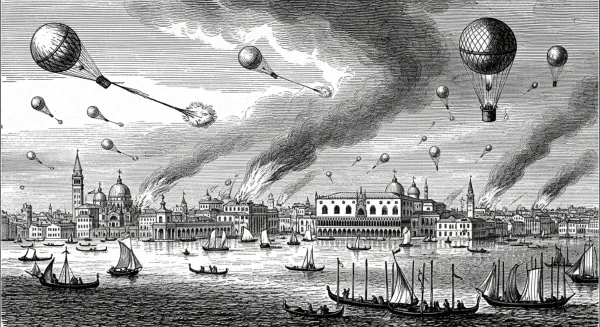
Next: Part 2 will trace the historical inflection points in detail—from the Austrian bomb‑balloons of 1849 to the lessons of Nagorno‑Karabakh, examining how each conflict forced a leap in drone doctrine.