
The Drone Wars
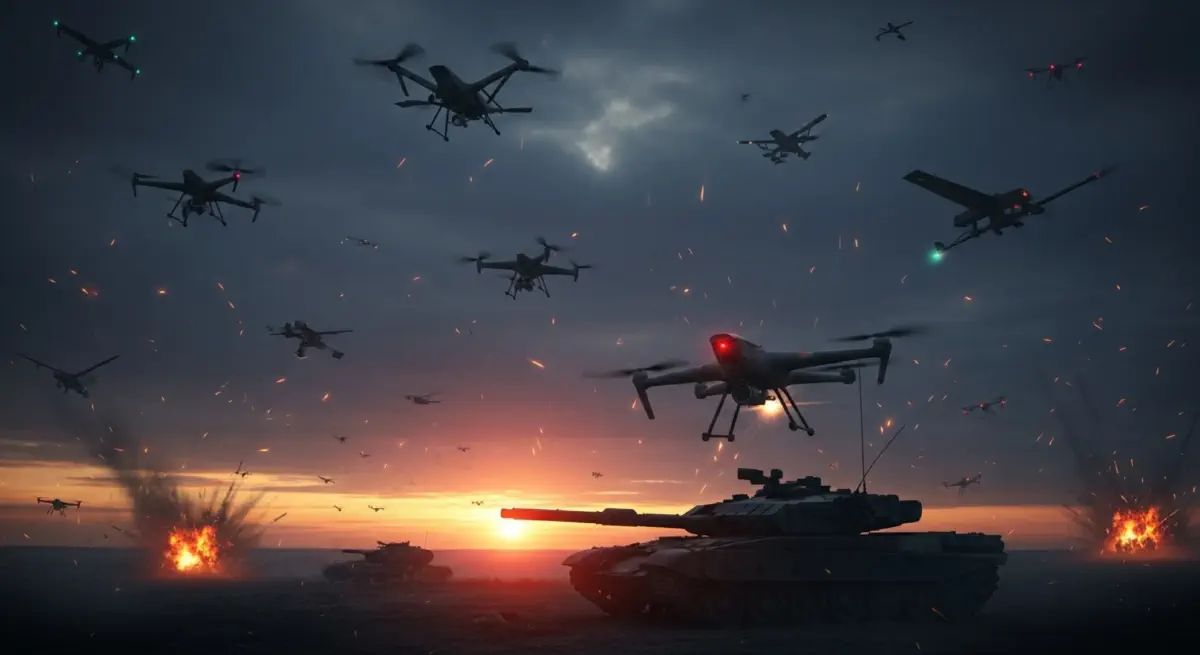
A 500-dollar quadcopter can destroy a 4-million-dollar tank. That arithmetic has shattered every assumption about how wars are fought, who can fight them, and what victory means. This six-part series dissects the drone as a system disruptor — not through narrative alone, but through systematic analysis of cost-exchange ratios, adaptation cycles, economic attrition, and the fragile human element at the heart of modern combat.
Series Summary#
The Drone Wars is a comprehensive analytical series published by The Economist in 2026. It examines the role of unmanned aerial systems across six thematic articles, moving from foundational concepts to historical inflection points, through the industrial laboratory of Ukraine and the strategic saturation of the Persian Gulf, balancing strengths against vulnerabilities, and concluding with a sober assessment of autonomous swarms and the future of warfare.
Each article applies system-level reasoning: drones are not merely new weapons but disruptors of cost structures, electronic spectra, and political risk calculations. The series draws on open-source intelligence, declassified documents, UN proceedings, think‑tank analyses, and field reports from Ukraine and the Middle East. It is intended for policymakers, defence professionals, scholars, and engaged readers seeking a reference‑grade survey of the drone revolution.
Series Overview#
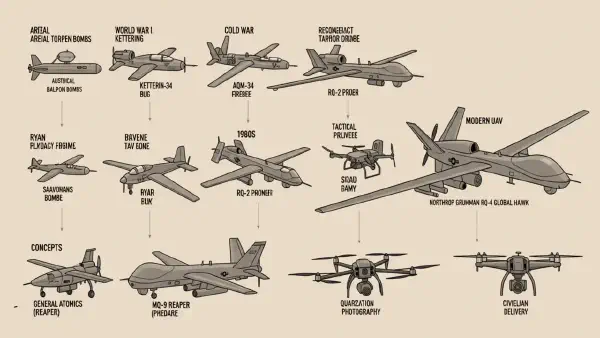
A Timeline of Drone Warfare#
Headline: From the first bomb‑balloon to the million‑drone war
Part 1 – Definition and Core Logic#
Headline: What is a drone? And why it has broken the old calculus of combat
Defines the drone by its three core features (persistence, low cost, separable pilot) and introduces the central mechanism of asymmetric economic attrition (the 100:1 cost‑exchange ratio between a Shahed drone and an Arrow interceptor). Establishes a taxonomy of combat drones and the autonomy spectrum from human‑in‑the‑loop to fully autonomous.
Key analytical mechanism: The drone forces the defender to spend one to two orders of magnitude more than the attacker spends to launch.
Part 2 – A Short History of Unmanned Combat#
Headline: From Austrian balloons to Bayraktar – three leaps
Traces the evolution of unmanned combat across three inflection points: (1) the bomb‑balloons of Venice (1849); (2) the reconnaissance drones of the Vietnam War (Lightning Bug, 3,400+ missions); (3) the armed Predator over Afghanistan (2001). The decisive breakthrough arrives in Nagorno-Karabakh (2020), where the Bayraktar TB2 became the first drone to determine the outcome of a conventional war. Each leap exploited a gap in the defender’s legacy systems.
Key analytical mechanism: The side that identifies and exploits a sensor or doctrinal gap first wins the tactical generation.
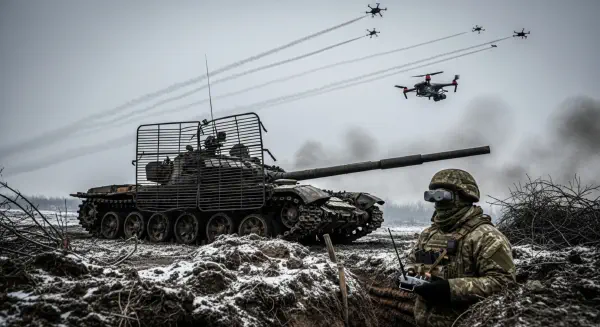
Part 3 – The Ukrainian Laboratory (2022–2026)#
Headline: Industrial attrition and the million‑FPV war
Dissects the three phases of drone adaptation in Ukraine: the rise and fall of the Bayraktar TB2 (2022); the FPV revolution (2023–2024), where cottage‑industry drones accounted for over 70 % of kills; and the era of industrial swarming and the Shahed flood (2025–2026). Examines the electronic warfare spiral (jamming → frequency‑hopping → fibre‑optic → AI terminal guidance), the human pilot bottleneck (5,000 new pilots per quarter; 2,000 lost), and the return of the manned fighter as a stand‑off missile launcher operating behind drone cover.
Key analytical mechanism: Production capacity without pilot capacity is wasted. The EW adaptation cycle is inexorable; advantage shifts every three to six months.
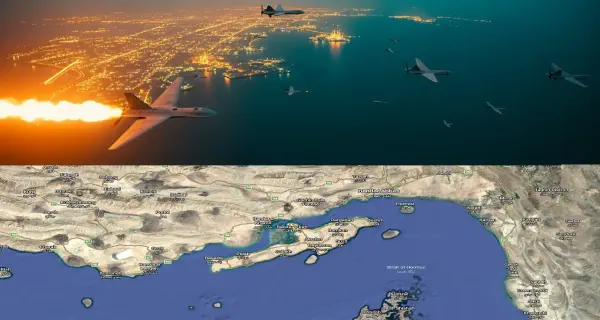
Part 4 – The Middle Eastern Siege (US–Israel vs. Iran)#
Headline: Strategic saturation and reverse engineering
Examines Iran’s doctrine of mass‑produced loitering munitions (the Shahed‑136, cost \$20,000–\$50,000) and its application in the 2026 war. In March 2026 alone, Iran launched 3,560 Shaheds and 2,410 missiles, forcing the US and Israel to expend an estimated \$12–\$15 billion in interceptors – a cost‑exchange ratio of up to 100:1. Introduces the US response: the LUCAS (FLM 136), a reverse‑engineered copy of the Shahed, produced for \$35,000 per unit. Analyses the air‑defence crisis, the limits of directed‑energy weapons (lasers, microwaves), and the role of proxies (Houthis, Hezbollah) in creating a distributed, deniable network of fire.
Key analytical mechanism: The drone is primarily an economic weapon – the goal is not to destroy armies but to exhaust treasuries and interceptor inventories.
Part 5 – The Paradox: Strengths, Vulnerabilities, and Unintended Consequences#
Headline: No silver bullet, no free lunch
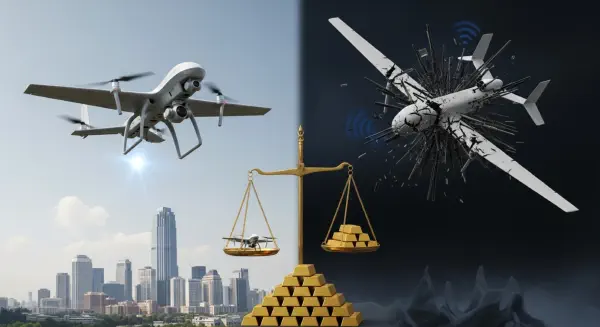
Provides a dispassionate balance sheet. Five strengths: low barrier to entry, asymmetric economic attrition, reduction of political risk, persistence (the “unblinking eye”), and force multiplication. Five vulnerabilities: EW fragility, the skilled‑pilot bottleneck, counter‑drone adaptation (the defender learns), logistics and weather constraints, and the attribution gap (which cuts both ways). Unintended consequences: the end of sanctuary (no rear area is safe), the social media spectacle (the war is narrated through the attacker’s lens), legal grey zones (the responsibility gap for autonomous systems), and the hollowing of conventional forces (over‑investment in cheap drones risks creating a force that can harass but not conquer).
Key analytical mechanism: Every strength creates a corresponding vulnerability; the adaptation cycle never ends.
Part 6 – The Autonomous Swarm (2030 and beyond)#
Headline: Removing the human from the decision loop
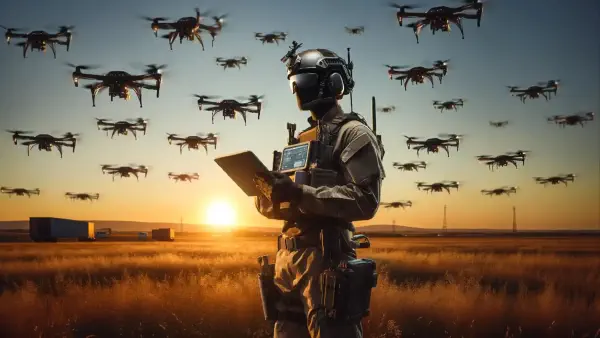
Examines the three technical stages of autonomy: (1) machine‑vision terminal guidance (already deployed in Ukraine, e.g., the Saker FPV); (2) autonomous search and track (testing, 2025–2027, using edge computing such as NVIDIA Jetson modules); (3) swarm coordination and autonomous engagement (2028–2030). Analyses why autonomy is inevitable: the pilot bottleneck, reaction time (human 0.4–1.0 seconds vs. machine 20–50 milliseconds), and EW resilience (no radio link to jam). Introduces four swarm tactical concepts (attrition swarm, reconnaissance swarm, decoy swarm, interceptor swarm). Discusses the legal chasm: the “meaningful human control” principle, the responsibility gap, and the proliferation nightmare (non‑state actors gaining access to autonomous systems). Concludes with four predictions for 2030.
Key analytical mechanism: Removing the human shifts the binding constraint from pilot training to algorithm development and production capacity.
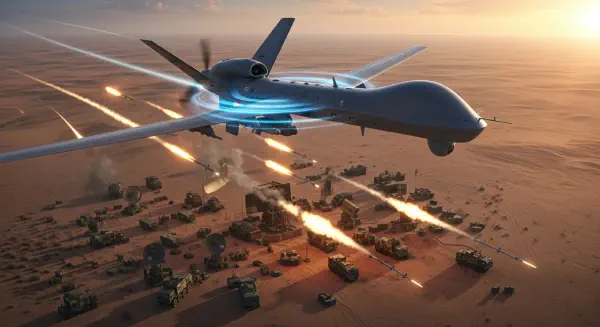
Drone Reference Guide#
Headline: A visual reference for the 40+ unmanned systems and counter-drone platforms discussed in The Drone Wars series, organised by role.
Related Content on This Site#
- The Drone Warfare Expert Report: A comprehensive assessment of unmanned aerial systems in modern conflict: economics, technology, doctrine, and strategic implications.
References#
All references listed below have been verified for legitimacy. URLs are functional as of April 2026.
Foundational Think‑Tank and Academic Reports#
Phillips, D., Duplessis, B. T., Stoll, H., Kelly, T. K., & Parker, T. (2025). Small uncrewed aircraft systems (SUAS) in divisional brigades: Small UAS and counter‑UAS training (RR‑A2642‑5). RAND Corporation. https://www.rand.org/pubs/research_reports/RRA2642-5.html
RAND Corporation. (2025). Dispersed, disguised, and degradable: Lessons from the Ukraine conflict for future wars against China and Russia. https://www.flightglobal.com/military-uavs/2025/05/rand-draws-lessons-from-ukraine-conflict-for-future-wars-against-china-russia/
Afina, Y. (2025). Regional perspectives on the application of international humanitarian law to lethal autonomous weapons systems. UNIDIR. https://unidir.org/publication/regional-perspectives-on-the-application-of-international-humanitarian-law-to-lethal-autonomous-weapon-systems/
UNIDIR. (2025). Artificial intelligence in the military domain and its implications for international peace and security: An evidence‑based road map for future policy action. https://unidir.org/publication/artificial-intelligence-in-the-military-domain-and-its-implications-for-international-peace-and-security-an-evidence-based-road-map-for-future-policy-action/
Lewis, D. A., Blum, G., & Modirzadeh, N. K. (2016). War‑algorithm accountability. Harvard Law School Program on International Law and Armed Conflict. https://pilac.law.harvard.edu/aws/
United Nations and Multilateral Sources#
United Nations General Assembly. (2024). Lethal autonomous weapons systems (Resolution 79/62). https://docs.un.org/a/res/79/62
Guterres, A. (2025, May 12). Secretary‑General’s video message to the informal consultations on lethal autonomous weapons systems. United Nations. https://www.un.org/sg/en/content/sg/statements/2025-05-12/secretary-generals-video-message-the-informal-consultations-lethal-autonomous-weapons-systems
United Nations Office for Disarmament Affairs. (2025). Informal consultations on lethal autonomous weapons systems – Meeting documentation. https://meetings.unoda.org/unoda-stu-meeting/LAWS-consultations-2024
Regional Conflict and Technological Assessments#
India Today OSINT Team. (2026, March 5). The Shahed problem: Mapping Iranian breaches across US defences. India Today. https://www.indiatoday.in/world/story/the-shahed-problem-mapping-iranian-breaches-across-us-defences-2877908-2026-03-05
Center for Strategic and International Studies. (2022, December 6). Drones galore: Changing battlefields. https://www.csis.org/analysis/drones-galore-changing-battlefields
Center for Strategic and International Studies. (2025, May 28). The Russia‑Ukraine drone war: Innovation on the frontlines and beyond [Transcript and video]. https://www.csis.org/analysis/russia-ukraine-drone-war-innovation-frontlines-and-beyond
Breaking Defense. (2025, December 6). ‘It’s alive’: Biden‑era Replicator drone initiative lives on as DAWG, looking at bigger UASs. https://breakingdefense.com/2025/12/its-alive-biden-era-replicator-drone-initiative-lives-on-as-dawg-looking-at-bigger-uass/
Legal and Ethical Frameworks#
International Committee of the Red Cross. (2025, May 12). Preserving human control over the use of force: A call to regulate lethal autonomous weapon systems [Statement]. https://www.icrc.org/en/statement/preserving-human-control-over-use-force-call-regulate-lethal-autonomous-weapon-systems
Harvard Law School Program on International Law and Armed Conflict. (2026, March 26). Three pathways to secure greater respect for international law concerning war algorithms. https://hls-pilac.squarespace.com/three-pathways-greater-respect
Citation Guide#
In the The Drone Wars series, references are cited using the IDs listed above. For example:
“As the RAND Corporation found in its 2025 analysis of the Ukraine conflict, low‑cost UASs allow strikes against distant targets and offer the potential to saturate air‑defence networks.”
“The United Nations Secretary‑General has called for a legally binding instrument to ban lethal autonomous weapons systems by 2026, stating that ‘machines that have the power and discretion to take human lives without human control are morally repugnant’.”

Drones Reference Guide
·287 words·2 mins
A visual reference for the 40+ unmanned systems and counter-drone platforms discussed in The Drone Wars series, organised by role.