Introduction#
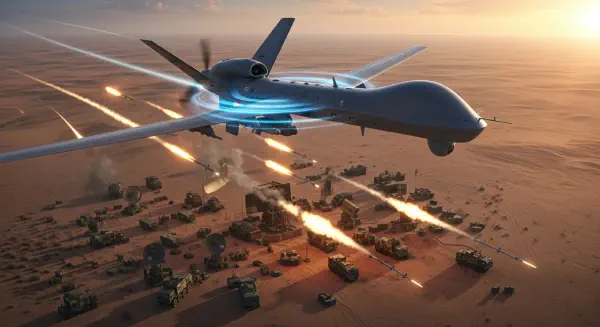
Warfare changes when the cost of delivering lethal force drops by three orders of magnitude overnight. That is what unmanned aerial systems have done.
A century ago, sending a bomb to a target required a pilot, an aircraft, a crew to service it, and an industrial base to replace losses. Today a volunteer in a Ukrainian basement can assemble a strike weapon for five hundred dollars, train a pilot in three months, and dispatch it against a vehicle worth four million. The defender must spend a thousand dollars for every dollar the attacker spends, or accept the hit.
This report synthesises the operational data from the six-part series The Drone Wars to produce a single, evidence-based assessment of where drone warfare stands in 2026: its economics, its technology, its doctrine, and the trajectory it is taking. The analysis draws on data from the Ukrainian Ministry of Defence, British Defence Intelligence, the RAND Corporation, UNIDIR, IISS, and the series' own open-source intelligence synthesis.
Section 1: The Economics of Asymmetric Attrition#
The Cost-Exchange Problem#
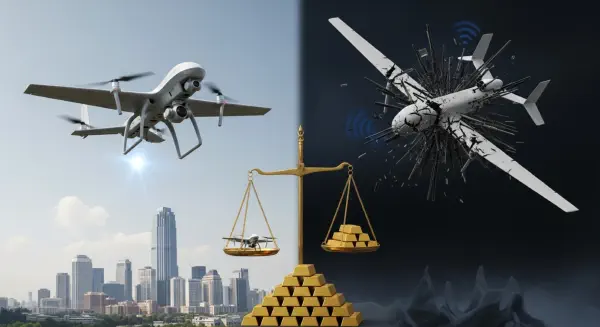
The central insight of modern drone warfare is not technological; it is economic. Militaries that spent the twentieth century optimising weapons for lethality and precision now confront a structural inversion: the cheapest weapons can force the most expensive defensive responses.
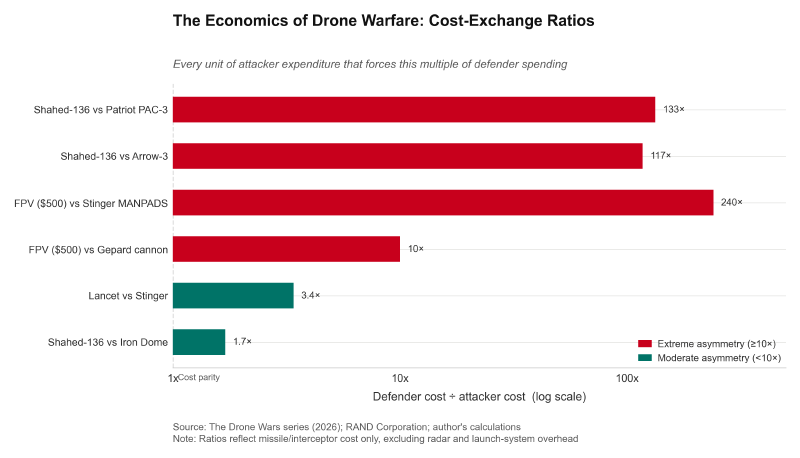
The Shahed-136, an Iranian loitering munition that costs approximately $30,000 to produce, triggers an Arrow-3 interceptor worth $3.5 million. The resulting cost-exchange ratio is 117:1 in the attacker's favour. Against a Patriot PAC-3 missile ($4 million), the ratio rises to 133:1. Only the Israeli Iron Dome Tamir interceptor ($50,000) approaches parity at 1.7:1, but the Iron Dome has a ceiling of roughly 5,000 metres; Shaheds can fly above it.
The improvised FPV drone raises the asymmetry further. At $500 per unit, an FPV striking a $4-million tank achieves an 8,000:1 cost-exchange. When the United States shipped Stinger MANPADS (at $120,000 each) to intercept these drones, the ratio hit 240:1 in the attacker's favour; the US military quickly concluded this was fiscally indefensible.
Table 1: Cost-exchange ratios for selected drone-versus-interceptor matchups, 2022–2026.
| Matchup | Attacker cost | Defender cost | Ratio |
|---|---|---|---|
| Shahed-136 vs Patriot PAC-3 | $30,000 | $4,000,000 | 133:1 |
| Shahed-136 vs Arrow-3 | $30,000 | $3,500,000 | 117:1 |
| FPV vs Stinger MANPADS | $500 | $120,000 | 240:1 |
| FPV vs Gepard cannon | $500 | $5,000 | 10:1 |
| Lancet-3 vs Stinger | $35,000 | $120,000 | 3.4:1 |
| Shahed-136 vs Iron Dome | $30,000 | $50,000 | 1.7:1 |
The March 2026 Case Study#
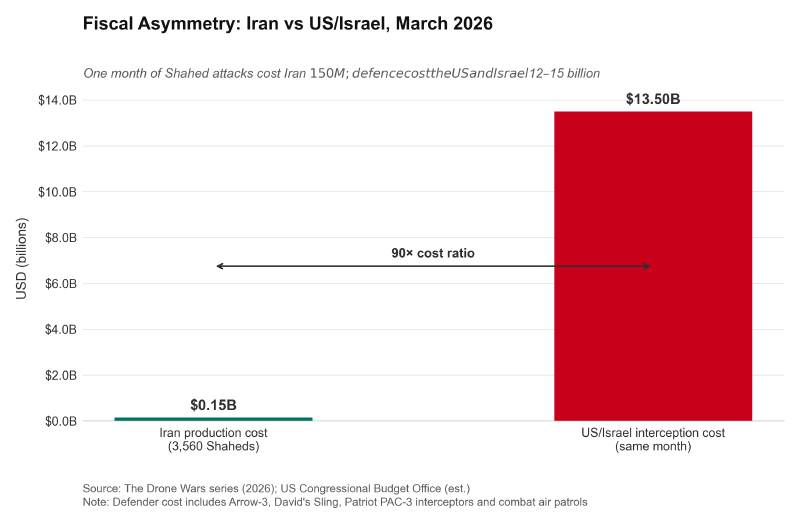
March 2026 provides the clearest single-month demonstration of this principle. Iran launched 3,560 Shahed drones and 2,410 ballistic and cruise missiles in a coordinated campaign against US and Israeli positions. The production cost of those drones was approximately $150 million. The interception bill for the US and Israel was $12 to $15 billion. The cost-exchange ratio for one month of warfare: 80:1 to 100:1.
The US Congressional Budget Office warned in April 2026 that Arrow-3 inventory depletion was a near-term operational constraint. Iran's factory ran another month. That is the structural problem no interceptor can solve while the underlying cost differential persists.
Section 2: Industrial Capacity and the Production Race#
Who Makes What#
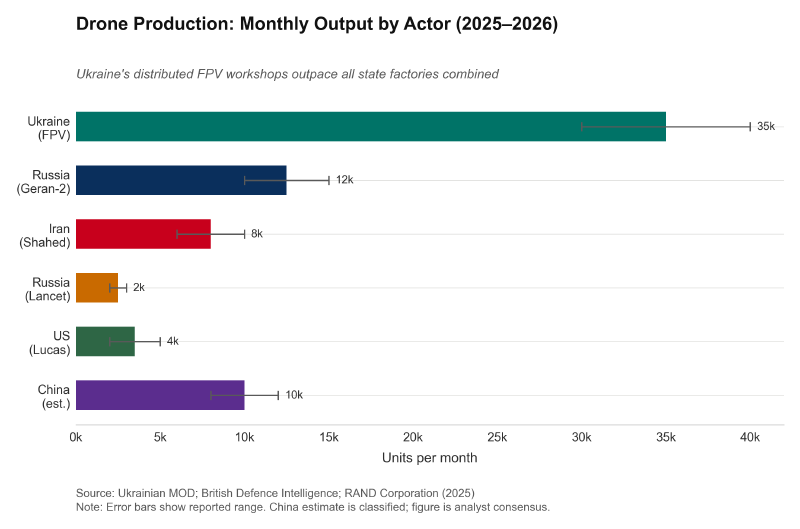
Drone warfare is ultimately a manufacturing contest. The actor that can sustain attrition loses if its supply line breaks first. As of mid-2026, the production landscape is as follows:
Table 2: Monthly drone production output and unit cost by actor, mid-2026.
| Actor | System | Monthly output | Unit cost |
|---|---|---|---|
| Ukraine (workshops) | FPV kamikaze | 30,000–40,000 | $500 |
| Russia (Alabuga SEZ) | Geran-2 | 10,000–15,000 | $30,000 |
| China (estimated) | Various | 8,000–12,000 | unknown |
| Iran | Shahed-136 | 6,000–10,000 | $20,000–50,000 |
| Russia | Lancet-3 | 2,000–3,000 | $35,000 |
| United States | Lucas (FLM-136) | 2,000 (target: 5,000 by 2027) | $35,000 |
Ukraine's distributed production model is the most instructive. Rather than building a single factory as Russia did at Alabuga, Ukraine dispersed production across hundreds of small workshops. The result is a monthly FPV output that exceeds every state drone factory in the world. Russia has bombed seventeen of these workshops; output has not declined.
Russia's trajectory is also important: its Geran-2 production increased 250% between January 2024 and January 2025, from roughly 6,000 to 15,000 per month. That rate of industrial acceleration, sustained in wartime, is without historical precedent for a weapon class that did not exist in mass form five years earlier.
The Copycat Dynamic#
Reverse engineering has compressed the lead time from field deployment to adversary parity to under twelve months. The Shahed-136 entered Russian service in September 2022. Within eight months, Russia was producing its own copy (Geran-2) at a fraction of the original. By 2026, the United States was producing the Lucas (FLM-136), a domestically engineered equivalent at $35,000 per unit.
Three countries now build functionally similar loitering munitions at comparable price points. The design is commoditised. The only remaining competitive dimensions are scale, accuracy, and guidance sophistication.
Section 3: A 177-Year History in Brief#
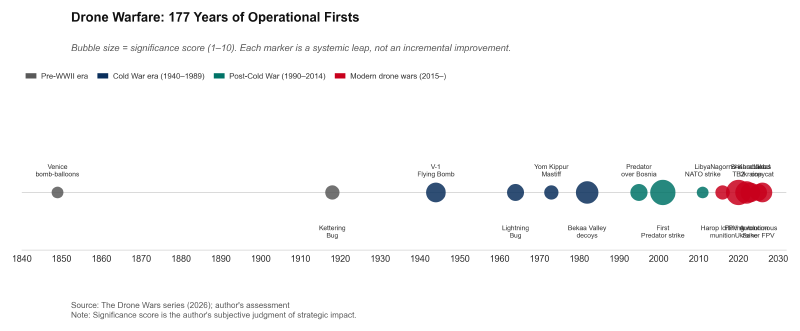
Drone warfare did not begin with the Predator or even with radio control. It began in 1849, when Austrian forces launched bomb-carrying balloons over Venice. Most missed. Several did not. The concept was sound: remove the pilot from the risk, reduce the crew, and accept lower precision in exchange for lower loss rates.
The lineage from 1849 to 2026 follows a consistent logic. Each generation of unmanned weapons solved one constraint and exposed the next.
1849 (Vienna, Austria): Bomb-balloons over Venice. First use of unmanned aerial weapons in recorded warfare. Wind-dependent; limited accuracy; operationally marginal.
1918 (USA): The Kettering Bug. A pre-programmed biplane that flew a set distance and then dove. The first purpose-built pilotless strike aircraft. Never used in combat but shaped all subsequent cruise-missile design.
1944 (Germany): The V-1 flying bomb. The first mass-produced loitering munition in history. Over 10,000 launched against Britain and Belgium. Cost: approximately $5,000 each. Required thousands of anti-aircraft guns, barrage balloons, and fighter sorties to defeat.
1964–1975 (USA): The Lightning Bug over Vietnam. First persistent unmanned reconnaissance aircraft operating in an active combat environment. Flew 3,435 missions; returned imagery that changed US targeting.
1973 (Israel): The Mastiff over the Sinai. The first drone to transmit live video to a ground operator. Tactical intelligence in real time, without risk to the crew.
1982 (Israel, Bekaa Valley): The first integrated drone-jet air campaign. Israeli Mastiffs and Scout decoys forced Syrian air-defence radars to activate; SEAD jets then destroyed them. Eighty-seven Syrian aircraft were shot down. Zero Israeli pilots were lost. The template was studied by every major air force.
1995 (USA, Bosnia): The Predator over the Balkans. First satellite-linked long-endurance ISR drone. A pilot in Nevada watched a video feed from the Balkans in real time.
2001 (USA, Afghanistan): The first armed Predator strike. Mullah Omar's convoy, Kandahar. A new category of warfare opened: persistent surveillance with immediate lethal response, operated from a continent away.
2011 (NATO, Libya): First drone strike authorised under a UN Security Council resolution.
2016 (Azerbaijan, Nagorno-Karabakh): First operational use of the Israeli Harop anti-radiation loitering munition. It homed on Armenian radar emissions and killed the radar; the subsequent ground offensive succeeded in a week.
2020 (Azerbaijan, Second Karabakh War): The Bayraktar TB2 and Harop combination made Nagorno-Karabakh the first war decided by drones. Armenian armour was systematically destroyed in what RAND called "the first peer-versus-peer drone war." Azerbaijan won in forty-four days.
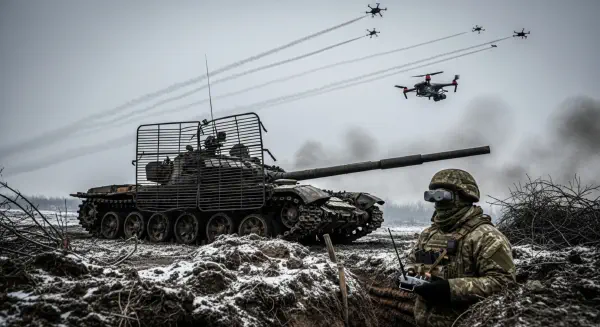
2022 (Ukraine): The FPV revolution. Volunteer workshops began converting $50 racing drones into precision kamikaze weapons. By mid-2022, Ukrainian brigades were destroying Russian tanks at a rate of eight to twelve per day using weapons that cost $500 each.
2023 (Ukraine): The Shahed flood. Russia began launching 1,000-drone nightly raids, saturating Ukrainian air defences and depleting interceptor stockpiles. The strategy was not precision; it was economic attrition.
2025 (Ukraine): Semi-autonomous terminal guidance. The Ukrainian "Saker" FPV acquired a machine-vision lock at 100 metres, requiring no radio link in the terminal phase. Jammers became irrelevant for the final approach.
2026 (USA): Lucas. The United States began producing a domestically engineered Shahed copy at SpektreWorks for $35,000 per unit, for offensive use by US forces and allies.
Section 4: Ukraine as a Laboratory#
Scale#
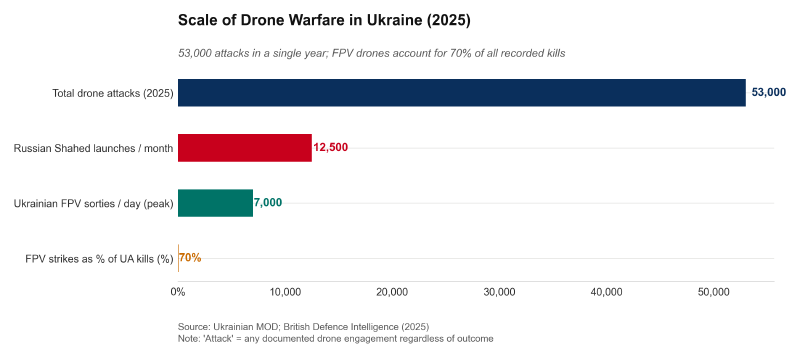
Ukraine in 2025 was the most drone-intensive theatre in military history. Both sides combined for over 53,000 drone attacks in the year. Ukrainian FPV sorties peaked at 6,000 to 8,000 per day. Russian Shahed launches averaged 10,000 to 15,000 per month. The front line was, for practical purposes, continuously contested by unmanned systems 24 hours a day.
FPV drones accounted for approximately 70% of all kills recorded in Ukrainian open-source battle-damage assessments in 2024–2025. Tanks, artillery, armoured personnel carriers, and logistics vehicles were all targeted. Drones destroyed systems worth hundreds of millions of dollars for a total monthly cost measured in the tens of millions.
The Pilot Pipeline#
Ukraine's human constraint is not drones; it is operators. FPV piloting is a skilled function: it requires spatial awareness, radio discipline, EW awareness, and the ability to execute terminal guidance under fire. Training a basic FPV pilot takes three to six months; advanced training takes twelve to eighteen.
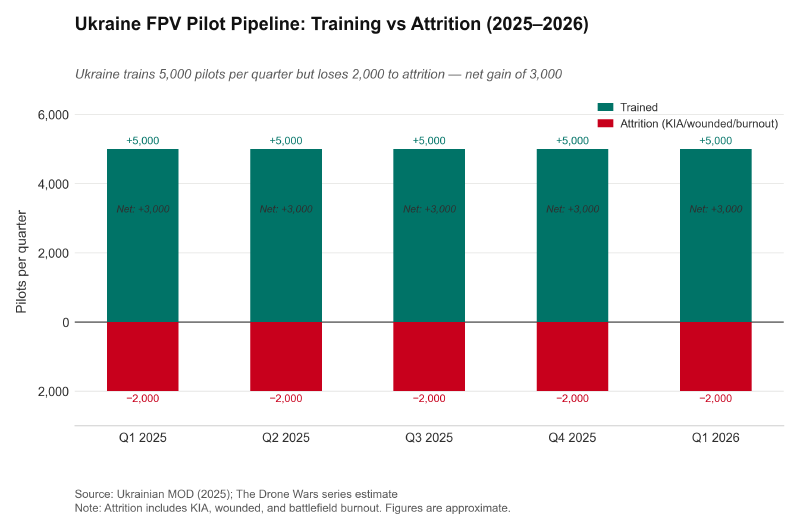
In 2025, Ukraine trained 5,000 operators per quarter. It lost 2,000 to KIA, wounding, and burnout. The net quarterly gain of 3,000 was barely sufficient to crew the accelerating drone output. By mid-2025, roughly 25,000 drone operators were deployed, each working a rotation of five to ten drones.
The Electronic Warfare Spiral#
The defining technological contest of the Ukraine war was not drone versus tank; it was radio-spectrum dominance. The sequence of adaptation and counter-adaptation was the fastest in military history.
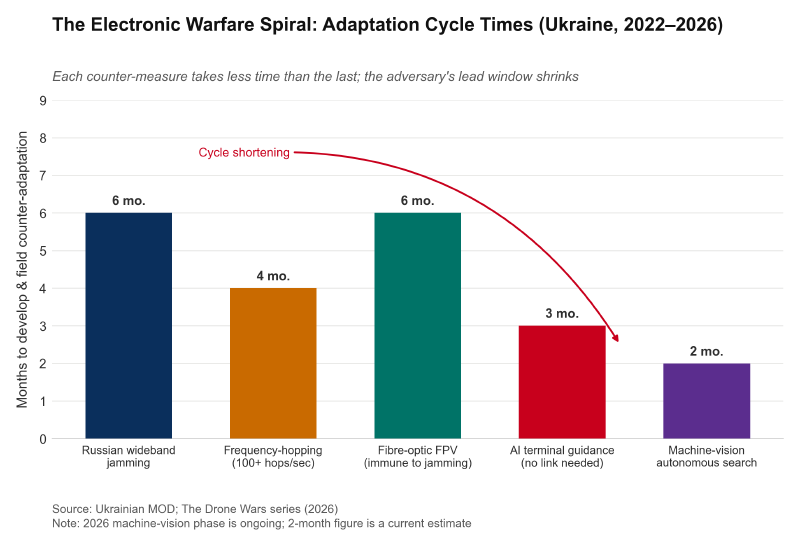
Phase 1 (early 2022): Standard 2.4 GHz analogue. Both sides used commercial off-the-shelf protocols. The Russian electronic warfare system was calibrated for conventional military frequencies and could not suppress these signals.
Phase 2 (late 2022): Russian wideband jamming. Brute-force white noise across the 433 MHz to 5.8 GHz spectrum. Thousands of Ukrainian FPVs were grounded.
Phase 3 (2023): Ukrainian frequency-hopping. More than a hundred channel changes per second, faster than any single jammer could follow. Response time from Russian jamming to Ukrainian counter: four months.
Phase 4 (2024): Fibre-optic FPV. A physical filament carried the control signal. No radio; no jamming possible. Effective to five to ten kilometres. Response time: six months.
Phase 5 (2025): AI terminal guidance. Machine-vision lock acquired at 100 metres. No radio link in the final approach; the jammer has nothing to jam. Response time: three months.
Phase 6 (2026, ongoing): Machine vision for autonomous area search. The drone classifies and engages independently within a designated zone. Response time: estimated two months and shortening.
Each cycle is faster than the last. In 2022, an advantage lasted six months. By 2026, it lasts two. A military that cannot adapt in sixty days is already behind.
Section 5: The Middle East Theatre#
The Houthi Red Sea Campaign#
From late 2023, the Houthis demonstrated that a non-state actor with Iranian-supplied drones could hold global commerce at risk with limited political cost. Commercial vessels transiting the Red Sea were struck by Shahed variants and cruise missiles. By early 2024, the Suez Canal had lost forty percent of its normal transit volume. Shipping rerouting around the Cape of Good Hope added fourteen days and roughly $500 million per major attack in aggregate costs to global supply chains.
The US and allied response — Tomahawk cruise missiles, F/A-18 strikes, and interceptors from USS Dwight D. Eisenhower — cost more per week than Iran's entire Houthi drone-supply programme for the year. A single US Tomahawk strike against a Houthi drone storage facility cost approximately $2 million; the drones inside cost $30,000 each.
The Iran Campaign (March 2026)#
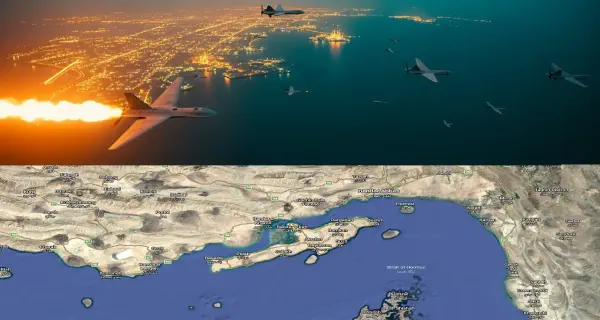
March 2026 moved the Middle East drone war from chronic attrition to acute crisis. Iran launched the largest coordinated drone-and-missile strike ever recorded against military installations in Saudi Arabia, the UAE, and Israeli-operated positions in the Eastern Mediterranean.
The 3,560 Shahed drones were the attritional layer: designed to saturate interceptor magazines, exhaust radar operators, and force expensive high-tier missiles to engage cheap targets. The 2,410 ballistic and cruise missiles that followed were the precision layer: they targeted specific hardened facilities that the Shaheds had forced out of active air-defence coverage.
The interception bill reached $12 to $15 billion in a single month. Iran's factory kept running. The fiscal arithmetic was unsustainable for the defender.
Section 6: The Paradox of Precision#
Drones Are Precise; Drone Wars Are Not#
A single FPV drone can hit the open hatch of a tank turret at a range of two kilometres. It can do so at night, in rain, and with a guidance update in the final metre. By any historical standard, this is extraordinary precision. The Normandy carpet-bombing of 1944, which killed approximately 1,000 Allied soldiers through short drops, used hundreds of aircraft to achieve the destruction that one drone can now inflict with certainty.
Yet the conduct of drone warfare in Ukraine, the Middle East, and beyond does not reflect this precision. Russia launches drones against Ukrainian cities in nightly raids. The targeting logic is economic and psychological: keep Ukrainian air defences spending, keep the population awake, force interceptor use at unfavourable ratios.
The precision is real. The restraint is not.
The Accountability Gap#
Armed drones lower the political cost of lethal action. No pilot dies; no aircraft appears on a foreign radar; no prisoner is taken; no body is repatriated. The political feedback loop that once constrained casualty-generating operations is severed.
This produces a structural expansion of the kill chain. Actions that would have required political authorisation under manned-aviation rules are now delegated further down the command hierarchy. In the Pakistan operations of 2004–2018, the CIA authorised strikes that would previously have required Presidential-level sign-off. In Ukraine, junior brigade commanders authorise drone strikes in real time without escalation to corps or army level. The decision cycle is faster; the deliberation is shorter.
International Humanitarian Law was written for a world of slow decisions and identifiable actors. Autonomous guidance systems, fire-and-forget munitions, and multi-operator swarms challenge the attribution requirements of that legal framework at a structural level.
Section 7: The Technology Frontier#
Current Capabilities (2026)#
The operational drone of 2026 is a fundamentally different instrument from the Predator of 2001. Three developments have produced this discontinuity:
Affordable autonomy. Machine-vision systems derived from consumer smartphone chips can now distinguish a military vehicle from a civilian one at two hundred metres with greater than ninety-five percent accuracy. These chips cost $8. They can be incorporated into a $500 FPV airframe without modifications to the aerodynamics or propulsion system.
Swarm coordination. Distributed formation flying, where drones share target assignments and deconflict flight paths without human instruction, has been demonstrated in units of up to fifty aircraft. Ukraine's Saker programme tested sixteen-drone coordinated attacks in October 2025. Russia's response was a counter-drone drone: an autonomous FPV that hunted other FPVs.
Fibre-optic and AI guidance. The combination of fibre-optic physical tether (immune to electronic jamming) and machine-vision terminal guidance (immune to signal jamming) means that a $2,000 drone can reach its target even in an environment with total radio-frequency suppression.
The Reaper Is Not Dead, But It Is Obsolete#
The MQ-9 Reaper costs $32 million per airframe. It operates at 15,000 metres, flies at 290 km/h, and carries 1,700 kg of munitions. In 2010, it was the most capable armed drone on Earth. In 2026, it is a vulnerability.
A $30,000 Shahed launched from a light aircraft or truck could, if steered accurately, destroy a Reaper on the ground. Electronic warfare systems that would barely register against a TB2 can jam the Reaper's control links. Against a near-peer adversary with competent EW, the MQ-9 cannot operate.
The US Air Force has recognised this. Its Collaborative Combat Aircraft programme seeks to replace high-value single-unit platforms with swarms of cheaper expendable aircraft. The target unit cost is under $3 million. The Reaper's $32 million will build ten of them.
Drone Specifications Comparison#
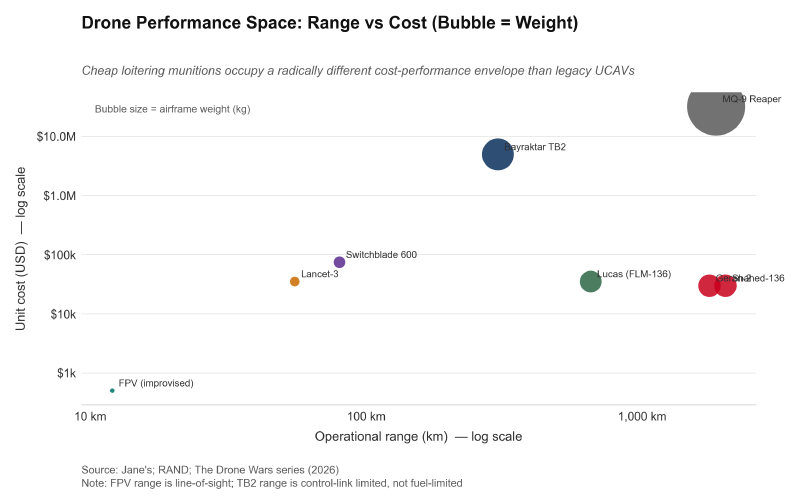
The eight systems below span six orders of magnitude of cost and represent the full spectrum of current unmanned aerial capability.
| System | Type | Cost (USD) | Range (km) | Weight (kg) | Warhead (kg) |
|---|---|---|---|---|---|
| FPV improvised | Kamikaze | $500 | 5–20 | 0.5–1.5 | 0.5–2 |
| Shahed-136 (Iran) | Loitering munition | $30,000 | 2,000 | 200 | 30–50 |
| Geran-2 (Russia) | Loitering munition | $30,000 | 1,500–2,000 | 200 | 50 |
| Lancet-3 (Russia) | Loitering munition | $35,000 | 40–70 | 12 | 3–5 |
| Lucas / FLM-136 (US) | Loitering munition | $35,000 | 650 | 180 | 18–20 |
| Switchblade 600 (US) | Loitering munition | $75,000 | 80 | 23 | 15 |
| Bayraktar TB2 (Turkey) | Tactical UCAV | $5,000,000 | 300 | 650 | 88 |
| MQ-9 Reaper (US) | Armed reconnaissance | $32,000,000 | 1,850 | 4,760 | 1,700 |
Table 3: Specifications of eight representative unmanned systems spanning six orders of magnitude of cost, 2026.
Section 8: Strategic Implications#
For Great Powers#
The United States spent three decades building a drone advantage that allowed it to surveil and strike anywhere in the world with impunity. That advantage has been commoditised. Russia, Iran, China, and Turkey all manufacture competitive loitering munitions. Thirty-six nations will have armed drone capability by 2027, up from four in 2001.
The US response has been twofold. The Replicator programme, announced in 2023, seeks to field thousands of cheap autonomous drones within eighteen to twenty-four months. The Lucas (FLM-136) programme reverse-engineers the Shahed at $35,000 per unit to build a domestic supply of attritional munitions. Both represent an acknowledgement that the era of drone monopoly is over.
For Middle Powers#
Turkey's Bayraktar TB2, sold to forty-one countries at $5 million each, is the most commercially successful armed drone in history. It proved decisive in Libya (2020), Azerbaijan (2020), and Ukraine (2022, first phase). Turkey extracted maximum political and economic leverage from a single successful platform.
This model is now widely understood. Poland, South Korea, India, and the UAE all have active programs to develop exportable armed drone systems. Drone production capability is the new metric of defence-industrial relevance.
For Non-State Actors#
The Houthis in 2023 and Hamas in 2024 demonstrated that a group with a national-state patron can operate strategic-level drone campaigns. The Houthis disrupted global shipping. Hamas deployed FPVs in tunnel-clearing operations where Israeli infantry would face severe casualties.
The technology is not controlled. The components are available on AliExpress. The airframes can be printed. The guidance software is open-source. A sufficiently motivated non-state actor can replicate the core FPV capability for under $1,000 per unit, including the machine-vision terminal guidance chip.
For the Global Market#
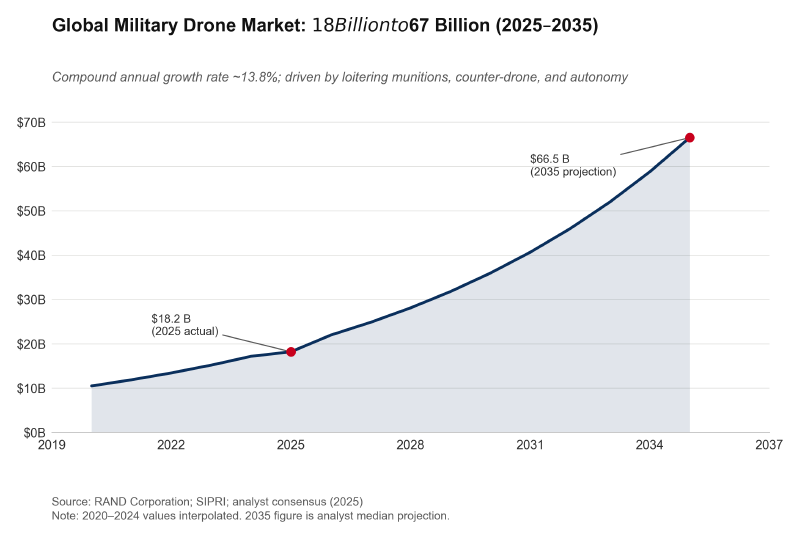
The global military drone market reached $18.2 billion in 2025. Projections for 2035 range from $55 billion to $67 billion, implying a compound annual growth rate of roughly 13–14%. Loitering munitions, counter-drone systems, and autonomous swarm platforms drive the highest-growth segments.
Russia's monthly production cost for its Shahed campaign is approximately $450 million, roughly equivalent to Ukraine's monthly interceptor-ammunition cost. Both are donor-funded, directly or indirectly. The financial sustainability of industrialised drone warfare at this scale is an open question for both NATO and its adversaries.
Section 9: Autonomy and the Legal Threshold#
What "Autonomous" Means in 2026#
The word "autonomous" is used to describe a wide range of capabilities, from GPS-guided waypoint following (programmed, not autonomous) to machine-vision target acquisition (semi-autonomous) to fully independent target selection and engagement without human authorisation (fully autonomous, sometimes called LAWS: Lethal Autonomous Weapons Systems).
In 2026, the operational systems in Ukraine occupy the semi-autonomous category. The Saker FPV acquires its machine-vision lock only in the terminal phase, after a human operator has aimed the drone at a target. The human decision is made; the machine completes the terminal guidance. This is consistent with the legal principle of "meaningful human control."
The boundary is eroding. Ukraine's sixteen-drone coordinated attack in October 2025 assigned individual targets to individual drones in real time, without human re-authorisation per target. The human decided to launch the swarm at a grid square. The machines divided the targets. Whether that satisfies "meaningful human control" under IHL is contested.
The 2028–2029 Horizon#
Intelligence assessments cited in the ICRC's 2025 report on autonomous weapons suggest that fully autonomous target selection and engagement, with no human authorisation for individual strikes, is likely to be fielded by at least one state actor before 2030. The most probable theatre is a contested airspace environment where communication latency prevents real-time human control.
No international treaty prohibits LAWS. The UN Group of Governmental Experts on LAWS has met since 2014 without producing a legally binding instrument. The pace of capability development has consistently outrun the pace of legal deliberation.
The Accountability Gap at Scale#
International humanitarian law requires a human to be accountable for each lethal decision. It also requires proportionality, distinction between combatants and civilians, and precaution in attack. These principles were written when the human who aimed the weapon was identifiable and traceable.
A swarm of fifty autonomous drones operating under a delegated zone-clearance order is not easily mapped onto this legal architecture. The commander who authorised the zone is not the entity that selected the individual target. The software that selected the target has no legal personality. The manufacturer is not present in the theatre. The existing legal framework has a structural gap that no state has yet proposed to close.
Section 10: Projections for 2030#
Based on the adaptation rates, production trajectories, and technology development paths documented above, the following developments are probable before 2030:
Swarm operations at brigade scale. Units of fifty to a hundred autonomous drones, operating under a single high-level command, will be standard in at least four militaries (US, Russia, China, Ukraine). Each will carry a full sensor-to-shooter loop without human relay.
Sub-$10,000 precision loitering munitions. The commoditisation of machine-vision guidance and the continued reduction in manufacturing costs will bring a basic autonomous loitering munition below $10,000 for state purchasers and below $2,000 for improvised production. The distinction between "expensive drone" and "cheap drone" will effectively disappear.
Counter-drone as a primary mission. Air defence will reorganise around counter-drone as its primary task, with legacy anti-aircraft guns, directed-energy weapons, and autonomous interceptors forming layered screens. Kinetic interception of mass drone raids is fiscally unsustainable at current cost ratios; directed energy is the only viable long-term answer.
Sixty to seventy percent of air forces are drones. By 2035, most major air forces will be majority-drone by unit count, though manned platforms will retain a share of high-end strike and air-superiority missions. The economics of drone attrition will have permanently shifted force structure planning.
First confirmed autonomous kill without human authorisation. Intelligence assessments suggest this will occur before 2030, likely in a classified context. It will be attributed retrospectively, after the fact, if at all.
Conclusion#
Drone warfare is not a niche capability grafted onto conventional war. It has restructured the economics of attrition, shortened the innovation cycle to weeks, democratised precision strike, and created legal gaps that existing frameworks cannot close.
The five mechanisms that recur throughout drone warfare history — risk transfer, gap exploitation, economic asymmetry, electronic warfare spiralling, and copycat proliferation — have accelerated to the point where a military advantage measured in months can translate to a battlefield defeat measured in weeks.
The most important implication is fiscal. Defenders cannot sustain cost-exchange ratios of 80:1 to 240:1 indefinitely. Interceptors will run out before drones do. The only viable responses are: matching the attacker's production costs (which requires commoditising defensive munitions to the same price point as offensive ones), fielding directed-energy systems that kill drones at near-zero marginal cost, or accepting that some attacks will get through.
None of these responses is quick or cheap. All of them require a rethinking of defence investment that most major militaries began too late.
Infographic#
This infographic synthesises the key data points from the report into a visual format. It includes cost-exchange ratios, production volumes, historical milestones, and future projections. The design is intended to be accessible to both military professionals and the general public, providing a clear overview of the drone warfare landscape in 2026.
More Reading on This Site#
- The Drone Wars series, Parts 1–6 (2024–2026): A detailed open-source intelligence analysis of drone warfare in Ukraine and the Middle East, with a focus on operational data, production trends, and tactical evolution.
References#
- Ukrainian Ministry of Defence, open-source intelligence reports (2024–2026)
- British Defence Intelligence daily updates (2024–2026)
- RAND Corporation, Drone Warfare: A Cost-Exchange Analysis (2025)
- UNIDIR, Lethal Autonomous Weapons Systems: Status Report (2025)
- IISS, Military Balance (2025)
- ICRC, Autonomous Weapons and IHL (2025)
- SIPRI, Military Expenditure Database (2025)
- Jane's All the World's Aircraft (2025 edition)
- The Drone Wars series, Parts 1–6 (2026)