The Lying Miracle#
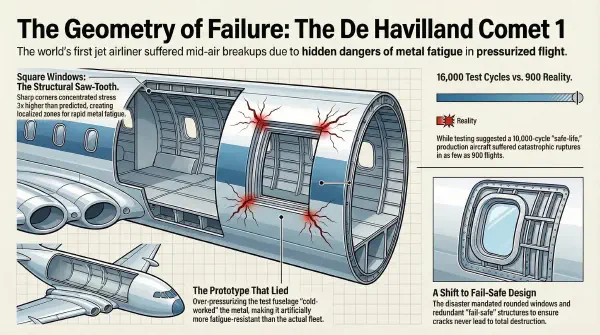
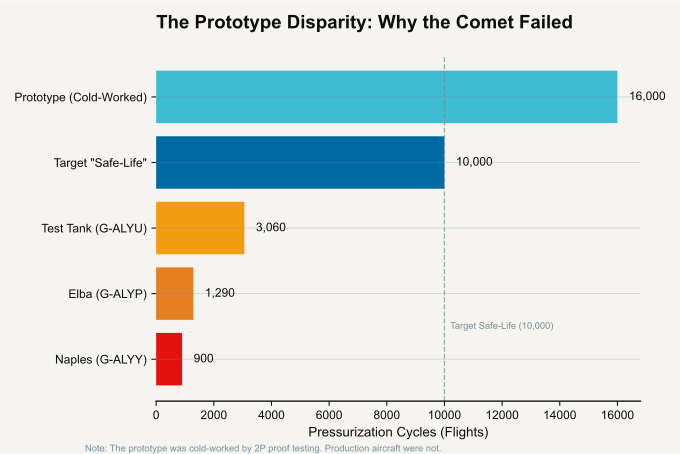
In the history of engineering, few machines have committed a more dangerous act of deception than the de Havilland Comet prototype, G-ALVG. This aircraft was the hero of the test facility. It was the proof that the Comet was safe. While the production planes—the ones carrying passengers—were falling apart after 900 or 1,200 flights, the prototype had endured 16,000 pressurization cycles in testing before it finally showed a crack. Sixteen thousand. The design target was 10,000. The prototype had exceeded its requirement by sixty per cent.
The engineers at de Havilland looked at this data and felt vindicated. They had built a machine that could outlast its expected lifespan. They had proved, with hard numbers, that the Comet was strong. When the production planes began to crash, they did not question the prototype data. Why would they? The data was right there, written in the test logs. The prototype had survived. The design was sound. The crashes must have other causes.
But the prototype was a liar. It had survived not because the design was perfect, but because the engineers had accidentally immunized it against the very disease that killed the production fleet. They had given it a treatment that no passenger-carrying Comet ever received. And they did not even know they had done it.
The Proof Test#
The story begins with a seemingly reasonable decision. Before subjecting the prototype to fatigue testing—the thousands of pressure cycles that would simulate years of flying—de Havilland wanted to prove that the fuselage was strong enough to withstand the maximum pressure it might ever encounter. They performed a "proof test." They pumped the cabin up to twice its normal operating pressure: 16.5 psi instead of 8.25 psi. They held it there. The fuselage did not burst. It passed. The engineers nodded with satisfaction and moved on to the fatigue test.
They did not know that they had just changed the metal.
When you stress a metal beyond its elastic limit—the point at which it springs back to its original shape—you enter the plastic zone. The metal deforms permanently. It does not break, but it bends. In the case of the Comet prototype, the metal at the corners of the square windows—the points of highest stress—was pushed past its yield point. It deformed. The deformation was tiny, invisible to the naked eye. But it changed the internal structure of the metal.
This process is called "cold-working." It is the same process that blacksmiths use to harden iron by hammering it. When you deform a metal plastically, you create dislocations in its crystal lattice. These dislocations tangle and interfere with each other. The metal becomes harder and stronger. It also becomes more resistant to fatigue.
The prototype's window corners had been cold-worked by the 2P proof test. They were now tougher than virgin metal. When the fatigue test began, these corners resisted the formation of cracks. The prototype sailed past 10,000 cycles, then 12,000, then 16,000. The engineers thought they were seeing the natural strength of their design. They were actually seeing the unnatural strength of a test specimen that had been accidentally fortified.
The Virgin Fleet#
The production Comets—the ones that flew from London to Johannesburg, from Rome to London, from Calcutta to nowhere—never received this cold-working treatment. They were pressurized to normal operating pressure, 8.25 psi, on every flight. They were never pushed to 16.5 psi. Their window corners remained virgin metal, soft and vulnerable.
When these production aircraft began their service lives, the fatigue process started immediately. With every climb, the square corners experienced their full, undiluted stress concentration. Cracks began to form after a few hundred cycles. They grew with every subsequent flight. At 900 cycles (Naples) or 1,290 cycles (Elba), the cracks reached critical length and the fuselages tore apart.
The prototype, by contrast, had been pre-stressed into a state of artificial resilience. Its 16,000-cycle performance was real—the machine really did survive that long—but it was not representative. It was a laboratory artifact, a ghost generated by a testing protocol that had corrupted the specimen.
This is the cold-work deception. It is not a conspiracy. No one lied. No one falsified data. The engineers at de Havilland were honest, diligent, and thorough. They were also wrong. They had followed the best practices of their time, and those best practices had led them into a trap.
The Safe-Life Fallacy#
The Comet disaster exposed a fundamental flaw in the engineering philosophy of the 1950s. That philosophy was called "safe-life." The idea was simple: calculate how long a component will last under normal use, then retire it before it fails. Build in a safety factor. Replace the part at half its calculated life, or a quarter, and you will never have a failure.
The problem with safe-life is that it requires you to know exactly how long the component will last. You need accurate data. You need a testing regime that perfectly replicates real-world conditions. You need to account for every variable that might affect fatigue life: stress concentration, material variations, manufacturing tolerances, environmental factors.
The Comet proved that this level of knowledge is impossible. De Havilland thought they had a safety factor of two—the prototype lasted 16,000 cycles, so they set the safe-life at 10,000. The actual life of the production aircraft was 900 cycles. The safety factor was not two. It was negative. The aircraft were failing before they reached even one-tenth of the supposed safe-life.
After the Comet, the industry abandoned safe-life for pressurized fuselages. They replaced it with a philosophy called "fail-safe" or "damage tolerance." In a fail-safe design, you assume that cracks will occur. You do not try to prevent fatigue entirely—that is impossible. Instead, you design the structure so that a single crack does not cause catastrophic failure. You add redundant load paths. You add "rip-stops" that contain the crack. You design the aircraft to stay in one piece even when it is broken.
The Boeing 707 was the first major airliner designed with fail-safe principles. It had rounded windows, of course. But it also had a fuselage structure that could tolerate a crack growing to several feet in length without unzipping. The 707 flew for decades without a single catastrophic pressure failure. The Comet died so that the 707 could live.
The Regulatory Response#
The British government moved quickly after the Comet inquiry. In 1956, the British Civil Aircraft Requirements were revised. The new regulation, D3-7, specifically addressed the testing of pressure cabins. It required that fatigue testing be conducted on a complete fuselage that had not been used for proof testing or any other strength test. The test specimen had to be representative of the production aircraft. No more cold-working. No more immortal prototypes.
This regulation is still in force today, in various forms, around the world. Every new airliner design must undergo full-scale fatigue testing on a representative fuselage. The test article is not proof-tested first. It is cycled from the beginning in its virgin state. The data from that test determines the inspection intervals for the fleet.
The Comet also changed the way investigators think about accidents. After 1954, the default assumption was no longer "the pilot made a mistake" or "the weather was bad." The default assumption became "the machine failed." Investigators looked for design flaws first, not last. This shift in attitude has saved thousands of lives.
The Cost of Being First#
The de Havilland Comet 1 was a pioneering machine. It was the first of its kind. It flew higher and faster than any civilian aircraft before it. It was beautiful, silent, and smooth. It represented the future. And it killed ninety-nine people because the engineers who built it did not yet know what they did not know.
This is the tragedy of being first. The first always pays the price. The first steamship exploded. The first railway bridge collapsed. The first commercial jet disintegrated. The knowledge that comes after is bought with the wreckage of the ones that came before.
But there is also a kind of nobility in this. The Comet 1 was not a failure. It was an experiment that produced negative results. Those results—the square windows, the cold-working deception, the safe-life fallacy—became the foundation of modern aviation safety. Every time you buckle your seatbelt on a 787 or an A350, you are flying on a machine that exists because the Comet showed what not to do.
The metal was tired. The windows were the wrong shape. The tests were a deception. The engineers were wrong. But they were wrong in the right way: they were wrong publicly, catastrophically, and permanently. Their mistakes were written in wreckage and read by the world. And the world learned.
What the Comet Teaches Us#
There are four lessons from the Comet that every engineer should memorise.
First, geometry matters. A square corner in a pressure vessel is not a minor detail. It is the difference between 16,000 cycles and 900 cycles. Pay attention to the shape of things.
Second, test specimens must represent the production fleet. If you strengthen a prototype through proof testing, you are not testing the design. You are testing a different machine. Do not let your prototypes lie to you.
Third, safe-life is a dangerous assumption. You cannot predict fatigue life with perfect accuracy. Design for failure. Assume cracks will occur. Build redundancy.
Fourth, and most important: when a machine fails, look first at the machine. Do not blame the weather. Do not blame the pilot. Do not blame bad luck. The machine is usually telling the truth. The question is whether you are willing to listen.
The Comet was telling the truth from the first crash in Calcutta. It took three crashes and ninety-nine deaths for anyone to hear. The square windows were screaming. The engineers were deaf.
Do not be deaf.