The Recovery from the Sea#
In the summer of 1954, the Royal Navy began pulling pieces of the sky out of the Mediterranean. The wreckage of Comet G-ALYP lay two hundred feet down, scattered across the sea floor near the island of Elba. The British used underwater television cameras for the first time in history—a technological marvel of its age—to guide the recovery. They were looking for the "primary failure." They were looking for the exact point where the metal had decided to stop being an aeroplane and start being a cloud of debris.
By August, they had recovered seventy per cent of the aircraft. They laid the pieces out on the floor of a hangar at the Royal Aircraft Establishment in Farnborough, a place that sounds like a gentleman's club but was in fact a morgue for machines. The engineers walked among the wreckage, picking up fragments of aluminium skin, looking for the secret that the Comet had taken to the bottom of the sea.
But the sea gives up its secrets slowly. The engineers grew impatient. They decided to build their own disaster.
The Water Tank#
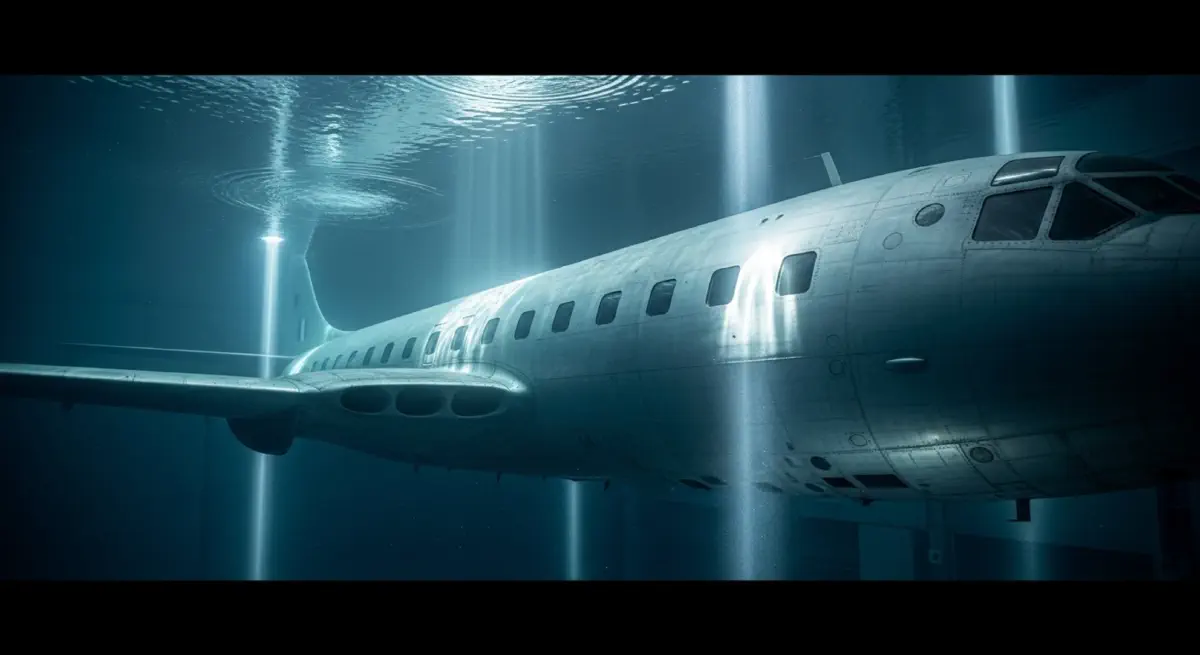
The idea was simple and brutal. Take a complete Comet fuselage—not a wreck, but a whole, undamaged airframe—and kill it on the ground. Submerge it in a giant steel-lined tank filled with water. Pump water into the cabin until the pressure reaches the same 8.25 psi that the plane experienced at altitude. Then release the pressure. Do this again. And again. And again. Thousands of times. Simulate years of flying in a matter of weeks.
Water was the key. Air is compressible. If a pressure vessel fails while filled with air, the expansion is explosive. The tank would become a bomb. But water does not compress. When the fuselage cracked, the water would simply leak out. The failure would be gentle enough to preserve the evidence.
The engineers at Farnborough chose a fuselage designated G-ALYU. It had already flown 1,230 flights—more than the Naples aircraft, fewer than the Elba aircraft. They submerged it in the tank and began the cycles.
They did not know what they would find. But they suspected the windows.
The Aesthetic of the Guillotine#
The Comet was a beautiful aeroplane. This is not a trivial observation. The men who designed it were proud of its appearance. They had given it large, squarish passenger windows that offered a wide view of the world below. In the 1950s, this was a selling point. Passengers wanted to see the earth from 35,000 feet. They wanted to feel the grandeur of flight. The square window was a luxury feature, like the reclining seats and the hot meals.
But beauty has a cost. In a pressurized vessel, stress flows like water in a pipe. If the pipe is smooth and rounded, the water flows evenly. If the pipe has a sharp corner, the water piles up. It eddies. It pushes harder against the walls. The same thing happens to stress in a metal skin.
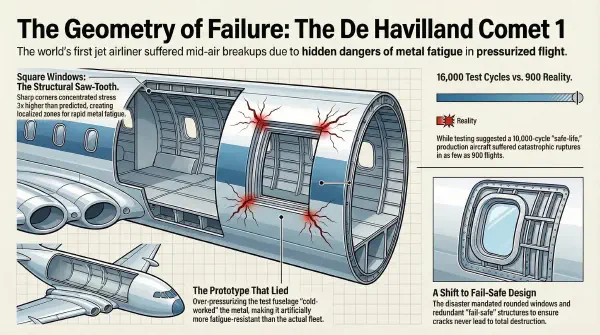
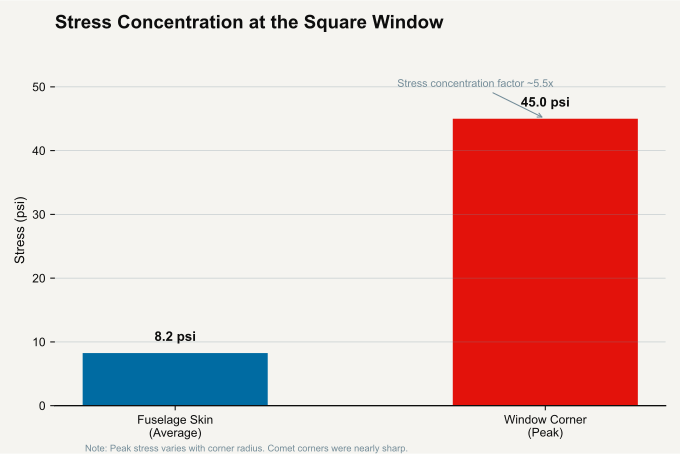
At the corner of a square window, the stress is not the same as the average stress on the fuselage. It is higher. Much higher. Five times higher. Six times higher. The exact multiple depends on the sharpness of the corner, and the Comet's corners were sharp. They were right angles, ninety degrees, the most efficient shape for concentrating stress ever devised by geometry.
The engineers at de Havilland had calculated the average stress and found it safe. They had not calculated the stress at the corners because they did not know they needed to. The mathematics of stress concentration was still young. The textbooks of the day did not warn against square holes in pressure vessels because no one had ever built a pressure vessel that cycled its pressure ten thousand times.
The Comet was teaching a lesson that no one had asked to learn.
The Failure#
The water tank experiment ran for weeks. The engineers cycled the pressure, watched the gauges, listened for the sound of cracking metal. Nothing happened. The fuselage survived 1,000 cycles. Then 2,000. Then 3,000. The engineers began to wonder if they had been wrong. Perhaps the Comet was safe after all. Perhaps the crashes had been caused by something else.
Then, at 3,060 cycles, the fuselage split open.
The failure did not start in the wings. It did not start in the engines. It did not start at a rivet or a seam. It started at the corner of a forward escape hatch window—a square corner, sharp as a razor, where the stress had been piling up with every cycle.
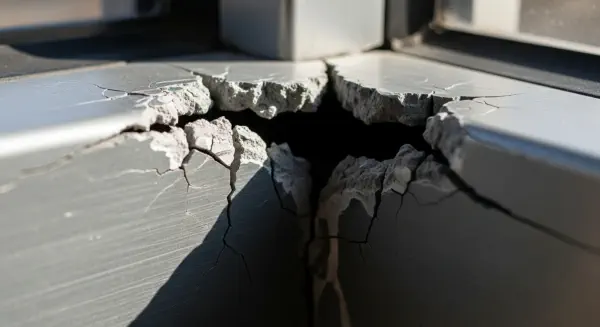
The engineers examined the fracture surface. They saw the characteristic marks of fatigue: tiny striations, like the growth rings of a tree, showing how the crack had grown a little bit with every pressurization. The crack had started small, invisible to the naked eye. It had grown slowly, flight by flight, until it reached a critical length. At that moment, the remaining metal could no longer contain the pressure. The fuselage unzipped.
With this fingerprint in hand, the investigators returned to the Elba wreckage. They looked at the top of the fuselage, just forward of the wings, where the Automatic Direction Finder (ADF) windows were located. These windows were also squarish. They found a piece of skin containing two ADF windows. The metal showed the same fatigue cracks.
The conclusion was inescapable. The Comet had not been blown up by a bomb. It had not been knocked down by a storm. It had simply reached the end of its life. And that life was far shorter than anyone had imagined.
The End of the Square Window#
The discovery at Farnborough changed the shape of aviation forever. The investigators wrote their report in the flat, careful language of engineers. They stated that the accident at Elba was caused by "the structural failure of the pressure cabin in the region of the ADF window, brought about by fatigue." They suggested the same was true for the Naples crash.
The industry listened. Boeing, which was designing the 707, changed its window design from square to oval. Douglas did the same for the DC-8. Every jet airliner built since 1954 has rounded windows. It is not an aesthetic choice. It is a survival choice.
The square window died in the water tank at Farnborough, along with the Comet 1. But the lesson is larger than windows. The lesson is that geometry matters. A shape that is safe in a static structure can be lethal in a dynamic one. A corner that is harmless in a building can be a death trap in an aeroplane. The engineers of the 1950s did not know this because no one had ever built a machine that stressed its skin ten thousand times.
The Comet taught them. The price of the lesson was ninety-nine lives.
The Physics of the Corner#
Let me be precise about what happens at a square corner.
Imagine a rubber band stretched between your fingers. The tension is evenly distributed along the band. Now imagine cutting a tiny notch in the edge of the band. When you stretch it again, the notch opens. The rubber around the notch stretches more than the rest of the band. The stress has concentrated at the notch.
A square window in a pressurized fuselage is a notch. A very large notch, with four sharp corners. When the fuselage expands under pressure, the skin around each corner stretches more than the skin elsewhere. The stress is not 8.25 psi at the corner. It is 40 psi, or 50 psi, or even higher. The exact number depends on the radius of the corner. The Comet's corners had a very small radius. They were almost perfectly sharp.
The aluminium alloy used in the Comet—DTD 546—was strong. It could handle 40 psi of static stress without breaking. But static stress is not the problem. The problem is cyclic stress. Every time the aeroplane climbed, the corner experienced that 40 psi spike. Every time it landed, the spike went away. Then it came back on the next climb. And the next. And the next.
After enough cycles, the metal grew tired. Tiny dislocations formed in the crystal structure. These dislocations merged into micro-cracks. The micro-cracks merged into a visible crack. The visible crack grew with every cycle until the remaining metal could no longer hold the pressure. Then the fuselage tore open.
This is metal fatigue. It is not a flaw in the material. It is a fundamental property of metals under cyclic stress. Every metal fatigues. Every metal will eventually crack if you stress it enough times. The only questions are how much stress and how many cycles.
The Comet's square corners answered both questions: too much stress, too few cycles.
The Silence After#
The Comet 1 never flew commercially again in its original form. De Havilland spent four years redesigning the aircraft. The Comet 4 had rounded windows and reinforced skin. It entered service in 1958, but by then the Americans had taken the lead. The 707 and the DC-8 were faster, cheaper, and more reliable. The British jet industry never recovered.
But the Comet's legacy is not failure. It is learning. Every rounded window on every aeroplane you have ever flown is a direct descendant of the water tank at Farnborough. Every inspection regime that looks for fatigue cracks before they become catastrophic is a child of the Comet. Every engineering student who learns about stress concentration learns about the Comet.
The machine died so that others could live. That is the closest thing to redemption that engineering allows.