The first one fell into the mud of India.
It was May 2, 1953. The aircraft was G-ALYV, a de Havilland Comet 1, the pride of British aviation and the first jet airliner to carry paying passengers. It had been exactly one year since the Comet began its reign. The plane took off from Calcutta's Dum Dum Airport—a name that seems almost too absurd for a tragedy—climbed into a sky the colour of a rotten plum, and six minutes later ceased to exist as a machine. Witnesses saw fire. The wreckage scattered across the Bengal countryside like confetti after a funeral.
Forty-three people died. The investigators from the Government of India looked at the storm clouds, looked at the twisted metal, and wrote a tidy verdict. They called it a "thundersquall." They suggested the pilot, a man of considerable experience, had either fought the storm too hard or let the storm fight him too much. The weather, they said, had done this.
It was a lie. But it was a comfortable lie. It meant the Comet—the beautiful, silent, stratospheric Comet—remained a perfect machine. It meant the only enemy was nature itself, and nature could be blamed without consequence. The real enemy was hiding in the metal, waiting to strike again.
The Weight of Invisible Air#
To understand why the Comet fell, you must first understand that you live at the bottom of an ocean. The air above you weighs something. At sea level, it presses down with fourteen and a half pounds on every square inch of your body. You do not feel this weight because your body pushes back with equal force. But a machine has no such internal pressure unless you give it one.
The Comet was designed to fly at 35,000 feet, where the air is thin and cold and the engines burn fuel with the efficiency of a miser. At that altitude, the pressure outside is only three and a half pounds per square inch. Inside the cabin, the pressure was kept at the equivalent of 8,000 feet—about eleven pounds per square inch. The difference, the pressure that the fuselage had to contain, was 8.25 pounds per square inch.
This does not sound like much. It is less than the pressure in a car tyre. But a car tyre is small and round and made of rubber. The Comet was seventy feet long and ten feet wide, a hollow tube of aluminium skin barely a sixteenth of an inch thick. Every square inch of that skin felt eight pounds of force pushing outward. Multiply that by the millions of square inches in the fuselage, and you have a force trying to tear the plane apart like a child pulling the legs off a spider.
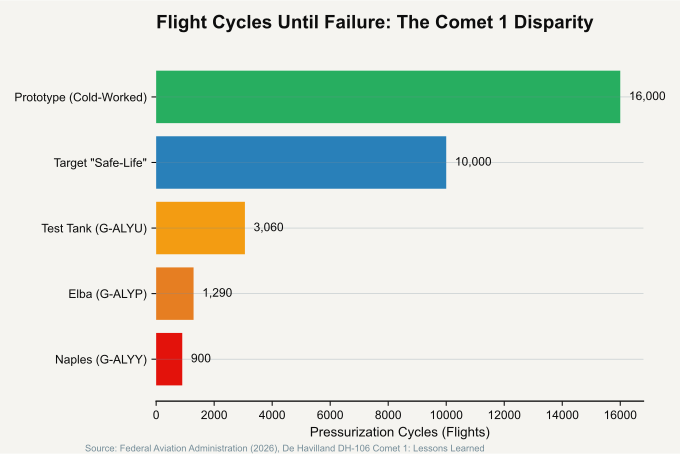
De Havilland knew this. They built a prototype and tested it. They pressurized it 2,000 times. They thought they had seen the future.
They had not.
The Comfort of Blame#
The Calcutta verdict was a masterpiece of institutional self-preservation. The Indian Court of Inquiry wrote that the aircraft "encountered a severe thundersquall" and that "the pilot lost control in the violent updraughts." They did not say this because the evidence pointed that way. They said it because the alternative was unthinkable.
Think about what it means to blame the weather. Weather is random. Weather is an act of God. If weather kills an aeroplane, you change nothing. You express regret, you pay the insurance, and you continue flying. The machine remains innocent. The designers remain geniuses. The shareholders remain happy.
But if the machine killed itself—if the metal simply grew tired and tore apart at the seams—then everything changes. Then the Comet is not a triumph but a trap. Then every Comet in the sky is a potential coffin. Then the pride of British engineering becomes the shame of British engineering.
So they blamed the weather. They called it a "thundersquall" and moved on.
The second crash came eight months later.
The Interrupted Sentence#
January 10, 1954. Comet G-ALYP, call sign "Yoke Peter," left Rome for London. It was a clear day. No thundersqualls. The sky was the colour of a robin's egg. The crew spoke to the air traffic controller in Rome, their voices calm and professional. Then, mid-sentence, the transmission stopped.
The plane had been climbing through 27,000 feet near the island of Elba. Witnesses on the ground saw a streak of fire. The aircraft did not crash. It disintegrated. Thirty-five people fell into the Mediterranean.
This time, they could not blame the weather. There was no storm. There was no pilot error—the pilot never had time to make an error. There was only a clear sky and a broken aeroplane.
The fleet was grounded. But only briefly. De Havilland made sixty modifications. They checked the engines. They checked the fuel lines. They checked the wings for fatigue. They did not check the fuselage. They believed the Calcutta crash was "completely accounted for" by the storm. They believed the Elba crash must be a fluke—perhaps a bomb, perhaps a fire, perhaps something else that was not their fault.
Two weeks after the planes returned to the sky, the third crash came.
The Naples Catastrophe#
April 8, 1954. A South African Airways Comet, G-ALYY, took off from Rome bound for Johannesburg. It climbed through 35,000 feet near Naples. Twenty-one people died.
The fleet was grounded again. This time, permanently.
The three crashes—Calcutta, Elba, Naples—were not separate accidents. They were the same accident, repeated three times, because the men in charge refused to believe what the metal was trying to tell them. They looked for bombs. They looked for fires. They looked for pilot errors. They looked for anything except the windows.
To look at the windows was to admit that the very shape of the plane was a mistake. And that was a truth too terrible to face.
The Geometry of Silence#
The Comet had square windows.
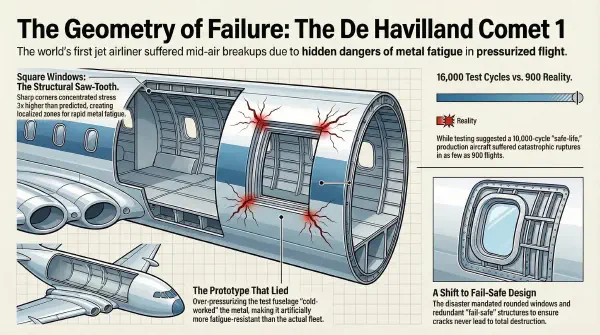
This seems like a small thing. It is not a small thing. In a pressurized vessel, a square corner is a trap for stress. The pressure pushes outward. The metal stretches. At a rounded corner, the stress flows around the curve like water around a stone. At a square corner, the stress piles up. It concentrates. It multiplies. It turns a gentle push into a hammer blow.
The engineers at de Havilland had calculated the average stress on the fuselage and found it safe. They did not calculate the stress at the corners. They did not know that the corner experiences five or six times the average load. They did not know that every flight was driving a wedge into the metal, widening a crack that would eventually grow large enough to tear the plane apart.
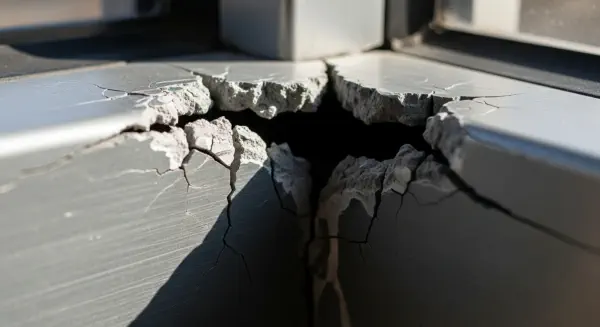
The water tank experiments at Farnborough would later prove this. When they submerged a Comet fuselage in a tank and cycled the pressure thousands of times, the failure always started at the same place: the corner of a square window. The metal did not snap like a twig. It grew a crack, slowly, invisibly, flight by flight, until the crack reached a critical length and the fuselage unzipped like a cheap suitcase.
But that discovery was still months away. In the spring of 1954, all the investigators knew was that three Comets had fallen out of the sky, and they did not know why.
The Cost of Certainty#
The grounding of the Comet fleet was a catastrophe for de Havilland and for Britain. The Americans—Boeing and Douglas—had been watching from across the Atlantic, taking notes. They would learn from the Comet's failure and build the 707 and the DC-8, the aeroplanes that would dominate the jet age. The British never caught up.
But the real cost was measured in lives. Ninety-nine people died because a design flaw went undetected and because the men who should have detected it preferred to blame the weather. This is the pattern of every engineering disaster: first the failure, then the denial, then the search for an external scapegoat, and finally, too late, the truth.
The truth was that the Comet 1 was a sacrificial machine. It was the first, and the first always pays the price. Its failure bought the safety of every jet that followed. Every rounded window on every modern airliner is a monument to the ninety-nine. Every inspection regime that looks for tiny cracks before they become ruptures is a direct result of the water tank at Farnborough.
But that safety was paid for in the mud of India and the deep waters of the Mediterranean. The history of aviation is written in wreckage. The only question is whether we read it before we repeat it.
What the Weather Hides#
The Calcutta crash was not caused by a thundersquall. The storm was present, yes, but it was not the cause. The storm was the trigger that pulled a gun already loaded. The metal was already cracked. The storm simply provided the final push.
This is the danger of blaming the weather. Weather is always present. There is always a storm somewhere, always a gust of wind, always a patch of turbulence. If you blame the weather, you never have to look at the machine. You never have to ask whether the machine was designed badly, built badly, or tested badly. You simply shrug and say, "Nature is cruel," and build the next aeroplane with the same square windows.
The investigators at Farnborough would eventually prove that the Comet's windows were the problem. They would prove that the square corners concentrated stress like a magnifying glass concentrates sunlight. They would prove that the prototype had survived 16,000 cycles only because it had been accidentally strengthened by the very tests meant to prove its safety.
But that is the story of the second and third posts. For now, the lesson is this: when a machine fails, look first at the machine. Do not look at the sky. The sky is innocent. The sky has no engineers. The sky does not cut corners to save money or meet a deadline. The sky simply is.
The men who built the Comet were not evil. They were not stupid. They were simply certain. And certainty is the deadliest thing in engineering.
Timeline of Events#
Below is a timeline of key events in the de Havilland Comet 1 story, formatted for the Blowfish timeline shortcode.
July 27, 1949
First flight of the de Havilland Comet prototype (G-ALVG). The world's first jet airliner takes to the skies, ushering in the commercial jet age.May 2, 1952
First scheduled jet service. BOAC launches the Comet 1 from London to Johannesburg. The aircraft flies faster and higher than any previous civilian plane.May 2, 1953
Calcutta crash (G-ALYV). One year to the day after commercial service began, a Comet breaks up near Calcutta, India, killing 43. The Indian Court of Inquiry blames a "thundersquall."January 10, 1954
Elba crash (G-ALYP). Comet "Yoke Peter" disintegrates near the island of Elba in the Mediterranean, killing 35. The fleet is briefly grounded but returns to service after 60 modifications.April 8, 1954
Naples crash (G-ALYY). A South African Airways Comet breaks up near Naples, Italy, killing 21. The entire Comet 1 fleet is permanently grounded.Summer 1954
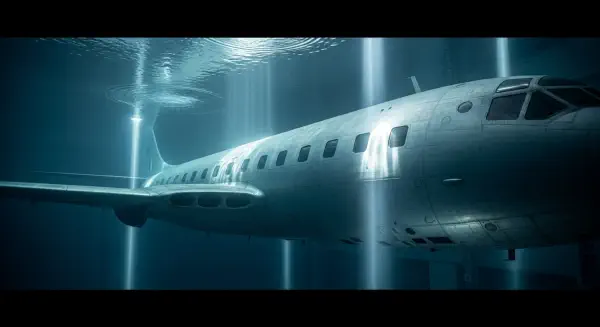
Underwater recovery at Elba. The Royal Navy recovers 70% of G-ALYP from the Mediterranean floor, using underwater television cameras for the first time.1954
Farnborough water tank experiments. Engineers at the Royal Aircraft Establishment submerge Comet fuselage G-ALYU in a water tank and cycle the pressure. After 3,060 cycles, the fuselage splits open at the corner of a square window.Late 1954
Fatigue cracks identified. Investigators match the water tank fracture pattern to wreckage from Elba, proving that square window corners concentrated stress and caused metal fatigue.1956
Regulatory reform (BCAR D3-7). British Civil Aircraft Requirements are revised to mandate that fatigue test specimens must not be used for proof testing first, ending the "cold-work deception."1958
Comet 4 enters service. The redesigned Comet features rounded windows and reinforced skin, but the American Boeing 707 and Douglas DC-8 have already captured the jet market.