In 2015, marine biologist Christine Figgener filmed her team removing a plastic straw from a sea turtle’s nostril. The video went viral, sparking a global movement against single-use plastics. Yet the straw was merely the visible tip of an invisible iceberg. For every straw spared, millions of other convenience items—plastic wrappers, disposable cups, fast-fashion garments, electronic accessories—continue flowing into ecosystems. The Great Pacific Garbage Patch, now three times the size of France, represents not accidental pollution but the logical endpoint of convenience-driven consumption. Each item was designed for momentary use and effortless disposal. Their collective impact is permanent.
This disconnect between individual convenience and cumulative consequence defines what environmental economists call “the tragedy of the commons in time.” We enjoy the immediate benefits of disposable products, fast delivery, and energy-intensive comforts while deferring their environmental costs to future generations. These deferred costs constitute what this analysis will term “environmental debt”—the accumulating ecological liabilities that our convenience-focused systems create but fail to account for. Like financial debt, environmental debt compounds silently, becoming more difficult to repay with each passing year. Unlike financial debt, it cannot be restructured or forgiven by central banks. When it comes due, payment is extracted not in currency but in ecosystem collapse, climate disruption, and biodiversity loss.
The convenience economy operates on what sustainability scholar Tim Jackson calls “the myth of decoupling”—the belief that we can sustain endless economic growth while reducing environmental impact through efficiency gains alone. Yet absolute decoupling remains elusive. Global material extraction has tripled since 1970, reaching 100 billion tons annually, while waste generation continues to increase. The convenience of cheap, disposable, instantly available goods is purchased with what ecological economist Herman Daly terms “natural capital depletion”—the systematic drawing down of finite resources that future generations will need for survival. Understanding this debt’s structure, its interest rates, and its eventual collection mechanisms reveals why our most convenient systems may prove to be our most costly legacy.
The Accounting of Absence#
The Externalization Imperative#
Modern environmental economics begins with a simple but revolutionary concept: the externality. First articulated by economist Arthur Pigou in 1920, externalities are costs or benefits that affect third parties who didn’t choose to incur them. The convenience economy externalizes environmental costs with remarkable efficiency. Carbon emissions from next-day delivery, microplastic pollution from synthetic textiles, soil degradation from intensive agriculture, electronic waste from rapid device turnover—all are excluded from market prices. A smartphone might cost $999, but its true environmental cost—mining, manufacturing, shipping, and disposal—could be two to three times higher if fully internalized.
This externalization isn’t accidental; it’s structural. A 2021 study in Nature Communications calculated that explicit environmental subsidies (tax breaks for fossil fuels, agricultural chemicals, etc.) total approximately $5.2 trillion annually—6.5% of global GDP. When implicit subsidies (unpriced pollution, resource depletion, etc.) are included, the figure rises to $11-12 trillion. These subsidies make convenience affordable by ensuring consumers don’t pay the full environmental cost of their consumption. The system functions precisely because its accounting is incomplete.
The psychological mechanism enabling this is what behavioral economists call “discounting.” Humans naturally value present benefits more than future costs—a phenomenon quantified through the “discount rate.” Environmental systems operate on entirely different timescales. Carbon dioxide persists for centuries, plastic decomposes over millennia, and species extinction is permanent. When we apply human discount rates (typically 3-7% annually) to environmental impacts, we effectively value the convenience of today’s plastic straw at thousands of times the cost of tomorrow’s ocean pollution. This temporal mismatch creates what philosopher Stephen Gardiner terms “the perfect moral storm”—where our cognitive biases, institutional structures, and intergenerational dynamics all align to prevent effective environmental action.
The Jevons Paradox and Efficiency Traps#
In 1865, economist William Stanley Jevons observed a counterintuitive phenomenon: as steam engines became more efficient, coal consumption increased rather than decreased. Improved efficiency lowered the cost of steam power, expanding its applications and ultimately increasing total resource use. This “Jevons Paradox” now operates across the convenience economy. LED lighting is 85% more efficient than incandescent, but global lighting energy consumption continues to rise as we illuminate more spaces for longer periods. Fuel-efficient vehicles haven’t reduced transportation emissions because we drive more miles in more cars. Digital dematerialization promised to reduce physical consumption, but e-commerce has increased packaging waste and transportation emissions.
The convenience economy weaponizes the Jevons Paradox through what researchers call “rebound effects.” When a product or service becomes more convenient and affordable, consumption typically expands in three ways: direct rebound (using the more efficient technology more intensively), indirect rebound (spending saved money on other consumption), and economy-wide rebound (efficiency gains stimulating broader economic growth). Studies suggest rebound effects typically recapture 20-60% of potential energy savings, with some sectors approaching 100%—meaning efficiency gains yield no net environmental benefit.
This creates a perverse dynamic: environmental improvements at the product level often increase impacts at the system level. Electric vehicles exemplify this tension. While they reduce tailpipe emissions, their production requires intensive mining for lithium, cobalt, and rare earth elements. Their electricity often comes from fossil fuels. And their convenience (lower operating costs, instant torque, home charging) may encourage more driving rather than modal shift to public transit. Without systemic changes to energy generation, urban design, and consumption patterns, technological efficiency alone cannot solve environmental problems—it may merely shift and sometimes exacerbate them.
The Linear Metabolism of Convenience#
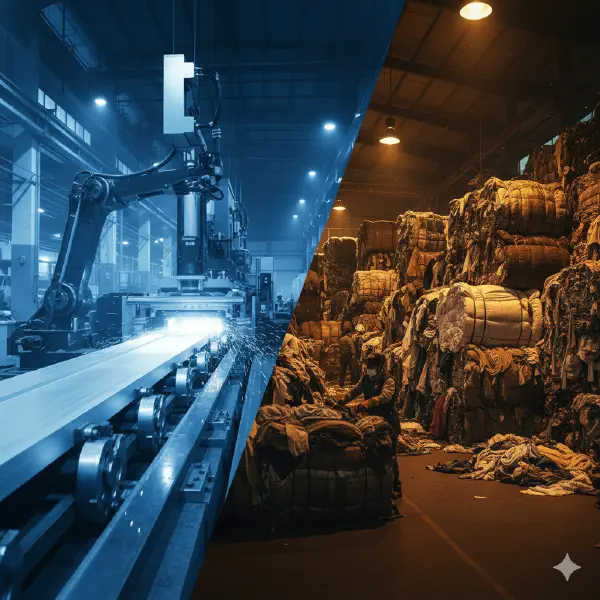
Natural ecosystems operate on circular metabolisms: waste from one process becomes food for another. The convenience economy operates on linear metabolism: extract, produce, consume, discard. This linearity is embedded in product design, business models, and consumer expectations. Fast fashion garments are designed for 7-10 wears before disposal. Electronics feature planned obsolescence through non-replaceable batteries and incompatible software updates. Single-use packaging constitutes 40% of global plastic production despite typically being used for minutes before centuries of environmental persistence.
The environmental costs of this linearity accumulate across what industrial ecologists call “life cycle stages.” A cotton t-shirt’s footprint includes pesticide-intensive agriculture (2,700 liters of water per shirt), energy-intensive manufacturing, chemical-intensive dyeing, long-distance transportation, and eventual landfill disposal or incineration. The convenience of cheap, disposable clothing externalizes these costs to cotton-growing communities (water scarcity, pesticide exposure), manufacturing regions (polluted waterways), and global commons (textile microplastics in oceans).
This linear metabolism creates what sustainability scholar Kate Raworth diagrams as “overshoot”—exceeding planetary boundaries while failing to meet social foundations. We’re extracting resources 1.7 times faster than Earth can regenerate them while disposing of waste faster than ecosystems can process it. The convenience of immediate consumption creates intergenerational injustice, as future generations inherit depleted resources, altered climates, and diminished biodiversity without having benefited from the consumption that caused these damages.
The Compounding of Unseen Liabilities#
Climate Change as the Ultimate Convenience Debt#
Climate change represents environmental debt’s most comprehensive manifestation. Each convenience that depends on fossil fuels—air conditioning, air travel, imported foods, disposable products—adds to atmospheric carbon concentrations that will persist for centuries. The convenience is immediate; the cost is deferred. The Intergovernmental Panel on Climate Change calculates that we’ve already committed to approximately 1.1°C of warming from past emissions alone, with further warming locked in from current infrastructure.
What makes climate debt particularly insidious is its non-linear compounding. Climate systems feature tipping points—thresholds beyond which changes become self-reinforcing and potentially irreversible. Arctic permafrost thaw releases methane, accelerating warming. Amazon deforestation reduces rainfall, increasing fire risk. Ice sheet collapse raises sea levels, disrupting ocean currents. Each tipping point crossed reduces the Earth’s capacity to absorb further impacts, effectively increasing the interest rate on our environmental debt.
The convenience economy systematically underestimates this non-linearity. Economic models typically price carbon through “social cost of carbon” calculations that assume linear damage functions. But as climate scientist Will Steffen notes, “The Earth System’s responses to climate change are not linear. They can be abrupt and irreversible.” When we make decisions based on linear assumptions—flying because the ticket is cheap, consuming because disposal is easy—we’re effectively betting that climate systems will remain predictable and gradual. This bet looks increasingly unwise as extreme weather events intensify, ecosystems shift abruptly, and previously stable systems destabilize.
Biodiversity Loss as Silent Bankruptcy#
While climate change captures headlines, biodiversity loss represents an equally critical but less visible environmental debt. The convenience economy drives extinction through habitat destruction (for agriculture, mining, urbanization), pollution (chemical runoff, plastic waste), and invasive species (through global trade). The current extinction rate is estimated at 100-1,000 times background levels, with approximately 25% of assessed species threatened.
This loss matters not just ethically but functionally. Biodiversity provides what ecological economists call “ecosystem services”: pollination, water purification, soil formation, climate regulation, and disease control. When species disappear, these services degrade or collapse. The convenience of pesticide-intensive agriculture, for example, reduces immediate crop losses but contributes to pollinator decline that threatens long-term food security. Each extinction represents not just a loss but a subtraction from Earth’s functional redundancy—its capacity to withstand shocks.
What makes biodiversity debt particularly dangerous is its irreversibility. Extinction is forever. While we might theoretically re-engineer climate through geoengineering or replace fossil fuels with renewables, we cannot recreate extinct species or reassemble lost ecosystems with their full complexity and resilience. The convenience of today’s consumption becomes the permanent impoverishment of tomorrow’s biosphere. As biologist E.O. Wilson warned, we’re conducting “biological surgery with an axe” when we should be performing it with a scalpel.
The Toxification of Time#
Beyond climate and biodiversity, the convenience economy creates what environmental health experts call “chemical debt”—the accumulation of persistent toxic substances in ecosystems and human bodies. Plastic additives like phthalates and bisphenol-A, pesticide residues like glyphosate, industrial chemicals like PFAS (“forever chemicals”)—these substances persist for decades or centuries, accumulating in soil, water, and living tissue.
The convenience of non-stick pans, stain-resistant fabrics, and disposable plastics comes with health costs that emerge slowly: endocrine disruption, developmental abnormalities, immune dysfunction, and increased cancer risk. These costs are systematically externalized because chemical regulations typically require proof of harm rather than proof of safety. Only about 1% of the 350,000 chemicals in commercial use have been comprehensively tested for human health effects. The precautionary principle—the idea that we should avoid potentially harmful actions even without definitive proof of harm—is systematically subordinated to the convenience principle.
This creates intergenerational chemical burden. Babies are now born with hundreds of synthetic chemicals already in their bodies, passed through placental transfer. These “body burdens” represent a form of toxic inheritance—convenience’s chemical legacy. Unlike financial debt that can be repaid or restructured, chemical debt persists through biological pathways we don’t fully understand and often can’t reverse.
Toward Environmental Solvency#
True Cost Accounting and the End of Externalization#
The first step toward environmental solvency is honest accounting. “True cost accounting” attempts to quantify and internalize environmental externalities, making the invisible visible. The Dutch company Tony’s Chocolonely, for example, calculates and publishes its “slavery footprint”—the estimated number of enslaved workers in its supply chain—alongside its environmental impacts. While imperfect, such accounting begins to correct market failures by revealing hidden costs.
Policy instruments can accelerate this shift. Carbon pricing (through taxes or cap-and-trade systems) makes fossil fuel convenience reflect climate costs. Extended producer responsibility laws make manufacturers responsible for product disposal, incentivizing durability and recyclability. Right-to-repair legislation preserves product longevity against planned obsolescence. Each policy introduces friction where convenience created externalities, aligning economic incentives with environmental realities.
Circular Design and the Metabolism Revolution#
Beyond accounting, we need metabolic transformation—shifting from linear to circular systems. The circular economy, as articulated by the Ellen MacArthur Foundation, designs waste out of systems through principles of regeneration, sharing, and optimization. Products are designed for durability, repairability, and eventual disassembly. Materials are kept in continuous cycles. Business models shift from selling products to providing services.
Some companies are pioneering this shift. Patagonia’s Worn Wear program repairs and resells used clothing, extending garment life. Interface’s carpet tiles are designed for easy replacement of worn sections rather than entire carpet replacement. Philips’ “light as a service” model provides illumination rather than light bulbs, incentivizing energy efficiency and longevity. Each model introduces some friction (repair takes longer than replacement, service contracts require commitment) but reduces environmental debt accumulation.
Cultural Reformation and the Ethics of Enough#
Ultimately, addressing environmental debt requires cultural as well as economic and technological change. We need what philosopher Kate Soper calls “alternative hedonism”—finding pleasure in sustainable practices rather than convenience-driven consumption. This might mean valuing seasonal, local foods over imported, out-of-season produce; appreciating durable, repairable products over disposable novelties; choosing experiences over possessions; and finding satisfaction in sufficiency rather than endless accumulation.
Educational systems can cultivate this sensibility by teaching ecological literacy alongside digital literacy, emphasizing systems thinking over linear consumption narratives. Media can highlight sustainable lifestyles rather than luxury consumption. Communities can create sharing economies that reduce individual ownership while increasing access. Each shift represents a recalibration of values—from convenience as supreme good to convenience as one consideration among many, balanced against sustainability, equity, and resilience.
The sea turtle with the plastic straw survived after painful extraction. But millions of other creatures won’t be so fortunate, and the gyres of plastic continue to grow. The convenience that delivered that straw—and countless other disposable items—created a debt that future generations of humans and other species will pay. The question is whether we will continue accumulating this debt until collection becomes catastrophic, or whether we will begin the difficult work of environmental solvency. For in the end, there are no bailouts for planetary systems, no restructuring for extinct species, no forgiveness for altered climates. The bill always comes due, and the interest compounds in silence until it screams.