On March 23, 2021, the container ship Ever Given ran aground in the Suez Canal. For six days, this single vessel blocked a waterway carrying approximately 12% of global trade. The immediate economic impact was staggering: $9.6 billion in delayed goods per day. But the more revealing impact was psychological. For millions of consumers accustomed to seamless delivery, this was a rare moment when the invisible machinery of global commerce became visible. Here was friction—literal, physical, monumental friction—that could not be outsourced, automated, or abstracted away. It was a temporary rupture in what geographer David Harvey called “time-space compression,” the process by which technological and logistical innovations make distance feel irrelevant.
Modern supply chains represent humanity’s most ambitious attempt to eliminate friction from material existence. A customer in Denver can order a specialty yogurt from Greece, a novel from England, and electronics from Taiwan, with all items arriving in coordinated packages within 48 hours. This achievement depends on what logistics experts call “friction outsourcing”—the systematic displacement of delays, uncertainties, labor intensity, and risk away from the consumer’s field of vision. The interface remains calm: a tracking number, a progress bar, a cheerful delivery notification. Meanwhile, the system absorbs extraordinary turbulence through complex coordination, buffer inventories, and labor flexibility. This arrangement creates what economist Tim Jackson terms “the illusion of immateriality”—the sense that goods move through the world effortlessly, without environmental or social cost.
This illusion is precisely the point. A fully transparent supply chain would be commercially unviable because it would force consumers to confront the true costs of their consumption. Instead, we have constructed what anthropologist Anna Tsing calls “supply chain capitalism,” a system where “the ability to make a commodity seem to come from nowhere is a form of power.” That power depends on maintaining what this analysis will reveal: a deliberate architecture of invisibility that prioritizes endpoint satisfaction over systemic health, creating networks that are extraordinarily efficient yet catastrophically fragile.
The Logistics of Obfuscation#
The Calculus of Hidden Labor#
The modern supply chain is a masterpiece of distributed effort. When a customer clicks “buy,” they initiate a cascade involving dozens of workers across multiple continents: warehouse pickers racing against productivity algorithms, container ship crews on months-long voyages, truck drivers navigating deregulated gig-economy conditions, last-mile delivery personnel optimizing routes under constant surveillance. Yet this labor remains deliberately obscured. A 2022 Oxfam study found that 78% of consumers in developed nations could not name a single country where their most recent online purchase was manufactured, let alone identify working conditions along its supply chain.
This invisibility serves a specific economic function. If consumers directly witnessed the 14-hour shifts in Amazon fulfillment centers, or the sleep-deprived long-haul truckers, or the precarious existence of delivery gig workers, the psychological cost of consumption would increase dramatically. Behavioral economists call this “cognitive dissonance reduction through information avoidance.” By outsourcing the friction of production and distribution to invisible actors and distant locations, the system stabilizes demand that might otherwise be constrained by ethical hesitation. The result is what philosopher Iris Marion Young termed “structural injustice”—harm that results not from malicious intent but from the normal operations of economic systems designed to hide their own consequences.
The Inventory Illusion and Just-in-Time Vulnerability#
The development of just-in-time (JIT) inventory management in the 1980s represented the ultimate triumph of friction outsourcing. By synchronizing production precisely with demand, companies could reduce inventory costs by 20–50%. Capital previously tied up in warehouses could be deployed elsewhere. The system appeared brilliantly efficient, with goods flowing like water through a precisely engineered pipe. But this efficiency was purchased with systemic fragility. JIT systems eliminated the buffers—the safety stock, the slack capacity, the redundancy—that absorb shocks.
The COVID-19 pandemic exposed this vulnerability with devastating clarity. When demand for certain products spiked (medical supplies, home electronics) while production stalled (factory closures, transport restrictions), the system had no resilience. The famous “toilet paper shortage” of 2020 was not a production problem—factories were operating at capacity—but a logistics problem. JIT systems had optimized for steady demand, not demand spikes. Similarly, the semiconductor shortage that crippled automotive production in 2021 resulted from decades of outsourcing chip manufacturing to a handful of specialized firms. The convenience of not maintaining expensive fabrication capacity became the liability of having no alternatives when those specialized suppliers faltered.
Professor Yossi Sheffi of MIT, author of The Resilient Enterprise, quantifies this trade-off: “For every 1% reduction in inventory costs through lean practices, companies experience a 1.5% increase in disruption risk.” This non-linear relationship reveals the hidden mathematics of convenience: minor gains in efficiency produce disproportionate increases in fragility. Yet because disruptions are probabilistic rather than constant, the costs appear only intermittently, making them easy to discount in quarterly financial reports.
Environmental Externalities as Spatial Displacement#
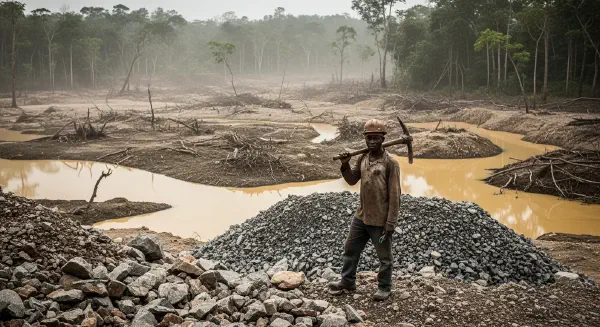
Perhaps the most comprehensively outsourced friction is environmental cost. The carbon emissions from container ships (which burn some of the dirtiest fuel on earth), the microplastic pollution from synthetic clothing fibers, the soil degradation from intensive agriculture, the electronic waste from rapid device turnover—all are geographically and temporally displaced from the point of consumption. A smartphone purchased in London might generate emissions in Chinese manufacturing, water pollution in Bangladeshi dyeing facilities, and toxic waste in Ghanaian recycling yards.
This spatial displacement creates what ecological economists call “externalities”—costs borne by parties not involved in the transaction. The convenience of cheap goods is subsidized by atmospheric carbon concentrations, ocean acidification, and biodiversity loss that affect everyone, but particularly vulnerable communities in the global South. The United Nations Conference on Trade and Development estimates that only 11% of environmental costs from global trade are internalized in prices. The remaining 89% represents an invisible subsidy from ecosystems and future generations to present-day consumers.
The psychological mechanism enabling this is “moral licensing through distance.” Research published in Nature Climate Change demonstrates that consumers feel less responsibility for emissions generated far away, even when those emissions directly enable their lifestyle. The supply chain, by stretching across continents, stretches moral accountability beyond breaking point. We have engineered not just logistical distance but ethical distance, creating what philosopher Glenn Albrecht calls “solastalgia”—the distress caused by environmental change while being physically separated from its visible manifestations.
The Fragile Architecture of Seamlessness#
Single Points of Failure in Hyper-Optimized Networks#
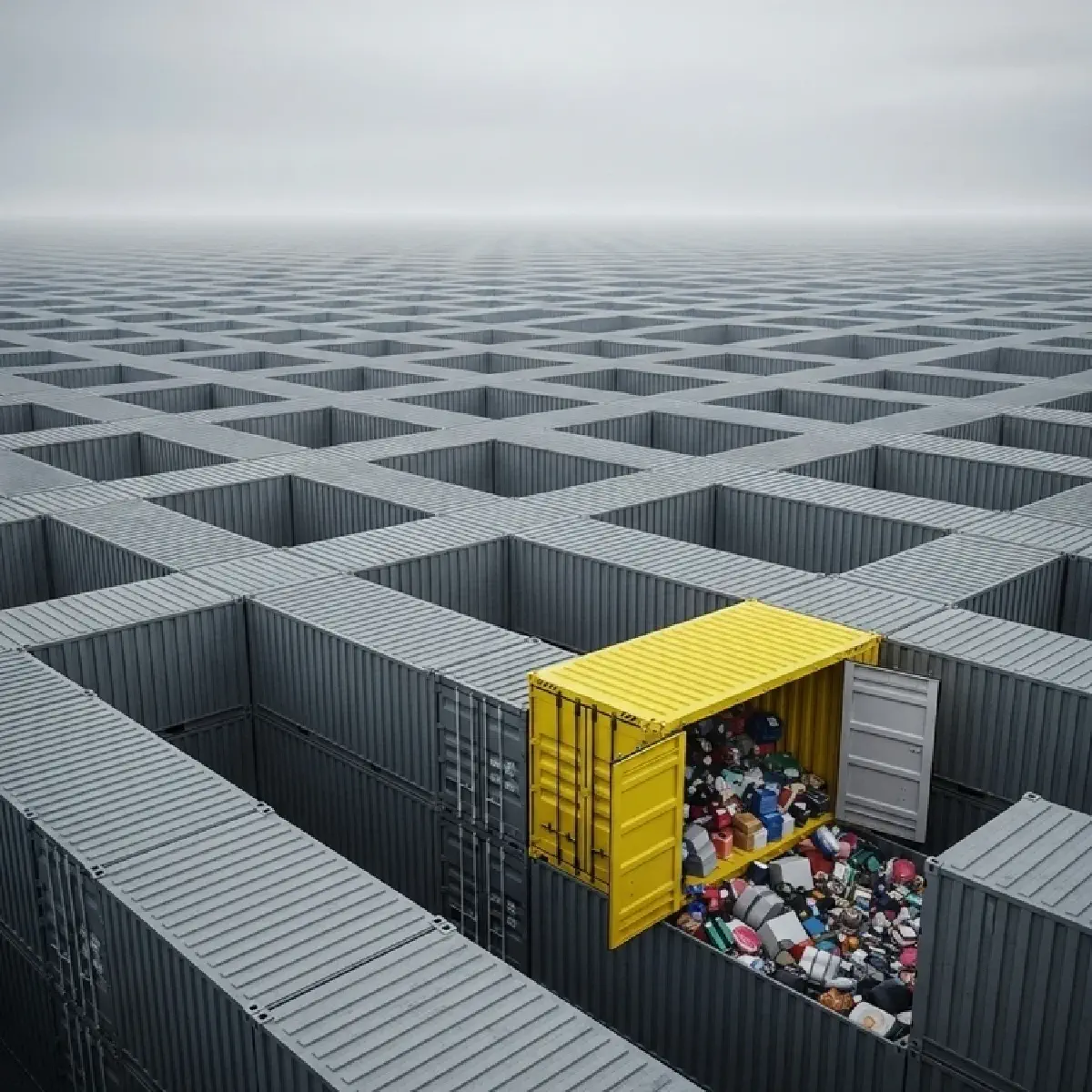
The quest for frictionless supply chains has produced networks of astonishing complexity and interdependence. A typical smartphone contains components from over 200 suppliers across 30 countries. This distributed production model increases efficiency and reduces costs, but it also creates what network theorists call “scale-free topology”—a structure with a few highly connected hubs. When those hubs fail, the entire network can collapse.
The 2011 Thailand floods demonstrated this vulnerability. Thailand produced approximately 45% of the world’s hard disk drives. When floods submerged industrial parks, global PC production dropped by 28% within weeks. Similarly, the 2020 closure of Yantian port in China (due to COVID-19) created backlog that took months to clear, with ripple effects across global manufacturing. These events reveal a paradox: as supply chains become more globally distributed, they often become more concentrated at critical choke points. The convenience of centralized production for specific components creates systemic risk that becomes visible only during disruption.
The Feedback Vacuum#
Friction serves an essential informational function in systems. It signals scarcity, congestion, risk, and imbalance. In natural ecosystems, negative feedback loops maintain stability: population growth leads to resource scarcity, which limits further growth. Modern supply chains systematically eliminate these feedback mechanisms. When a resource becomes scarce, prices should rise, signaling the need for conservation or substitution. But through subsidies, futures trading, and strategic stockpiling, we buffer consumers from these signals.
The result is what systems theorist John Sterman calls “policy resistance”—interventions that address symptoms while worsening underlying problems. When supply chains hide true costs, corrective actions are delayed until crises emerge. By then, solutions are necessarily reactive, expensive, and often inadequate. The 2022 infant formula shortage in the United States illustrates this dynamic. Decades of consolidation had left just three companies controlling 90% of the market. When one factory closed due to contamination concerns, the entire system lacked redundancy. The convenience of efficient consolidation became the liability of catastrophic concentration.
The Labor Arbitrage Time Bomb#
Friction outsourcing depends fundamentally on labor cost differentials—what economists call “arbitrage.” Goods are produced where labor is cheapest and consumed where purchasing power is highest. This creates enormous economic benefits for consumers in developed nations, but it also creates what historian Greg Grandin terms “the factory of the world” dynamic, where entire regions become specialized in low-margin, high-intensity production.
This system now faces multiple converging challenges. Rising wages in previously low-cost manufacturing centers, increasing automation, climate-induced migration, and growing geopolitical tensions are all eroding the stability of labor arbitrage models. The convenience of cheap goods may prove to be time-limited, with the bill coming due as global wage convergence accelerates. Already, the “China plus one” strategy adopted by many multinationals—maintaining Chinese suppliers while developing alternatives elsewhere—acknowledges this vulnerability. But diversification itself introduces new frictions and costs that challenge the convenience paradigm.
Toward Transparent Tensions#
Reforming supply chains to reveal rather than conceal friction requires both technological and cultural innovation. Blockchain-enabled traceability systems, while not panaceas, offer one pathway toward transparency. Companies like Provenance and Everledger are creating digital ledgers that track products from origin to consumer, making previously hidden information accessible. Similarly, “true cost accounting” initiatives attempt to quantify and internalize environmental and social externalities.
More fundamentally, we need to reconsider what economist Kate Raworth calls “doughnut economics”—designing systems that operate within social foundations and ecological ceilings. This might mean privileging regional supply chains over global ones for certain essential goods, accepting higher costs in exchange for greater resilience. It might mean designing products for repairability and longevity rather than disposability, even if that makes them less immediately convenient. It certainly means developing new metrics that value system health alongside transaction efficiency.
The Ever Given blockade was more than a logistical hiccup; it was a metaphor. For six days, the world saw the physical reality underlying digital convenience—the sheer materiality of global trade, its vulnerability to interruption, its dependence on fragile passageways. The ship was eventually refloated, traffic resumed, and the illusion of immateriality returned. But the lesson remains: systems designed to hide their friction eventually generate friction of catastrophic scale. The alternative is not to abandon global trade, but to design supply chains that acknowledge their own weight, their own costs, and their own indispensable humanity. For in that acknowledgement lies the possibility of systems that endure not because they hide their weaknesses, but because they have none worth hiding.