Blue Paradox - Part 5: Chemical Warfare, Deep-Sea Immortality, and the Price of Specialization#
The ocean operates through systems of unique specialization. Creatures employ chemical defenses, extreme sensory adaptations, and even biological trickery to navigate the constant struggle for existence. This diversity demonstrates the necessary adaptations required across the surface, the teeming reefs, and the perpetual blackness of the deep abyss. The success of marine life hinges on mastering these highly specific survival skills.
Chemical Warfare on the Open Sea#
Over half of all animals found in the open ocean survive by drifting in currents. Jellyfish exemplify this successful life strategy. They successfully cross entire oceans, feeding opportunistically on whatever tangles within their tentacles. Some jellies grow impressively large, sometimes reaching up to two metres (6.56 ft) across. When they encounter a rich patch of sea dense with plankton, their numbers rapidly explode. This successful strategy makes jellies one of the most common life forms found across the planet.
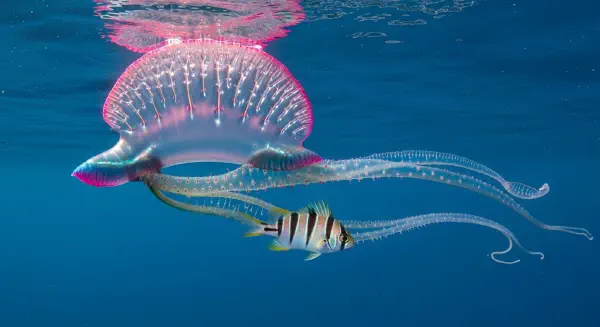
Among these successful drifters, a more complex and sinister organism exists. This creature is the Portuguese man o’ war. It appears superficially similar to a common jellyfish. The man o’ war floats with the assistance of a gas-filled bladder. A vertical membrane tops this bladder, functioning effectively as a sail. This natural sail allows the creature to maintain a steady course as it navigates the waves.
Trailing behind the main body are exceptionally long, delicate threads. Some of these threads extend as much as 30 metres (98 ft) in length. Each long thread carries many thousands of highly specialized stinging cells. The potency of these specialized weapons makes the man o’ war lethally effective. A single tentacle holds enough venom to kill a fish caught in its path. In rare instances, contact with the tentacle can also prove fatal to a human.
The man o’ war uses these deadly threads to paralyze and capture prey. When a tentacle catches a victim, the man o’ war immediately begins reeling the prey inward. The captured fish is often paralyzed almost instantly upon contact. Specialized muscular tentacles then transfer the victim to other dedicated digestive tentacles. These digestive tentacles liquefy the catch using powerful chemicals. Eventually, only a scaly husk of the consumed fish remains. This voracious predator demonstrates high efficiency, capable of collecting over 100 small fish in a single day.
Despite the extreme danger posed by the man o’ war, a specialized partner lurks nearby. The man o’ war fish lives safely among the creature’s lethal tentacles. This tiny, brightly colored fish feeds by nibbling on the man o’ war’s deadly appendages. While the fish has some innate resistance to the paralyzing stings, it must still maintain extreme caution. Most other fish lack this necessary resistance and easily fall victim to the tentacles.
The Art of Camouflage and Hypnosis#
In the Coral Triangle, immense rivalry exists for space and food. This cluster of reefs in Southeast Asia is among the richest coral reefs in the world. The cuttlefish exemplifies reef specialization, focusing its hunting efforts on crabs. A large crab represents dangerous quarry due to its powerful claws. The cuttlefish uses a remarkable natural talent to overcome this physical danger.
Its skin contains millions of specialized pigment cells. The cuttlefish precisely manipulates these cells to create constantly changing colors and complex patterns. This sophisticated visual display apparently serves to hypnotize the crab, making it vulnerable. Successfully establishing oneself in these bustling undersea cities yields great rewards.
While the cuttlefish uses clever techniques, it remains prey for larger predators. A shark is significantly bigger and actively hunts cuttlefish. When a shark approaches, the cuttlefish quickly disappears using camouflage or a burst of speed. The cuttlefish returns to its hunt, applying the same mesmerizing technique to secure new targets.
Deception also dictates reproductive success among giant cuttlefish. As the Australian summer concludes, these creatures, which live for just one or two years, must find a mate. Over 100,000 males compete fiercely for the arriving females in this single bay. A large male, potentially weighing about 10 kilos (22 lbs), attempts to dominate the scene. Bands of striking color sweep across the skin of the cuttlefish, representing their complex communication.
A smaller male employs trickery to succeed against the giant rivals. He immediately tones down his striking colors and tucks in his arms. The small male is just the right size and shape to effectively mimic a female cuttlefish. This deception successfully fools the large male. The small male completes his disguise by displaying a white stripe. Like the real female, he uses this stripe to deter the dominant male’s advances. He then quickly slips beside the actual female. They proceed to mate quickly. By mating with multiple partners, the female ensures the greatest possible genetic diversity for her young. Success is achieved through cunning deception rather than size alone.
Sensory Mastery in the Midnight Zone#
Life one kilometer from the surface, beyond the reach of the sun, requires extreme adaptation. This giant, black void, known as the midnight zone, is larger than all the world’s other habitats combined. Life here operates under pressure and perpetual darkness.
Nearly all deep-sea animals use dazzling light displays, known as bioluminescence, for communication. This language of light serves two critical objectives: attracting mates and repelling predators. These bioluminescent signals are likely the most common form of communication on the entire planet. Scientists still know little about the complexities of this visual system.
Hunters in the midnight zone frequently illuminate themselves. This self-illumination serves to attract inquisitive prey. Conversely, prey organisms employ light as a defense mechanism. They release a decoy resembling luminous ink. This sudden flash provides a temporary distraction, allowing the prey time to escape the darkness.
One of the midnight zone’s most voracious hunters is the fangtooth fish. This predator possesses the largest teeth relative to its size of any known fish. The fangtooth relies on sensory adaptations rather than sight to hunt. Pressure sensors cover its entire head and body. These sensors allow the fish to detect anything moving in the surrounding water. The fangtooth relies on infinite patience and acute sensitivity to secure its scarce meals.
The deep seabed forms an enormous, empty plain. This mud layer, accumulated over millions of years, can reach depths of up to one kilometre (0.62 miles) thick. This sediment covers approximately half the surface of our planet. The sea toad exemplifies the specialized mud dweller. This fish functions as an ambush predator. It waits patiently with its enormous mouth prepared. This fish has lived in the depths for such an extended period that its fins have changed. The fins have evolved into practical structures resembling feet. These feet help the sea toad shuffle about on the surface of the mud.
Another unique resident is the flapjack octopus. This small octopus hovers delicately just above the surface of the mud. It sifts through the sediment, searching for worms. The flapjack octopus must remain alert to danger. It can swiftly jet away at the first sign of a threat.
The Eternal Life Strategy#
Down in the blackness, creatures exist beyond the normal rules of time. Siphonophores exist as virtually eternal organisms. These unique creatures survive by repeatedly cloning themselves. Through continuous cloning, some siphonophores eventually grow to immense lengths. Certain individuals can exceed the length of a blue whale. Such massive size ensures their dominance in this dark, expansive environment.
Food in the deep ocean originates almost entirely from the productive waters above. Continuous clouds of organic debris drift slowly down from the surface. This phenomenon is called marine snow. This slow descent provides food for a wide variety of filter feeders. Jellyfish and delicate sea cucumbers depend on this falling organic matter. Filter feeders consume approximately 99% of the falling debris. Only 1% of the marine snow that falls eventually settles onto the seafloor.
The Lethal Oasis of Brine#
Geological events create unique environments of extreme toxicity in the deep ocean. In the Gulf of Mexico, eruptions release a super-salty liquid called brine onto the seafloor. This brine is significantly heavier than the surrounding seawater. Consequently, the super-salty liquid accumulates in great pools on the seafloor.
The result is a complex, almost unbelievable sight. A lake of concentrated saltwater, reaching 15 metres (49 ft) deep, rests at the bottom of the sea. Even more strangely, a dense profusion of life exists around the margins of this lethal pool.
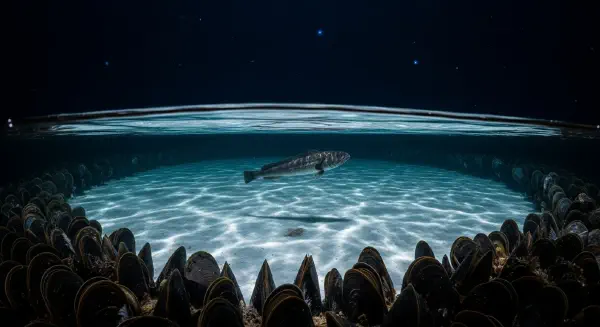
Giant mussels inhabit the edges of the brine lake. These mussels pack tightly together, forming massive colonies. They thrive in this unique environment, able to live and grow for a century or more. The large size of the mussels dwarfs other organisms that feed in the area. Shrimps and squat lobsters rely on the resources provided by the mussels and the lake margin.
Scavengers, such as cutthroat eels, visit the shores of the brine lake. They approach the toxic edge searching for anything edible. However, approaching the brine presents a severe risk. Some cutthroat eels venture directly into the concentrated brine. Spending even a short amount of time in the brine can send an eel into toxic shock.
The eel’s only chance for survival involves rising rapidly above the brine’s surface. While some eels successfully manage to escape the toxic liquid, others are not so fortunate. The concentrated brine acts as a powerful embalming agent. The preserved bodies of casualties, accumulated over decades, often line the margins of the lethal lake. These toxic environments represent the ultimate survival test for deep-sea life.
Coastal Commitment and Delicate Partnerships#
Survival strategies in the complex reef environment also rely on delicate partnerships. On the sand flats, a family of saddleback clownfish has found an excellent home. They live within the lethal tentacles of a large carpet anemone. The tentacles of this anemone can easily kill other fish. However, the clownfish are immune to the poison, allowing them to shelter safely from danger. In a reciprocal arrangement, the clownfish keep the anemone clean of debris.
A big female rules the clownfish family group. Her distinct white face marks her clearly as the boss of the territory. The diminutive male must continuously prove his worth to the female. He works tirelessly, removing debris and generally maintaining order in the home.
His greatest challenge involves finding a safe place where the boss can securely lay her eggs. Unfortunately, nothing solid is readily available for the female to lay them on inside the protective radius of the anemone. The tides eventually sweep an old coconut shell into the area. It looks perfectly suitable for the job, but it rests a long way from the safety of the anemone home.
The tiny male cannot move the coconut shell by himself. Therefore, the clownfish pair begins working together to move the heavy object. They finally drag the coconut shell into the protected area. The male makes a small adjustment to the anemone’s tentacles. This adjustment clears a perfect space for the shell, and they tuck it in securely.
The female then lays her eggs inside the safe nursery at last. By achieving this goal, the male has proved himself worthy to father her young. He immediately fertilizes the eggs. He will now meticulously tend the eggs, keeping them clean and healthy. The young clownfish will hatch in 10 days’ time.
The sheer range of strategies—from the paralyzing venom of the man o’ war to the cloning immortality of the siphonophore—shows the vast, tailored specializations required for life in the ocean. Each creature, whether surviving by chemical warfare or infinite patience, has perfected its unique method for enduring the blue paradox.