Blue Paradox - Part 4: The Great Gauntlet: Endurance, Piracy, and Long-Haul Survival#
Survival in the ocean requires both specialized adaptation and extraordinary endurance. Whether traveling thousands of kilometers or simply navigating the coastal tides, marine life confronts continuous peril and scarcity. Some creatures must master aerial predation, while others rely on fat reserves to withstand months of fasting. The necessity of delivering life-sustaining resources drives animals toward remarkable physical feats and highly strategic behaviors.
The Arctic Fishermen and Aerial Pirates#
Wave power naturally creates towering fortresses along Arctic coastlines. These sheer cliffs serve as a crucial refuge for tens of thousands of breeding seabirds. The sheer faces of the cliffs remain accessible only from the air. They offer many safe nooks and crannies for nesting seabirds. However, feeding their young requires the birds to master the ocean world far beyond the safety of the cliffs.
The puffin exemplifies this challenging existence. Puffins often maintain a mate for life. Both parents share the demanding burden of raising their young chick, known as a puffling. A week-old puffling needs five substantial meals every day. The puffin parents alternate fishing trips to meet this constant demand.
Puffins must sometimes fly as much as 50 kilometres (31 miles) out to sea to reach the best fishing grounds when fish stocks are low. Upon arriving, the puffin plunges into an entirely different world. Good fishing spots remain hard to find. The puffins often share these sites with guillemots. Guillemots possess short wings, much like the puffin, making them adept at diving. Puffins demonstrate impressive physical capacity underwater. They can hold their breath for over one minute and dive as deep as 40 metres (131 ft).
Securing a catch is only the first step in a long, difficult journey. The return trip home demands immense stamina from the parent. The round trip is an exhausting journey of almost 100 kilometres (62 miles). This perilous journey includes navigating a dangerous gauntlet near the coast.
Arctic skuas operate as formidable pirates along this coast. These predatory birds target returning parents. The skuas rob the puffins of their hard-won catch. Arctic skuas possess long, raked-back wings. These wings make the skuas both faster and more maneuverable than the returning puffins. The puffin must choose the optimal moment to make its final approach. One puffin experienced a near miss from a skua. It used a last, desperate burst of speed to escape. This successful return followed a three-hour round trip. The patient partner waits securely at the nest. The puffling successfully eats that day.
Successful puffin parenting becomes even harder in the changing seas of today. Many puffins currently find it difficult to secure enough food for their chicks. This difficulty arises because local fish numbers are in decline.
The Long Haul: Blue Shark Migration and Feast#
Blue sharks represent specialized long-distance travelers of the open ocean. They journey over 8,000 kilometres (4,970 miles) every year. These animals efficiently ride ocean currents. Their broad, wing-shaped fins provide essential support for this constant movement. This relentless traveling means a blue shark may fast for as long as two months without consuming a substantial meal.
Ocean currents carry promising traces of fatty oils from many kilometers away. These strong oil signals efficiently lead the shark to its next meal. The scent of food grows considerably stronger after days of travel. A blue shark may discover a dead whale, recently struck by a ship. This massive carcass provides the opportunity for a real feast.
However, the blue shark must approach this feast with extreme caution. Great white sharks exhibit highly possessive behavior around whale carcasses. A great white shark is approximately 10 times heavier than a blue shark. Great whites eagerly feed on the energy-rich whale blubber. Scientists recognize that this blubber constitutes a major part of the great white’s diet.
The blue shark must wait until the great white has satisfied its hunger. Only then do smaller sharks, such as the blue shark, tackle what remains of the enormous carcass. As the oils from the dead whale spread more widely across the water, the presence of more blue sharks appears. Within just a few days, all the energy-rich blubber will be stripped completely from the carcass. The whale loses the buoyancy provided by the oil and sinks into the deep abyss below. The blue shark has now successfully replenished its fat reserves. This replenishment allows it to survive for another two months without the need to eat.
The Coastal Race Against the Tide#
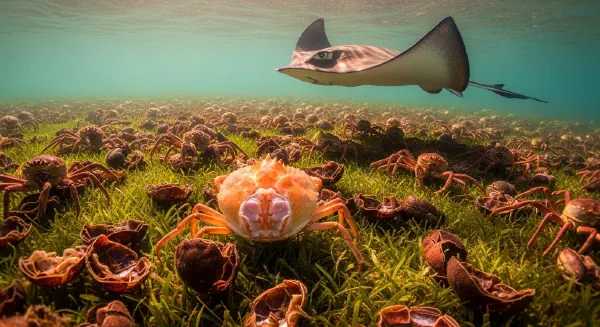
Survival near the shore demands constant negotiation with the environment’s fluctuating dangers. Thousands of Sally Lightfoot crabs gather daily on the tropical shores of Brazil. They patiently wait for the low tide to fully recede. The receding water exposes their vital feeding grounds. These feeding areas consist of seaweed-covered rocks located about 100 metres (328 ft) from the safety of the shore.
Reaching the feeding grounds becomes a desperate race against the clock and the returning tide. The crabs must leap skillfully from one rock to the next during their transit. These shore crabs display a noticeable fear of the water. This fear is entirely justified given the specialized predators lurking in the shallows.
A specific moray eel, the chain moray, specializes in hunting these crabs. The chain moray possesses blunt, powerful teeth. These teeth are designed specifically for crushing hard crab shells. This makes the moray eel the crabs’ deadliest enemy while they are near the water. Despite the continuous threat, the crabs must press on toward their distant feeding grounds. The danger increases when the enemy adapts its strategy. The moray eel sometimes crosses the land surface to reset its ambush position.
The crabs must continue their dash for food, understanding that absolute safety is impossible. Another significant threat is the octopus. An octopus also functions as a highly effective crab killer. The crabs make a final, desperate dash to reach the seaweed pastures. They successfully make it to the food. They risked life and limb during the transit.
They have approximately two hours to graze intensively before the tide begins to turn again. When the water starts to rise, the crabs must run the dangerous gauntlet all over again. They repeat the perilous journey to return to the relative safety of the shore.
Airborne Hunters and Calculated Ambush#
The vast open sea occasionally hosts remarkable instances of strategic predation involving land animals. During the dry season, more than half a million terns (500,000) crowd onto a remote Indian Ocean atoll. Terns raise their chicks here, which are visible in their dark, juvenile plumage. The chicks vary considerably in age and stage of development. The more advanced chicks can already take to the air independently. Others are not yet ready to fly.
The youngsters who are just starting to learn to fly use the shallow lagoon at the center of the atoll. This area serves as their critical training ground. Staying aloft proves difficult for some of the fledglings. This abundance of inexperienced prey attracts a gathering of highly specialized fish predators.
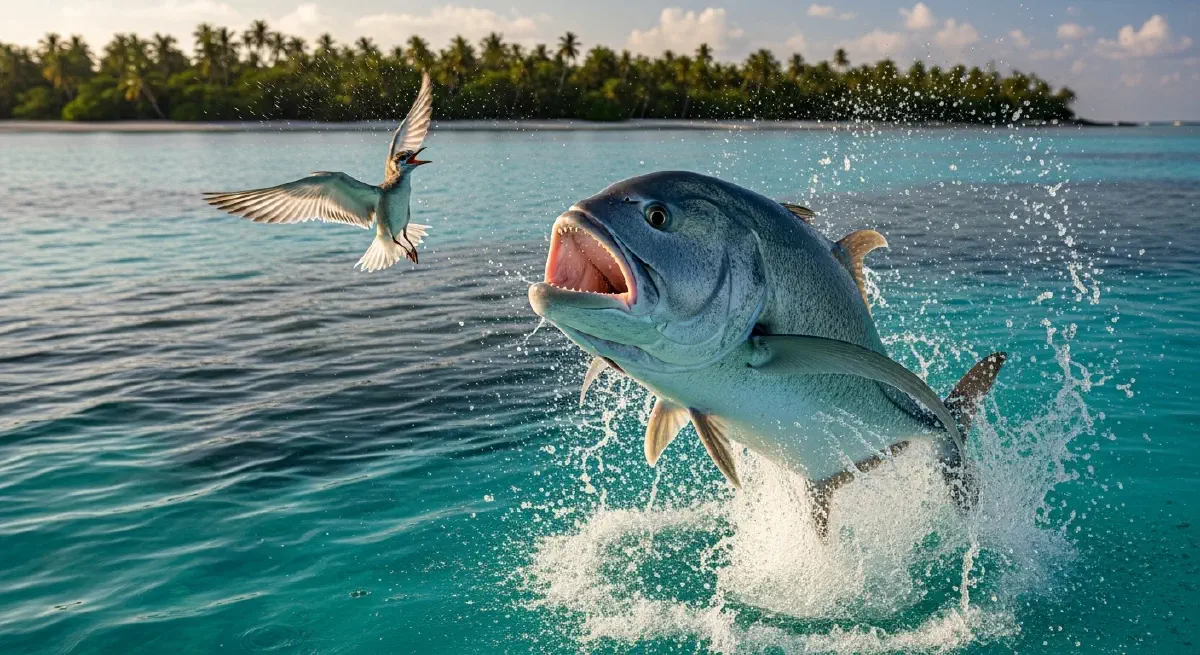
Giant trevallies are typically solitary hunters. About 50 of these large fish congregate here. They arrive from neighboring reefs, specifically drawn by the dense population of potential prey. The fledglings try hard to avoid landing on the water’s surface. They even manage to drink fluids while remaining airborne. The trevallies must significantly elevate their hunting game if they intend to catch these birds.
The trevally demonstrates astonishing mental capability. This fish possesses a brain that calculates the precise airspeed, altitude, and trajectory of a bird flying overhead. Every fledgling must eventually take to the air. They must also learn to collect food for themselves. Their adult parents lead them to the training grounds to learn this vital skill. The young birds must learn quickly if they hope to survive the experience. After a full month of intensive practice over the lagoon, the youngsters begin to depart. They leave the atoll to take their chances out over the vast open sea.
The blue paradox showcases the extreme physical demands required for survival in the global ocean. Whether a puffin flying 100 kilometres to feed a chick or a blue shark fasting for two months between meals, success depends entirely on biological specialization and relentless endurance. Creatures must overcome immense distances, strategic aerial pirates, and powerful coastal predators to maintain their existence.