Blue Paradox - Part 3: Below the Sun: Survival in the Midnight Zone and Toxic Seas#
The challenges of life extend far beyond the sunlit surface of the open ocean. Beneath the waves lies a giant, black void. This massive region, known as the midnight zone, is larger than all the world’s other habitats combined. Life here operates under a set of rules alien to those near the surface. Creatures must adapt to intense pressure, perpetual darkness, and scarce resources. The environment demands extreme biological specialization to ensure survival.
The Language of Light in the Midnight Zone#
Life in this black abyss utilizes dazzling light displays. Nearly all deep-sea animals use this light to achieve two critical objectives: attracting mates and repelling predators. This specific language of light is so widespread that these bioluminescent signals are likely the most common form of communication on the entire planet. Scientists still know little about the complexities of this visual communication system.
Hunters in the midnight zone frequently illuminate themselves. This self-illumination serves to attract inquisitive prey. Conversely, prey organisms have developed counter-strategies using light. They employ a defense mechanism resembling luminous ink as a decoy. This sudden flash and temporary distraction allows the prey time to escape. The conditions of this deep blackness allow creatures to exist beyond the normal rules of time.
Specialized Hunters of the Deep#
One of the midnight zone’s most voracious hunters is the fangtooth fish. This predator possesses the largest teeth relative to its size of any known fish. The fangtooth uses sensory adaptations rather than sight to hunt in the dark. Pressure sensors cover its entire head and body. These sensors allow the fish to detect anything moving in the surrounding water. The fangtooth relies on infinite patience and acute sensitivity to secure its scarce meals.
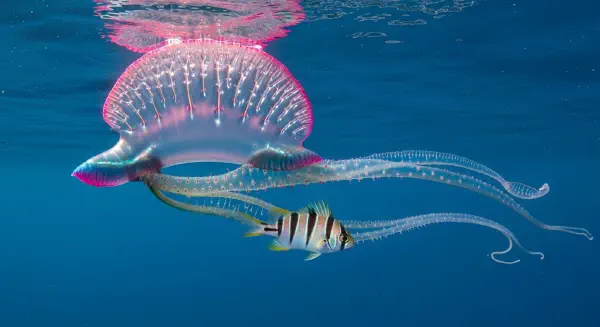
Some life forms here demonstrate evolutionary strategies that defy typical lifespans. Siphonophores exist as virtually eternal organisms. These unique creatures survive by repeatedly cloning themselves. Through continuous cloning, some siphonophores eventually grow to immense lengths. Certain individuals can exceed the length of a blue whale. Such massive size ensures their dominance in this dark, expansive environment.
The Constant Fall: Marine Snow#
Food in the deep ocean originates almost entirely from the productive waters above. It “snows” continuously in the midnight zone. These clouds consist of organic debris that drift slowly down from the surface. This phenomenon is called marine snow. The slow descent of this material provides food for a wide variety of filter feeders.
Filter feeders like jellyfish and delicate sea cucumbers depend on this falling organic matter. They consume the debris as it passes through the water column. These organisms harvest the marine snow to sustain themselves in this resource-poor habitat. Most of the marine snow is consumed before it reaches the bottom. Filter feeders consume approximately 99% of the falling debris.
The remaining fraction eventually settles onto the seafloor. Only 1% of the marine snow that falls from above eventually settles. Over millions of years, this accumulated material forms a thick layer of mud. This mud layer can reach depths of up to one kilometre (0.62 miles) thick. The resultant sediment covers approximately half the surface of our planet.
The Empty Plain and Mud Dwellers#
The deep seabed forms an enormous, empty plain. At first glance, this vast area appears largely lifeless. However, the seabed is home to a unique cast of specialized mud dwellers. These creatures employ adaptation and patience to survive on the nutrient-poor seabed.
The sea toad exemplifies the specialized mud dweller. This fish functions as an ambush predator. It waits patiently with its enormous mouth prepared. The sea toad exhibits infinite patience, waiting for prey to stray too close. This creature has lived in the depths for such an extended period that its fins have undergone a physical change. The fins have evolved into something more practical for the seafloor: feet. These feet help the sea toad shuffle about on the surface of the mud.
Another unique resident is the flapjack octopus. This small octopus hovers delicately just above the surface of the mud. It sifts through the sediment in search of worms. The flapjack octopus must remain alert to danger. It can swiftly jet away at the first sign of a threat. Both the sea toad and the flapjack octopus showcase unique modifications necessary for existence on the abyssal plain.
The Lethal Oasis: Brine Lakes#
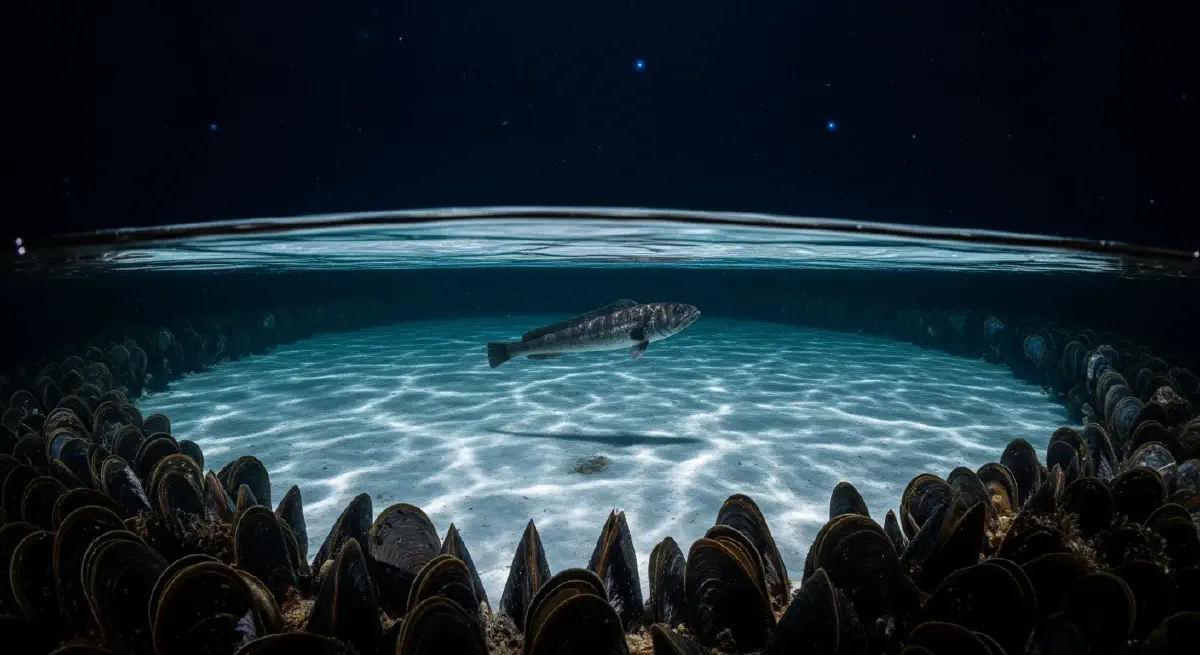
Not all deep-sea environments consist of uniform mud and water. In the Gulf of Mexico, specific geological events create environments of extreme toxicity. Eruptions release a super-salty liquid called brine onto the seafloor. This brine is significantly heavier than the surrounding seawater. Consequently, the super-salty liquid accumulates in great pools. These deep-sea pools effectively form toxic lakes on the seafloor.
The sight of these subsea formations is often difficult to comprehend. A concentrated saltwater lake, reaching 15 metres (49 ft) deep, rests at the bottom of the sea. Even more strangely, a dense profusion of life exists around the margins of this lethal pool.
Giant mussels inhabit the edges of the brine lake. These mussels pack tightly together, forming massive colonies. They thrive in this unique environment, able to live and grow for a century or more. The large size of the mussels dwarfs other organisms that feed in the area. Shrimps and squat lobsters rely on the resources provided by the mussels and the lake margin.
Scavengers, such as cutthroat eels, visit the shores of the brine lake. They approach the toxic edge searching for anything edible. However, approaching the brine presents a severe risk. Some cutthroat eels venture directly into the concentrated brine. Spending even a short amount of time in the brine can send an eel into toxic shock.
The eel’s only chance for survival involves rising rapidly above the brine’s surface. While some eels successfully manage to escape the toxic liquid, others are not so fortunate. The concentrated brine acts as an embalming agent. The preserved bodies of casualties, accumulated over decades, often line the margins of the lethal lake. These toxic environments represent the ultimate survival test.
The deep ocean, stretching from the bioluminescent midnight zone to the lethal brine lakes, showcases life pushed to its biological limits. Creatures here thrive through adaptations like sensory enhancement, eternal cloning, and the ability to utilize sinking debris. The survival of deep-sea life highlights the extreme resilience required to exist in the world’s largest, darkest habitat. Navigating the ocean’s depths demands specialization, transforming the black void into a complex and highly populated city of shadows.