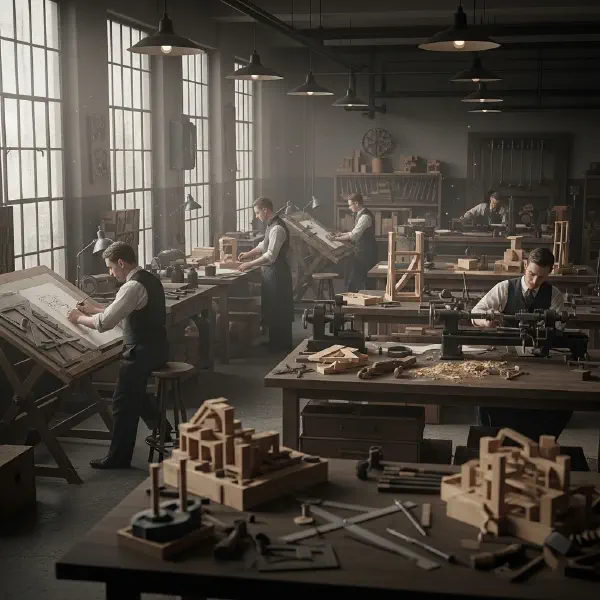
When Production Solved Its Own Problem#
By the mid-20th century, industrial economies crossed a decisive threshold. Manufacturing capacity no longer constrained prosperity. Distribution networks matured. Quality control stabilized. For most consumer goods, the engineering problem was effectively solved.
What remained was a surplus problem.
Factories could produce more than societies could rationally absorb. In this context, design could no longer be allowed to converge on functional sufficiency. If it did, markets would stall. The role of design therefore changed—quietly but fundamentally—from optimizing utility to stimulating replacement.
This was the moment design stopped answering “Does it work?” and began answering “Will it sell again?”
The Thesis: Design Was Reassigned From Solving Needs to Manufacturing Desire#
Once basic functionality became a given, competitive advantage shifted away from engineering performance and toward psychological differentiation. Design became an economic instrument, not a technical one. Its primary task was no longer to resolve constraints, but to generate dissatisfaction with what already existed.
This reassignment did not require abandoning rational production systems. It required redirecting their output.
The Separation of Use and Meaning#
Functional design treats meaning as a byproduct of use. Demand engineering reverses this relationship. Meaning is constructed first; use becomes secondary.
Products began to carry:
- Status signals
- Identity markers
- Temporal cues (“new,” “updated,” “modern”)
None of these improve core performance. All of them accelerate turnover.
Under this logic, a perfectly functioning object is a failure if it does not provoke desire for its own replacement.
Advertising as a Design Partner#
Advertising did not merely promote products; it reshaped design briefs. Visual novelty became synchronized with media cycles. Annual updates aligned with catalog printing, showroom refreshes, and later television campaigns.
Design decisions were increasingly made to:
- Photograph well
- Differentiate at a glance
- Signal novelty within seconds
Longevity became invisible in this ecosystem. Repairability was unmarketable. Stability looked like stagnation.
This marked a clean break from the logic implicit in Bauhaus, where clarity and restraint were ends in themselves.
The Rise of Feature Inflation#
Once cosmetic change alone proved insufficient, technological differentiation filled the gap. Features multiplied, not because they were needed, but because they were countable.
Each added function:
- Increased perceived value
- Reduced comparability with older models
- Complicated repair and maintenance
The system rewarded complexity even when it degraded reliability. The goal was not improvement in absolute terms, but relative obsolescence.
A product did not need to fail. It merely needed to feel behind.
Engineering Without Closure#
In classical engineering, a system converges toward an optimum. In demand engineering, convergence is actively prevented. Platforms are deliberately destabilized through:
- Minor incompatibilities
- Software dependencies
- Rapid interface changes
This ensures that technical progress never resolves into sufficiency. There is always a reason to upgrade, even if performance gains are marginal.
Design thus became an open loop, permanently suspended between “almost good enough” and “new enough.”
The Consequences of the Shift#
This transformation produced short-term economic growth and long-term systemic costs:
- Material throughput increased faster than utility delivered
- Waste volumes decoupled from population growth
- Environmental load rose without proportional benefit
These outcomes were not unintended. They were structurally necessary once demand engineering replaced functional closure.
Why This Matters for the Argument#
At this stage, Bauhaus logic was not defeated—it was made irrelevant by redefinition. Design was no longer evaluated by how well it solved problems, but by how effectively it sustained consumption.
The system did not reject rationality. It redirected it.
Design became precise, data-driven, and efficient—yet aimed at maximizing churn rather than minimizing waste.